

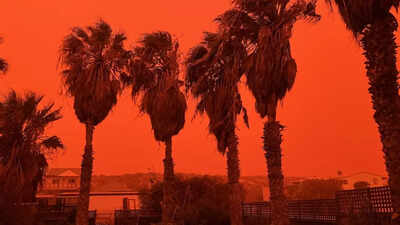
The sky in some parts of Western Australia, especially over Shark Bay and Denham, turned red due to severe dust storms that passed through this region. Strong winds, caused by an approaching climate system, carried large amounts of iron-rich soil into the atmosphere, resulting in the appearance of thick layers of dust in this region.
This led to a radical change in the color of the sky due to dust and other particles in the atmosphere, which led to the appearance of red in this region. The presence of this dust in the atmosphere has reduced visibility in this area, making it difficult for people living in this area to see. The dense fog in this atmosphere also caused sunlight to filter through this atmosphere, resulting in a ghostly appearance.
What is the science behind red skies in Australia during dust storms
This phenomenon is explained by the scattering of atmospheric light, a process associated with Rayleigh scattering and Mie scattering. Under normal conditions, the atmosphere scatters shorter wavelengths of light more effectively than longer wavelengths. For this reason, the natural color of the sky is blue.However, when a dust storm occurs, the atmosphere is filled with particles of a larger nature, specifically metallic particles.
These particles scatter light more strongly, specifically shorter wavelengths. In this case, the longer wavelengths of light, specifically red and orange, have the opportunity to be dominant. Iron oxide particles present in the soil contribute to this phenomenon, as they have the ability to reflect and intensify red light when it passes through thick layers of dust.The result of this phenomenon is a crimson or orange sky with no direct sunlight.
Regional impact of the dust storm across the Gascoyne and Pilbara in Western Australia
The most extreme visual changes occurred in the Gascoyne area, which includes Shark Bay. However, other impacts have occurred, such as those along the Pilbara coast, in places such as Exmouth and Karratha. It was reported that there was a sudden decrease in visibility and an increase in airborne particles, which is associated with extreme levels of dust transmission.The extent of the storm system contributed to atmospheric turbulence.
Cyclone Naril Unpredictable road and variable intensity
Cyclone Naril took an unusual path through different regions. The storm first made landfall on the Cape York Peninsula in Queensland, then moved to the Northern Territory, and later intensified in the Indian Ocean before reaching Western Australia.When the storm peaked, it reached Category 4 intensity, with wind speeds reaching 200 km/h or higher. Structural damage was observed in coastal areas, especially in Exmouth and Coral Bay.
How do iron-rich dust and strong winds change the color of the sky?
Sky color changes caused by dust are related to environmental conditions such as prolonged drought, loose topsoil, and strong wind systems. In arid and semi-arid regions of Australia, iron-rich soils are easily mobilized during high wind events, especially when vegetation is sparse.