Dear reader,

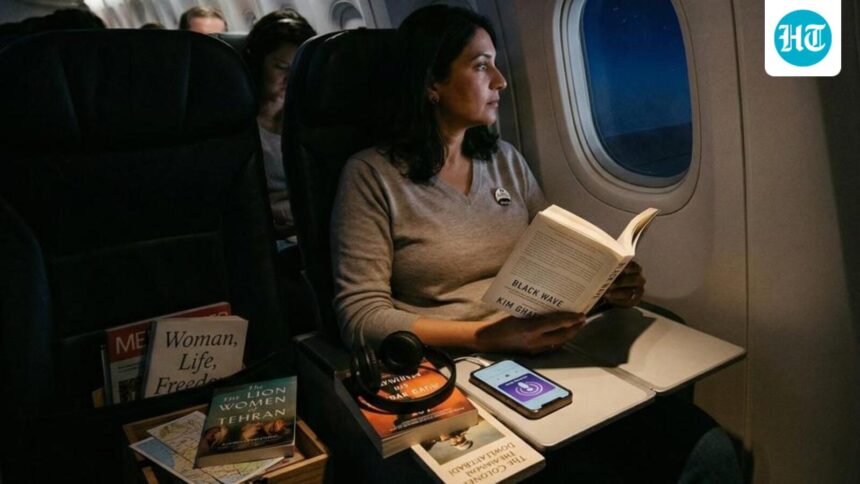
Three hours after we took off from London, the plane started to wobble. At first, I didn’t notice; I’m half asleep. Then the seat belt sign flashes.
I looked around at the dark cabin and was struck by a sudden panic: Are we flying over Iran? This war seems to be coming to an end, with everything from gas shortages to scary stories from people close to the hostilities, like a colleague from Dubai telling us about the fighter jets that escorted his commercial jet out of the airport, or another showing us photos of drone battles captured on his phone.
All day I’ve been reading “The Black Wave,” a history of West Asia from 1979. At 35,000 feet, somewhere in the region it describes, it stops feeling like history and starts feeling like present tense. Ghattas moves between power and the people—Saudi crown princes, Egyptian intellectuals, Syrian rulers, and the writers and journalists who lived through these transformations—tracing how political rivalry turned into cultural and religious control, and how suicide bombers and fatwas were used as a political weapon.
The plane is now stable. It was unrest, not war. But it’s hard to get this meaningless conflict out of my head.
In our book clubs, with readers based in India and around the world, we have been scouring literature with increasing desperation. We try to make sense of the barrage of claims and counterclaims that arrive on social media, and we turn to history, fiction, and even graphic novels to triangulate the truth.
We start with Women, Life, Freedom, a collection of comics edited by Marjane Satrapi, best known for her graphic novel Persepolis.
One reader says: “I found it a useful book to read bits of and then go off and look into other things, you know…it was eye-opening.”
The story set in Evin Prison, for example, leads us to The Bakers’ Club in Evin Prison, a heartbreaking account of women imprisoned by the Iranian regime. However, this collection of comics is mostly uneven and ignores several issues.
We turn to the genre that can feel, paradoxically, the most honest of all: fantasy.
In “The Lion’s Women of Tehran,” we find ourselves in Tehran during the era of the Shah. There we meet Elie and Homa, two best friends who move to opposite ends of the economic spectrum.
Another reader says: “It shows how history impacts not only the lives of ordinary people, but generations to come. Plus, it’s a quick, easy-to-read way to absorb a lot of history and context that would be difficult to absorb through dense non-fiction books.”
However, there is a problem, one that we all feel acutely. Most of these books are written by Westerners or people living outside the region.
“Diaspora narratives, including books like Not Without My Daughter or others marketed in the West, can exaggerate or exaggerate the demonization of Iran,” says one reader, voicing what many of us feel.
So where should we go to find out the “real” story?
Empire Podcast, Someone Says. Christiane Amanpour’s Ex-Files podcast says something else. The Colonel’s reading of Mahmoud Dolatabadi says third. I feel compelled to read and listen to all three. Books and other relevant narratives seem to be the best way to cope with the turmoil of these times.
However, when we arrived in Mumbai, and I finished Black Wave, I felt the helplessness that comes from clearly understanding something and not being able to do anything about it. The world outside the window seems ordinary: the landing gates, the neon-covered ground crew, the baggage carts. It is difficult to reconcile the world I read about with the world I live in, even though they are unambiguously the same. Maybe that’s what these books are about – they don’t offer us solutions, but they make sure we don’t look too far.
(Sonia Dutta Chowdhury is a Mumbai-based journalist and founder of Sonya’s Book Box, a personalized book service. Every week she brings you books specially curated to give you a comprehensive understanding of people and places. If you have any reading recommendations or reading dilemmas, write to her at sonyasbookbox@gmail.com. Views expressed are personal)