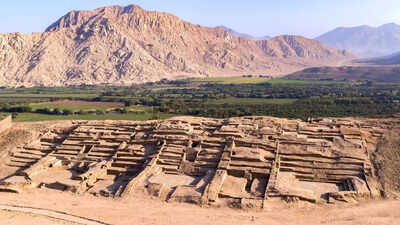
The desert doesn’t usually bring things back easily. Winds scrape away from the surface, heat bends the horizon, and whatever was standing there tends to stay buried forever. However, in the dry hills of Peru, something unexpected appeared.
The site known as Peñico was discovered in 2025, and is already changing conversations about early civilizations in the Americas. It’s not just its age, which is around 3,800 years old, but the story it seems to tell. One of adapting and surviving without violence. Experts point out that this may force a rethink of how complex societies develop in this part of the world.
Beniko archaeological site Reveals regimented life in Peru’s harsh Sub Valley
Benico is located in the Sub Valley, a few hours north of Lima, in a landscape that seems hostile to life.
The dry slopes stretch endlessly, and dust hangs in the air. This is not the kind of place where you would expect an orderly settlement.As the BBC reported, archaeologists, led by Ruth Shady, have discovered about 18 buildings here. Temples. Residential complexes. Open courtyards that may have hosted gatherings or rituals. The layout seems intentional. I carefully thought it through. Not messy. There is a feeling that this place was built on shared purpose rather than control.
Benico reveals links to the 5,000-year-old Caral civilization in Peru
To understand Benico, it helps to look back. Long before the Incas or Mayas, the area was home to the Caral civilization. One of the oldest known in the Americas. Its main centre, Karal Sub, dates back nearly 5,000 years. This places it alongside the early urban societies of Mesopotamia and ancient Egypt. Karal seems to have developed differently. No defensive walls. There are no visible marks on the weapons.
Instead, researchers found evidence of trade networks extending from the Pacific coast to the Andes and even toward the Amazon. Cotton, crops, and marine resources were exchanged across regions.
Benico offers insight into paleoclimatic survival without war
About 4,000 years ago, the climate changed. A long drought has struck the region. The rivers dried up. Fields failed. Food became scarce. For many ancient societies, this is where things break down. Caral seems to have taken another route.
Evidence suggests that people did not turn on each other. Instead, they moved on. amendment. Quoted. Benico appears to be part of that response, as it was built at higher elevations and closer to glacier-fed water sources.What stands out about Peñico is what’s missing. No fortified walls. No weapons have been detected yet. It’s not absolute evidence of peace, but it is eye-catching, especially during a time of crisis. Society may have focused on cohesion, researchers say. Trade links continued. The culture has not disappeared. Artifacts found at the site indicate this. Clay statues. Embroidered jewelry. Carved bones. One sculpture is said to show the head of a woman with an elaborate hairstyle, painted red with a metallic pigment.
It’s an expressive feeling. Almost personal.Excavations at Benico are still ongoing. Large parts of the site are still buried under desert. What has been found so far is just a glimpse.