The United States is preparing for a possible expansion of its military operations in Iran, laying out plans ranging from launching limited, targeted ground strikes to a broader deployment of forces, even as the White House publicly confirms that no decision has been made.
The evolving strategy reflects a widening gap between operational preparedness on the ground and cautious messaging from Washington, with officials signaling restraint and the potential for escalation at the same time.According to a report in The Washington Post, Pentagon officials have spent weeks developing options for ground operations that would stop short of a full-scale invasion, but could include a combination of special operations forces and conventional infantry.
These plans are being developed as contingency measures, providing flexibility to President Donald Trump as the conflict with Iran enters a potentially volatile phase.At the heart of the deliberations is a key strategic question: whether the United States can achieve its military and political goals through air power and limited strikes, or whether it will need to deploy forces on the ground, even in a limited capacity.
What the Pentagon is planning
Officials familiar with the discussions said the military is not currently preparing for a large-scale invasion similar to previous conflicts in Iraq or Afghanistan. Instead, the focus is on short-term, high-impact operations designed to neutralize specific threats.Among the options under consideration are:
- Targeted raids on Iranian coastal military installations
- – Operations to identify and destroy weapons capable of targeting commercial and military ships
- Potential seizure of strategic assets e.g
Kharg Island It is a major center for exporting Iranian oil in the Arabian Gulf
One official indicated that such missions would likely extend “weeks, not months,” while another suggested a possible timeline of “a few months,” stressing that any ground engagement would be limited in scope but likely to be intense.A former defense official said the plans were extensive and had been studied in detail. “We’ve looked into this. These were war games,” the official noted, adding that these were not last-minute preparations but part of a longer strategic assessment, according to the newspaper.
Deployment of USS Tripoli signals readiness
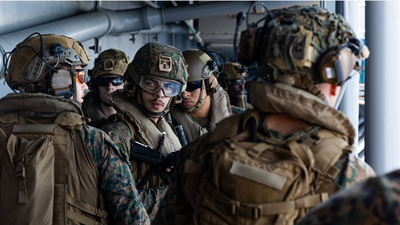
Amidst these deliberations, the arrival of the US aircraft carrier USS Tripoli in the Middle East has increased speculation about possible next steps.According to US Central Command, the ship, which serves as the lead ship for a contingent of about 3,500 Marines and sailors, arrived in the area on Saturday.
The group includes transport and strike aircraft, amphibious assault capabilities and tactical assets.
Images released by the command show Seahawk helicopters, Osprey aircraft used to transport troops, and F-35 fighter jets on deck, indicating its readiness for a range of missions, including rapid deployment and amphibious operations.The movement of these assets is seen as part of a broader effort to deploy forces in multiple emergency situations.
Mixed signals from Washington
Even as military preparations continued, the US administration’s general position remained ambiguous.“I’m not putting troops anywhere,” Trump said, speaking earlier this month. “If I were, I certainly wouldn’t tell you, but I’m not putting troops.”Meanwhile, multiple reports have indicated that the administration is considering deploying up to 10,000 additional troops to the Middle East, to supplement forces already stationed across the region.US Secretary of State Marco Rubio stressed on Friday that Washington could achieve its goals without deploying ground forces and stressed that the conflict “will not be long.”However, the White House also issued warnings of escalation. Press Secretary Carolyn Leavitt said that if Iran does not back down from its nuclear ambitions and threats, the president is “ready to unleash hell.” She added: “It is the Pentagon’s job to make preparations in order to give the commander in chief maximum choice.”
“This does not mean that the president has made a decision.”
Strategic objectives and operational risks
Kharg Island has emerged as a focal point in military discussions because of its importance to Iran’s oil exports. Seizing or disrupting operations on the island could provide the United States with leverage in any future negotiations.However, experts warn that such a move carries significant risks. The island’s confined geography and Iran’s ability to deploy drones, missiles and artillery could make it difficult to control.“I don’t want to be in that little place with Iran being able to shoot down drones and maybe artillery,” said Michael Eisenstadt, a defense analyst.He noted that a more viable approach might involve agile operations, where forces conduct rapid raids rather than holding territory for long periods. “Agility is part of protecting your force, if they are moving and conducting raids, at home and abroad,” he said.Other potential targets include Iranian coastal sites near the Strait of Hormuz, an important global oil shipping route that has seen increasing tensions in recent months.
Escalating risks for US employees
Any ground engagement would expose U.S. forces to a range of threats, including drone strikes, missile attacks, ground fire, and improvised explosive devices.More than 300 US service members have already been wounded in retaliatory strikes targeting US facilities in at least seven countries in the Middle East, the officials said. At least 10 of those injuries are reported to be serious.Last month alone, 13 US soldiers were killed in incidents including a plane crash in Iraq, a drone attack in Kuwait, and an attack on a base in Saudi Arabia.These developments highlight the potential cost of escalation, even without a formal ground invasion.
What lies ahead
For now, the Pentagon’s plans remain contingent on political approval, with officials stressing that preparing for multiple scenarios is a standard part of military planning.The current position suggests that the United States is seeking a balance between deterrence and restraint – while keeping options open without committing to a specific course of action.Whether the situation evolves into limited special operations, a broader deployment of forces, or continued reliance on air and naval power will depend on the decisions that will be made in Washington in the coming weeks, as well as Iran’s response on the ground.