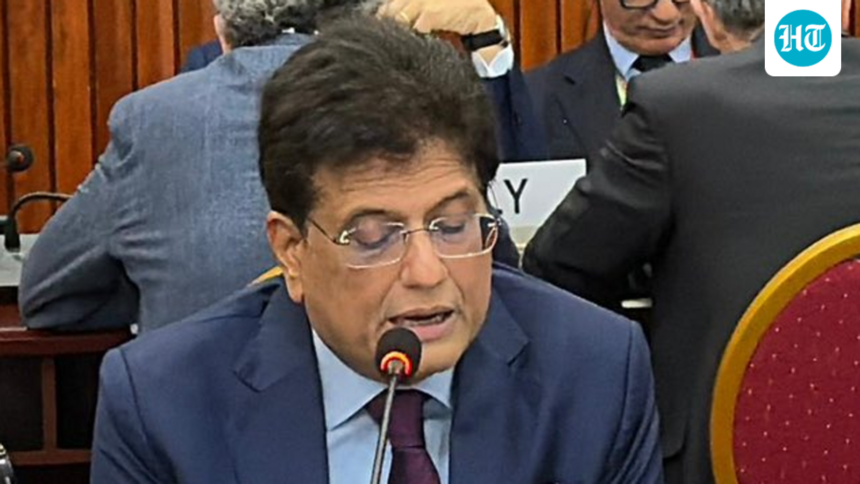
Union Commerce Minister Piyush Goyal urged the WTO to resume time-bound reforms and enhance enforceability of international trade laws, stressing the importance of all members having the opportunity to build productive capacity, create jobs, and participate meaningfully in global trade.

During trade ministers’ deliberations on the reforms on the second day of the 14th Ministerial Meeting of the World Trade Organization (MC14) in Yaounde, Cameroon, Goyal said on Friday that consensus-based decision-making is the cornerstone of the WTO’s legitimacy. Regarding equal opportunities, he stressed that discussions must take into account the disparities that had arisen from the Uruguay Round.
India emphasized the need to prioritize long-standing issues such as food security, public stocks and the special safeguard mechanism on cotton, while taking up new issues to address structural inequalities. These issues are important for India because they are necessary to continue the government’s plans, such as providing minimum support price to millions of poor farmers and free food rations to more than 800 million deprived citizens.
Agriculture is crucial to the livelihoods of millions, Goyal said. “For the Global South, a durable solution on public stocks for food security, the Special Guarantee Mechanism, and cotton are long-pending mandate issues; we must achieve them as a matter of priority.”
He said India remains committed to negotiating a comprehensive fisheries support agreement that balances current and future fishing needs, and protects the livelihoods of poor fishermen, with appropriate and effective special and differential treatment. Goyal highlighted the persistent flaw in the dispute settlement system.
On the second day of the 14th Ministerial Conference, India stressed that without effective adjudication, rules lose their enforceability, thus disproportionately harming smaller economies. It warned against using transparency as a weapon to justify trade retaliation or challenging legitimate domestic policies, according to a Commerce Ministry statement.
“Instead, it should be accompanied by meaningful and sustained support for capacity building, ensuring that all members are able to meet their commitments fairly and effectively. India also stressed the importance of all members having a fair opportunity to build productive capacities, create jobs, and participate meaningfully in global trade.”
Speaking about the transparency of WTO reform, Commerce Minister Rajesh Agrawal expressed India’s support for resuming reform efforts within a specific time frame with defined milestones, based on more robust analysis of evidence and through participation in ministerial submissions and decisions. “India unequivocally called for avoiding issues of selection and propagation of preconceived attitudes and prejudices,” the statement said.
“India also highlighted the need to give greater importance to the role of WTO committees, which, through their lived and learned experiences, can contribute to a comprehensive assessment through a bottom-up approach.”
Agrawal called for the consensus process to be based on the principles of openness, transparency, inclusiveness, participation and guidance of members. He warned that multiple parties would fragment the multilateral trading system.
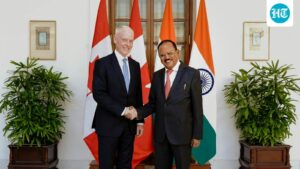
The Ministry of Commerce statement stated that on the sidelines of the 14th Conference meetings, Goyal held bilateral meetings with his counterparts from the United States, China, Korea, Switzerland, New Zealand, Canada, Morocco and Oman. He added, “The discussions focused on the agenda of the MC14 conference as well as on issues related to deepening bilateral trade relations.”