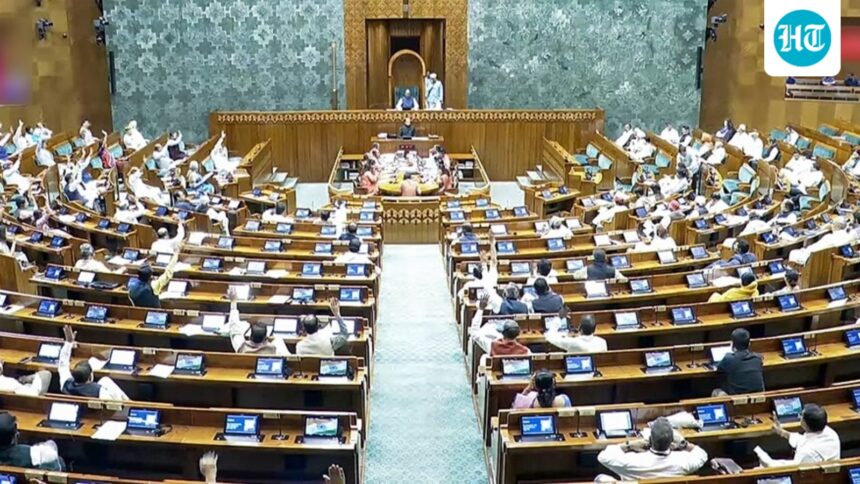
The government on Friday submitted to the Lok Sabha the second version of the Jan Vishwas Bill that seeks to amend some provisions to decriminalize a host of minor offenses to enhance ease of doing business.

The Jan Vishwas (Provisions Amendment) Bill, 2026, introduced by Minister of State for Commerce and Industry Jitin Prasada, proposes to amend 79 central laws administered by 23 ministries.
A total of 784 provisions are being proposed to be amended, of which 717 provisions are being decriminalized to enhance the ease of doing business, and 67 provisions are proposed to be changed to facilitate living.
Read also: ₹A £1,000 fine for a dog owner if a pet is found without a leash on the street under the proposed revision of the DMC Act. $A £1,000 fine for a dog owner if a pet is found without a leash on the street under the proposed revision of the DMC Act.
The draft law proposes to abolish imprisonment in 57 cases and fines in 158 cases. It also proposes reducing the prison sentence in 17 cases, and proposes converting imprisonment and a fine into punishment in 113 cases.
A look at the ten main modifications:
1. The government has proposed to amend the Motor Vehicles Act to introduce a grace period of 30 days after the expiration of a driving licence, during which it will remain valid.
2. Under the Food Safety and Standards Act 2006, the proposed amendment reduces the maximum prison sentence for tampering with seized substances (such as food or vehicles) from six months to three months.
3. The 153-year-old Livestock Trespass Act is set for a comprehensive overhaul, with major crimes decriminalized, prison sentences replaced with financial penalties, and fines geared toward animal welfare.
4. Amendments to the Electricity Law propose abolishing the prison sentence for non-compliance with official orders, while increasing penalties until they reach $10 lakh. The draft law also repeals provisions related to penalties for extinguishing public lights and simplifies existing penal provisions.
5. The New Delhi Municipal Council (NDMC) Act, 1994, will see property tax restructured into two components – building tax and vacant land tax, replacing the existing framework under Article 61.
6. Under the Slum Areas (Improvement and Clearance) Act 1956, violations will attract fines of up to $10,000 per case instead of imprisonment. Continued violations will incur an additional 1,000 per day, up to a maximum $1 lakh.
7. To provide relief to homebuyers, the amendment removes imprisonment of up to one year for allottees who do not comply with orders of the Land Appellate Tribunal. Alternatively, a fine of up to 10% of the cost of the property may be imposed.
8. In the event of unauthorized occupation of government buildings, penalties will be significantly increased. Violators may have to pay up to 40 times the license fee in the first month, with a 10% monthly increase after that. Illegal occupation of non-residential public land may also result in imprisonment of up to six months, a fine of 5% of the land value per year, or both.
9. The fine for allowing a dog to roam without a leash in public places under the Delhi Municipal Corporation Act, 1957 is proposed to be increased from $50 l $1000.
10. It is proposed to lift penalties under the Metro Rail (Operation and Maintenance) Act, 2002, for offenses such as being drunk, carrying offensive material or participating in demonstrations. $500 l $2500 according to the invoice.
(with PTI inputs)