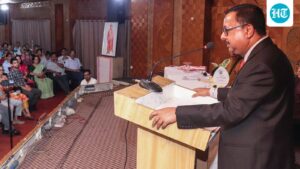
On Friday, Prime Minister Himanta Biswa Sarma threatened to break the “backbone” of the Mayas, a derogatory term for Bengali-speaking Muslims, if the BJP returns to power for the third consecutive time in Assam.

“In the past five years, Bangladeshi Mias have broken their bones, hands and legs [politically]. “In the next five years, I will also break their backbone so that they cannot challenge the indigenous people,” Sarma said during his election campaign ahead of the April 9 elections.
All India United Democratic Front (AIUDF) chief Badruddin Ajmal responded to Sarma. He said Sarma’s intimidation tactics will no longer work. “He will lose the elections and will have to leave Assam…and then there will be Dadagiri [intimidation] “Mayas,” said Ajmal, whose party counts Bengali-speaking Muslims among its core supporters.
Sarma has increased his rhetoric against Mayas in the run-up to the elections, as the ruling Bharatiya Janata Party seeks to play on the fear of “outsiders”. Fear is not new. The perceived threat to indigenous demographics, language, culture, and land from outsiders, especially the Mias, led to unrest that claimed hundreds of lives. It has shaped political and electoral discourse.
Ethnic and linguistic tensions in Assam date back to the 19th century, when the British declared Bengali the official language in 1836. Protests against this move forced its withdrawal in 1873.
Partition in 1947 and the linguistic reorganization of states in the 1970s sparked new protests against “outsiders.” In the 1980s, a six-year agitation against Bangladeshi “infiltrators” ended with the signing of the 1985 Assam Accord, which was signed on March 24, 1971, as the deadline for citizenship.
As part of the agreement, the government promised to close the border with Bangladesh and detect and deport illegal immigrants who entered the country after the creation of Bangladesh in 1971.
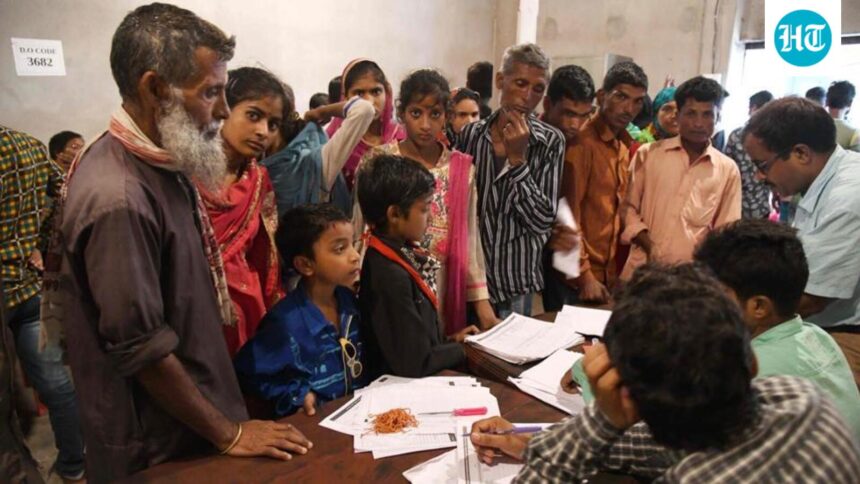
But concerns about Mias remained, even though many of them were Indians by the deadline. A large proportion of Assamese still consider them outsiders. A National Register of Citizens has been established in Assam to identify illegal immigrants who came to the state after 1971.
Muslims in Assam are not a monolith. Apart from the Mayas, there are also Muslim groups, such as the Guria and Maurya, who speak the Assamese language.
The migration of Bengali-speaking people from what is now Bangladesh dates back to British rule, when they settled in the fertile lands for agriculture. This trend continued even after partition, when East Bengal became East Pakistan, and in 1971 it became Bangladesh.
The BJP has used anti-Miya sentiment to its advantage by promising to stop “illegal infiltration” from Bangladesh and detect and deport them. She formed her government in Assam for the first time in 2016 and returned to power in 2021 under the slogan of protecting “jati, mate, bhiti” (race, land and homeland).
The BJP’s campaign against Mias intensified after Sarma became chief minister in 2021. Sarma’s policies, such as expelling so-called “trespassers” on government land and implementing strict laws regulating the transport, slaughter and sale of cattle and beef, were seen as measures targeting Mias.
The government has used provisions of a 1950 law, the Assam Migrants (Expulsion) Act, to bypass foreign courts and “return” those it considers “foreigners” to Bangladesh since last year.
Sarma claimed that Mias will represent 40% of the state’s population after the next census (2026-2027). According to the 2011 census, the Muslim population in Assam was 10.67 million, i.e. 34.22% of the population. A subcommittee formed in 2021 for Assamese Muslims estimated their numbers at 4.2 million.
Sarma said evictions targeting Mayas and other drives will continue when the BJP returns to power. Prime Minister Narendra Modi and Union Home Minister Amit Shah praised the evacuation. Shah has promised to deport all illegal immigrants from Assam and the rest of the country.
The Congress has sought to counter polarization in the BJP by emphasizing the creation of “Por Axum”. “We aim not only to oust the BJP and return to power, but also to create a Pur Axum, where people of all communities can live in peace and without fear, and no one is targeted because of his religion or language,” Congress president Gaurav Gogoi said.
Dibrugarh University political science professor Kaustubh Deka said the government’s policies against the Mias – from evictions to the policy campaign against child marriage – appear to be a very broad and complex mix of militant Hindutva, social reformism and sub-Assamese nationalism. “This has strengthened the polarization between the Assamese and the Mayas.”
This plays into the fear psychosis that Assam will turn into some Muslim-majority region, Deka said. “This narrative has been around before, but this government has taken some action on the ground, including bulldozing homes and mosques. [during evictions]”.
The BJP has benefited from it before and will do so again, Deka said, because it appeals to a section of voters who fear cultural aggression from outsiders. “Mayas may not be the main factor in how people vote.”
Bengali-speaking Muslims form a majority in districts such as Dhubri, Barpeta and Goalpara, and play a crucial role in the elections. They were the deciding factor in 30 to 35 of the 126 seats in Assam. This has changed with the redrawn of seats in 2023.
Political science professor Abu Nisar Saeed, who has written books on Muslim voting trends in Assam, said Muslims will play a decisive role in the outcome of 22-23 seats. “The community once voted en masse for Congress and then it switched to AIUDF.”
He said the Muslim vote in around two dozen seats in western Assam is likely to shift back to the Congress as the AIUDF is not in a position to form the government or be part of any ruling or opposition alliance.
Assam Minority Students Federation chief advisor Ain Uddin Ahmed said the eviction, which specifically targets Mayas, is an electoral issue in areas where Muslims are present in large numbers. He pointed out that the strict rules on cow slaughter and sale, beef consumption, etc. will influence the minds of Muslim voters when they vote, but most people from the community agree with the campaign against child marriage.
Guwahati University political science professor Akhil Ranjan Dutta said fear of Mias seems like a new normal. “Targeting Mayas will be an influential factor, but since the government has tried to balance it with schemes and development projects, from which all sectors have benefited, it may not have much impact.”