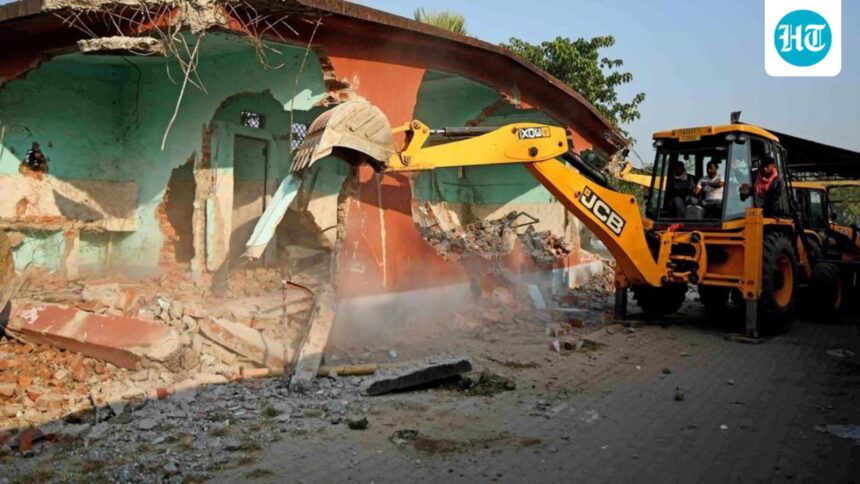
Soon after filing his nomination papers on Monday for the Goalpara East Assembly seat in Assam, Raijor Dal candidate Abdul Rashid Mandal made it clear that eviction would be the main focus of his campaign.

The incumbent Congress MLA from Goalpara West, recently switched sides to join the regional party, which is part of the Congress-led six-party alliance for the April 9 elections. Mandal transferred constituencies after his erstwhile constituency was reserved for Scheduled Tribes (STs) after the 2023 delimitation.
“Eviction is the most important issue in my seat right now. I am vying to win and ensure that evacuees get proper compensation and rehabilitation,” Mandal said, claiming that eviction drives have affected more than 1,000 families and displaced 5,000 to 8,000 people in his constituency.
He added: “These people did not receive any compensation from the government and did not obtain any alternative plot of land or means of earning their livelihood.”
Mandal alleged that the affected people were forced to leave their homes as part of a conspiracy by the ruling BJP-led coalition in the state on charges of grabbing forest land.
“I suspect that the records were tampered with as part of a joint survey conducted by the revenue and forest departments. There is a need to look into the matter by taking legal recourse and I am ready for that,” he said.
“The claims of the Raigor Dal candidate are nonsensical. All records of whether the area is a revenue village or a reserve forest are part of the documentary records. If Mandal has any evidence of tampering, he should approach the courts. One needs to know that evictions in Assam are being done as per the mandate of the Gauhati High Court,” senior BJP spokesperson in Assam Kishore Upadhyay said.
Since coming to power in 2021, the BJP-led coalition government led by Himanta Biswa Sarma has carried out more than 30 major eviction drives in which thousands of homes have been demolished and about 100,000 people uprooted from 49,500 acres of government land and forests that have been encroached upon.
“Since we were evacuated, we moved to another location where the state government provided us with one bigha (0.33 acre) of land,” said Ainuddin Haque, whose family was evacuated from Dalpur-Gorokoti in Darrang district in September 2021. “But we lost all our arable land during the evacuation, and now the family is supporting themselves with what we earn from irregular jobs.”
The Dhalpur-Gorukhuti eviction drive was the first major drive undertaken by the incumbent government in which around 800 families were uprooted to make way for a composite community agricultural scheme called the Gorukhuti Project. Two people died, including a 12-year-old boy, and 18 others, including eight policemen, were injured during clashes between police and evacuated families at the site.
Mainal Haq, Haq’s elder brother, was one of those killed. He said: “My father was shocked by my brother’s death. He stopped eating properly and died in 2024.”
The state government has made no secret of the fact that the evictions are targeting Bengali-speaking Muslims, who are pejoratively referred to as Mias.
“Only Mias in Assam have been evacuated. We will not evict the Assamese population,” Prime Minister Sarma said in January.
Experts say this may be a ploy to win support from the indigenous Assamese population who have had a fear of “outsiders” for decades, as seen in the six-year anti-foreigner agitation between 1979 and 1985.
“The evictions appear to be a broad and complex mix of several factors including hardline Hindutva stance, social reform as well as stance on Assamese sub-nationalism. This has intensified entrenched polarization,” said Kaustubh Deka, professor of political science at Dibrugarh University.
“Eviction is an important issue and will affect the mind of minority voters who may support the Congress this time. Nearly 100,000 people from around 15-20 Assembly seats (out of a total of 126 seats) have been affected due to the evictions,” said Ain Uddin Ahmed, chief advisor of Assam Minority Students Union (AAMSU).
He claimed that among those evacuated, the names of about 4,000 eligible voters were removed during the Special Review (SR) of electoral rolls conducted between November last year and February this year.
“Earlier we were part of Sibagar Assembly seat, but after eviction and transfer Mangalday became our constituency. After this shift, we applied for transfer of our votes. While 9 out of 11 eligible voters are mentioned in the updated voters list, the names of two of my sisters-in-law are missing,” Ainuddin Haq said.
“Election officials removed their names without informing them or giving them enough time to submit requests to transfer their votes to another constituency,” AAMSU’s Ahmed said.
The issue of eviction and concerns about the rights of displaced people also reached the judiciary. Last month, the Gauhati High Court ordered the Assam government to provide basic facilities such as drinking water, sanitation and medical care to families affected as part of the evacuation drive and living in makeshift camps.
The court was hearing a petition filed by 60 people affected by the eviction drive carried out in June last year at Hashila Beel, a wetland in Goalpara district, where 566 families were evacuated.
But the state government is not finished yet. According to Sarma, eviction operations carried out in the past five years have been able to remove encroachers from only part of the occupied territories, and large areas are still occupied by “illegal settlers.”
“No matter the pressure or hype, evictions will continue unabated. When we return with our next government, the pace will only double,” he said earlier this month.