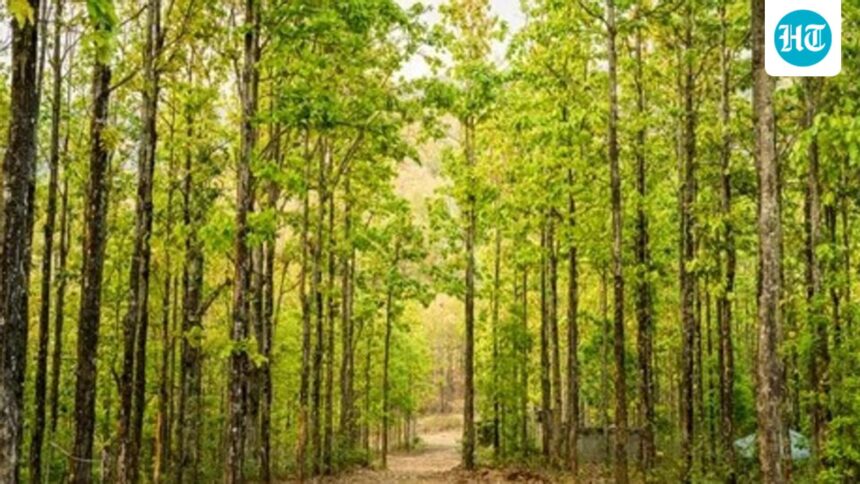
More than 17,000 sal trees in Uttarakhand’s Dehradun and Kalsi forests are likely to be felled following a massive infestation of the sal beetle, a wood-boring beetle, with officials identifying badly affected areas and starting clearing them to contain the spread of the pest.

Nearly 15,000 sal trees (Shorea robusta) in Dehradun forest division have been infected by sal borer (Hoplocerambyx spinicornis), while around 5,000 trees in Kalsi forest division have been affected, forest officials said on Friday.
The sal borer (Hoplocerambyx spinicornis) is a wood-boring beetle that attacks sal trees by laying eggs under the bark. Periodic outbreaks of the pest have been recorded in sal forests across northern India, although their severity varies.
Dehradun Forest Officer Neeraj Sharma explained that the larvae of the sal borer primarily feed on the internal tissues of the tree, disrupting the flow of nutrients and water, which ultimately leads to the tree drying out and dying. He added: “The larvae destroy the internal tissues of the tree, and over time the tree dries up. The presence of borers is not a new thing, but in some years the infestation increases.”
In Dehradun forest division, infestation was reported across multiple ranges, with officials identifying severely affected trees for felling as per the action plan. In Kalsi District, a detailed survey was conducted and trees were classified based on the extent of damage, with only the most affected trees being identified for removal to contain the spread of the disease.
Sharma said that the affected trees are being identified and cut after obtaining necessary permits from the Union Environment Ministry. “Once the trees are cut, they are left in the forest until insects emerge and can be destroyed, which helps break the life cycle of the pest,” Sharma added.
He said the infestation is usually observed in the monsoon season when the larvae develop, and prolonged or excessive rainfall can be a contributing factor.
Sharma further said that felling trees remains the only widely established method of controlling the infestation. “Research institutions such as the Forest Research Institute (FRI) have conducted experiments, but no alternative method has been standardized yet for widespread application,” he added.
Divisional Forest Officer (DFO), Kalsi, Mayank Garg, said that about 5,000 to 5,500 trees were initially identified as affected in the division. “Of these trees, about 2,000 severely affected trees will be cut down by classification to prevent further spread,” he said.
Although such infestations are not entirely new, the state’s dense salach farms are also considered more vulnerable to pest outbreaks, experts said.
Ecologist and forest historian Ajay Singh Rawat attributed the recurring problem to monoculture practices and called for diversification. “This will continue unless mixed forests are adopted. Sal was widely promoted in the Terai Bahbahar region during the British period of railway sleepers, which led to decline in diversity,” he said. “If it affects one tree, it eventually affects the entire forest,” he added.
Rawat also stressed the need for greater community participation in forest management. “Traditional practices and local knowledge systems should be integrated into forest policies to achieve more sustainable outcomes,” he said.