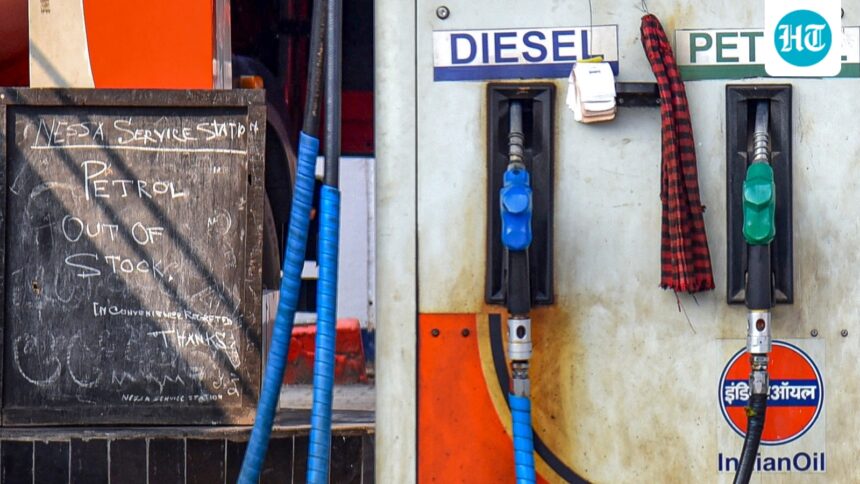
India’s largest private fuel retailer, Nayara Energy, has reportedly raised petrol and diesel prices, even as state-owned oil marketing companies continue to keep retail prices steady.

This move comes against the backdrop of a sharp rise in global crude oil prices following the recent escalation in conflict in West Asia.
Naira on Thursday raised gasoline prices by $5 per liter and diesel at a rate $3 per liter, news agency PTI reported, citing sources. The rise varies across states due to local taxes such as value-added tax, with gasoline prices increasing by as much $5.30 per liter in some areas.
Why did Nayyara raise fuel prices?
The decision comes as global oil prices have risen significantly since February 28, when the United States and Israel launched military strikes on Iran, triggering retaliation and disrupting global energy markets.
Read also | Nayara Energy has raised petrol and diesel prices across India. Check prices by city here
Private fuel retailers, unlike their state-owned counterparts, are under increasing financial pressure. “Private fuel retailers in India are not getting any government compensation to offset losses caused by curbing price increases, unlike state-owned enterprises (SOEs) which are being subsidized to act as good corporate citizens,” the news agency sources said, adding that the mounting losses have left them with no option but to review prices.
Nayara, which operates nearly 7,000 petrol pumps across the country – the maximum number for any private company – has chosen to partially pass on the increased input costs to customers rather than absorb the entire burden.
Another Reuters report said the Russian-backed private refiner raised prices in a move aimed at offsetting growing revenue losses from retail fuel sales, gasoline station dealers said.
State-owned enterprises bear interest rates
Despite the rise in global prices, state-run oil companies – Indian Oil Corporation, Bharat Petroleum Corporation Limited and Hindustan Petroleum Corporation Limited – continue to keep retail prices of petrol and diesel unchanged. These companies control about 90 percent of the fuel retail market in India.
Retail fuel prices have remained largely frozen since April 2022, as these companies absorb losses during periods of high crude oil prices and recover margins when global prices decline.
However, some companies have recently raised premium gasoline prices $2 per liter and increase bulk diesel prices for industrial users by approx $22 per litre. In Delhi, premium petrol is now more expensive $101.89 per liter, up from $99.89, while wholesale diesel prices rose sharply.
However, regular petrol and diesel prices remained unchanged $94.77 f $87.67 per liter respectively in the national capital.
Indian refineries are incurring losses estimated at more than $50 per liter on diesel and its surroundings $$20 per liter of gasoline is due to the fuel being retailed below market prices, Reuters reported, citing an industry source.
Global oil fluctuations are behind the pressure
The recent price pressure stems from geopolitical tensions in the Middle East. Crude oil prices rose to about $119 a barrel earlier this month before falling to about $100.
India, which imports nearly 88% of its crude oil and about half of its natural gas, is particularly vulnerable to such disruptions. A large portion of these imports pass through the Strait of Hormuz, a major global energy corridor.
Jio-bp, a joint venture between Reliance Industries and BP Plc, has not hiked prices so far despite incurring losses, indicating different strategies among private players, the PTI report added.
Following the attacks on Iranian facilities, Tehran warned shipping away from the Strait of Hormuz, effectively disrupting ship traffic and tightening supplies.