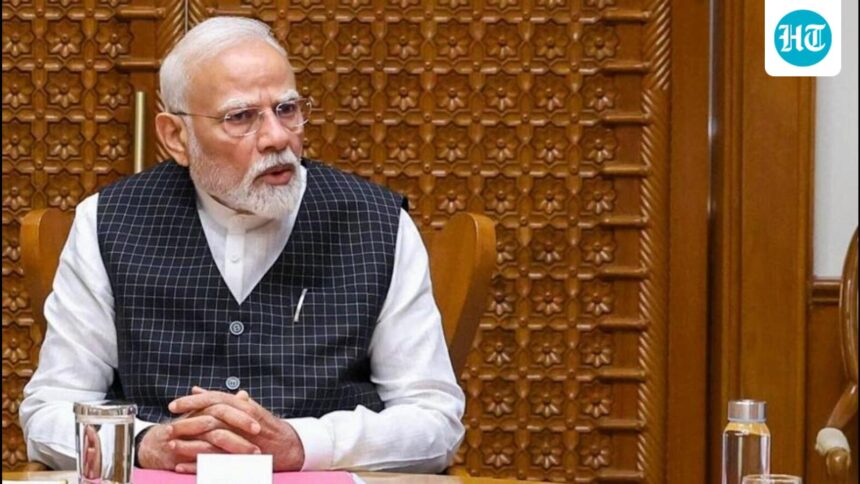
The Cabinet, headed by Prime Minister Narendra Modi, on Wednesday approved the launch and implementation of the Regional Connectivity Scheme (RCS) – Revised Ude Desh ka Aam Naagrik (UDAN) for 10 years, with a total outlay of Rs. $28,840 crore supported by government budget support.

Under this scheme, which will be implemented from FY 2026-27 to FY 2035-36, the government will develop 100 airports/airstrips. “Under the revised UDAN plan, 100 airports are proposed to be developed from existing unserved airstrips to enhance regional connectivity, in line with the Viksit Bharat 2047 vision to expand infrastructure and transform India into a globally competitive aviation ecosystem, with a total outlay of $“Rs 12,159 crore over the next eight years,” a statement issued by the government said.
“It will serve as a boost to economic growth, trade and tourism in Tier 2 and Tier 3 cities, support affordable air travel for common citizens, (help in) improving emergency response and access to healthcare in remote and hilly areas, increase viability and sustainability of regional airports and airline operators, strengthen the domestic aviation sector under the Atmanirbhar Bharat framework and progress towards the FEXIT Bharat 2047 target,” the statement added.
The first UDAN scheme (UDAN 1.0) was launched in October 2016 and took off on April 27, 2017, with the aim of making air travel affordable and enhancing connectivity to Tier 2 and Tier 3 cities. UDAN 2.0 was launched in 2018, UDAN 3.0 in 2019, and UDAN 4.0 in 2020. A series of UDAN 5 were launched from April 2023. After that, UDAN 5.1 was launched in May 2023, UDAN 5.2 in July of the same year, UDAN 5.3 in January 2024, UDAN 5.3 in January 2024, and UDAN 5.3 in January 2024. 5.4 in August 2024, and UDAN 5.5 was launched in February last year.
Over more than nine years of implementation, 663 routes were operated across 95 airports, helipads and waterfields as of February 28 this year. So far, more than 3.41 lakh flights have been operated, carrying 162.47 lakh passengers.
Key components of the revised scheme, announced on Wednesday, include airport development, operations and maintenance (O&M), development of modern helicopter platforms, and viability gap financing (VGF).
Speaking about airport maintenance, the government said: “Given the high recurring O&M costs and limited revenue streams for RCS-only airports, the scheme proposes to provide O&M support for a maximum of three years.” $3.06 crore per annum per airport and $Rs 0.90 Crore per annum per helipad/seaport, estimated at $2,577 crore for around 441 airports.
The government has also proposed to develop 200 modern helicopter platforms to address connectivity issues in mountainous areas.
“To meet the connectivity challenges in mountainous, remote, island and aspirational areas, the scheme proposes to develop 200 modern helicopter platforms in $15 crores each, which comes to the total requirement $“Rs 3,661 lakh crore over the next eight years (inflation adjusted), focused on priority areas and aspirational areas to improve last-mile connectivity and emergency response,” the government said.
Under the RCS, airline operators receive financial support in the form of VGF to operate the awarded routes, the government said. “Recognizing the need to develop the market for a longer period, it is proposed to support the VGF to airline operators in the equivalent of $Rs 10,043 crore over 10 years, she said.
To address the shortage of small fixed-wing aircraft and helicopters needed for operations in remote and difficult areas, and to enhance the vision of Atmanirbhar Bharat, the government has proposed to purchase two HAL Dhruv helicopters for Pawan Hans and two HAL Dornier aircraft for Alliance Air.
It is confirmed that since the inception of the UDAN scheme, 925 valid routes have been given to the RCS, of which 663 routes have been operational as of February this year.
According to the latest government data, 327 routes have so far been grounded due to a variety of factors such as disruption caused by the COVID-19 pandemic, aircraft shortages, supply chain issues, aircraft maintenance, airport/runway maintenance, and reduced passenger demand on some routes.
In order to address issues of route sustainability and further enhance regional connectivity, the government announced a revised UDAN plan to connect 120 new destinations and cater to 4 crore passengers over the next 10 years. A total of $Rs 4,593.28 crore has been disbursed as VGF to selected airlines since inception.
Information and Broadcasting (I&B) Minister Ashwini Vaishnao said that under the UDAN scheme, out of the 95 airports that have been commissioned, 15 have been temporarily closed.
“Airports which could not be covered in the previous UDAN scheme will be covered in the revised UDAN. Priority will be given to discrete mountainous areas and also to those in challenge mode,” he said.