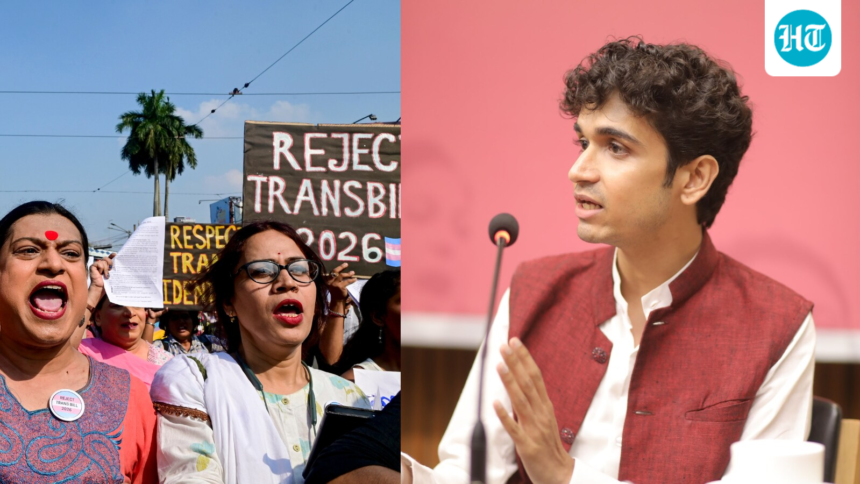
The Lok Sabha on Tuesday passed the Transgender Persons (Protection of Rights) Amendment Bill, 2026, despite protests from opposition members and backlash from transgender activists. Protests were organized across the country by activists, who said the proposed legislation narrows the scope of the 2019 law by changing the definition of a transgender person, while excluding many transgender men and women, non-binary and genderqueer individuals, and others who rely on self-identification.

In an exclusive conversation with HT, NCP-Sharadchandra Pawar (NCP-SP) spokesperson Anish Gawande criticized the proposed legislation and raised concerns over lack of consultation with the transgender community on the proposed changes. He also said the bill removes the principle of self-identification, which may deprive many people within the community of recognition.
Read also | The new bill represents a regressive turn in transgender rights
Inside the Transit Amendment Bill: An Overview
Below is a brief overview of the changes proposed in the draft law:
Notably, this bill changes how a trans person is defined. Under the new proposal, protections would apply only to those “who face severe social exclusion for biological reasons through no fault of their own or lack of choice.”
Essentially, it moves away from the idea of self-identification. The law will apply to a narrower group of transgender people from certain socio-cultural communities such as Hijras, Kanars, Aravanis and Jogtas. This would reduce the number of people recognized as transgender.
It will also propose mandatory certification from medical councils and district judges, along with additional approvals for those undergoing gender confirmation surgery.
The bill also seeks to punish those who “force a person to come out as a transgender person and engage in begging, servitude or forced labour.” The punishment ranges from five to 10 years in prison and a fine of not less than one thousand rupees if the “victim” is an adult, and from 10 to 14 years in prison with a fine of not less than three thousand rupees if the “victim” is a child.
Anish Gawande on the Transit Amendment Bill
Here are some excerpts from the interview:
(edited excerpts)
1. The bill was approved in the Lok Sabha despite protests. What do you think is the main problem with this proposed legislation?
Anish: There are multiple problems with the bill. But the main issue is that the people the Bill is intended to protect were not consulted before the Transgender Persons (Protection of Rights) Amendments Act 2019. This is a bit strange.
On one hand, there is Union Minister for Social Justice and Empowerment (Virendra Kumar), who claims that the move is aimed at taking care of transgender people. However, on the other hand, members of the trans community are protesting in the streets. So the society you are fighting for opposes your actions.
Aside from consultation, there are three main problems with this bill. These include a lack of recognition of gender identity and self-determination, a push towards the medicalization of society, and the criminalization of support systems.
It will put NGOs in prison for helping trans people escape their homes. You will criminalize powerful people for saying that trans rights are important because that would seem like forcing others to become trans. And then maybe criminalize politicians for speaking out about transgender rights.
2. As a member of the LGBTQ+ community and someone who is vocal about their rights, what policy changes would you suggest so that other members of the community do not face such challenges?
Anish: Rights are not to be claimed. They are meant to be ordered. To demand something, you need to act. My party leader, Supriya Sule, said in the Lok Sabha that if the government was serious about supporting it, it should introduce reservations in Parliament for transgender people. Follow the spirit of the 2014 NALSA ruling and give people representation where they deserve it.
The rights of LGBTQ+ people go beyond this issue. The Government has failed to consider my own party’s Member’s Bill on same-sex marriage in Parliament. It also does not criminalize homosexual assault against men.
Even on basic transgender rights, if the government says it supports it, why is there no concrete action? A government that fails to stand up for transgender rights must first implement its own schemes.
If the government wants to do well, reserve seats for transgender people in parliament. The opposition stands united.
3. What is your one message to our readers about how the general public can embrace diversity when it comes to trans people and members of the broader LGBTQ+ community?
Anish: It’s not very complicated. You don’t need to fully understand what LGBTQ+ means. All you need to understand is humanity.
India is an ancient society that has always shown the world how to lead carefully. We are a society where kindness is considered the most important virtue. Building community is a part of community, which includes people who may not look or dress like us, and that diversity has always been respected.
This is a country where diversity is its greatest strength, and the most important thing is to embrace it.
4. Finally, what message would you like to send to members of the LGBTQ+ community who are hesitant to come out due to fears of discrimination and social exclusion?
Anish: Many young people today are afraid to go out. Some feel that the law is not in their favor, while others feel uncertain about their future in the country. My message to them is to be brave and be kind to themselves.
We will continue to fight regressive laws in the future. But one thing that will remain constant is that you will always win.