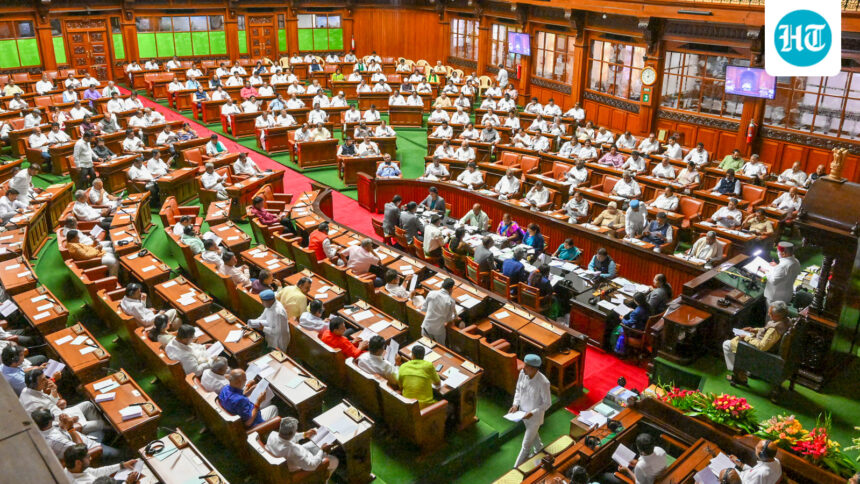
The Karnataka Assembly on Monday passed two major bills, including the Karnataka Freedom of Choice in Marriage and Prevention and Prohibition of Crimes in the Name of Honor and Tradition Bill, 2026, with the government asserting that both the measures are aimed at social reform and heritage preservation.

Moving the bill on marriage, Law and Parliamentary Affairs Minister Hong Kong Patel said the legislation aims to address social issues such as honor killings and promote constitutional values in society.
“This is a bill that aims to bring about social change and, in a way, enable a social revolution,” he said.
He noted that the values of equality and inclusion have long been expressed in Indian philosophical traditions but have not been translated into practice.
“We have accepted these values as social values, but they have not really entered our lives. Rather, they remain mere topics of discourses,” he added, adding that there was a need to give such values legal support.
Referring to violence in the name of marriage, the minister said: “In matters of marriage, especially when it comes to freedom, we have witnessed many cases of violence in society.”
He also stressed that the draft law would provide legal force to protect couples and promote social harmony.
“The intention is good. But when the law is made, the government must take into consideration the facts,” Opposition Leader R Ashoka said.
He noted frequent incidents of honor killings, especially in parts of Old Mysuru district, and sought clarification on the need for a new law.
In response, the minister said the government conducted extensive deliberations and was assured that the law would complement the existing provisions.
The government has ensured that this law does not conflict with the existing provisions of the Bharatiya Nyai Sanhita Act. He added that this law aims to enhance the government’s message and promote a healthy social environment.
During the discussion, Suresh Kumar, BJP MLA S, sought clarification on the provisions relating to advertisements for couples, asking whether it meant support for live-in relationships.
The minister explained, “This law will not support the concept of coexistence. Let me clarify that it aims to strengthen the institution of marriage.”
He added that the draft law went beyond merely addressing murder crimes.
“The matter is not limited to murder. There are many incidents of social boycott, harassment and exclusion that occur but are not reported,” he added, noting that provisions have been included regarding preventive measures, protection, civil remedies and mechanisms for supporting spouses.
Later, the Council approved the draft law.
The House also passed the Karnataka Jnana Bhandar Manuscripts and Digitization Bill, 2026, with the minister stressing the urgent need to preserve ancient manuscripts spread across the state.
Explaining the intent of introducing the bill, Minister Patel said that the main objective is that there are innumerable manuscripts in our state today and they are owned by individuals, institutions or in unknown places.
He stressed the importance of preserving such materials.
“The government must protect these manuscripts. We must preserve this repository of knowledge,” he said, noting that they cover diverse topics including religion, medicine, science and history.
Highlighting the current situation, the minister said that many manuscripts were kept in homes but remained unused.
“They are preserved faithfully, but in many homes they are not opened or read,” he said, warning that failure to preserve them could lead to permanent loss of knowledge.
Noting historical efforts to preserve manuscripts, he said the draft law would institutionalize these efforts through dedicated authority and clear objectives.
“We set clear goals – for example, digitizing at least five hundred thousand pages a year and conducting manuscript collection surveys.”
BJP MLA S Suresh Kumar supported the bill, but urged the state government to document traditional knowledge systems as well.
“This is a very good and necessary bill. However, there are traditional knowledge systems like those in the Solega community. This knowledge may be lost over time,” he said.
The House of Representatives then passed the bill.