

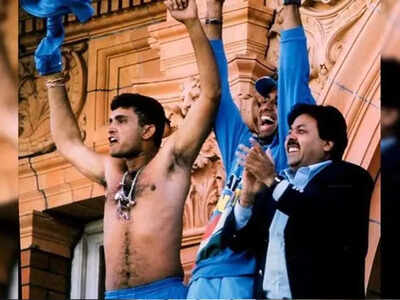
File Pic: Sourav Ganguly T-shirt celebration at Lord’s.
LUCKNOW: The image of Indian captain Sourav Ganguly moving his jersey from the Lord’s Terrace after the NatWest Trophy win in 2002 is still etched in the memory of cricket lovers.
For some, it was an appropriate response to a similar gesture made by Andrew Flintoff in India after England’s victory. For others, it clashed with the sport’s “gentlemanly” image.Go beyond boundaries with our YouTube channel. Subscribe now!However, what is less known is that Ganguly initially wanted the entire team to join him – an idea that Sachin Tendulkar quietly objected to.This anecdote was shared by BCCI Vice President Rajeev Shukla during the TOISA event, when he was asked about his most precious cricketing memory.
He watches
The greatest honor of a living legend!
Shukla said the NatWest Trophy final between India and England at Lord’s on July 13, 2002, tops his list. He then worked as the team’s manager, and remembers the emotional ups and downs that occurred on that historic night.“It was a fantastic team with a mix of experience and youth, and we got to the final without too much difficulty. In the final, England posted a huge 325, and I was starting to panic as we had to chase history to lift the cup.“Virender Sehwag assured me that there is nothing to worry about.
He opened the innings with Ganguly and struck up a century partnership in 14 runs. But in the next nine overs, we were 146/5.“But the two young men, Mohammed Kaif and Yuvraj Singh, played very well and scored one of India’s most famous victories.”Read also: Red Carpet, Real Champions: TOISA unites Olympic athletes, world champions and stars with special needsThe celebrations that followed were equally exciting.“Ganguly told me to ask the team to remove their shirts and celebrate. But Sachin advised me against it, saying it would not look appropriate. I agreed with him,” Shukla said.“But no one could stop Ganguly. He walked out on the Lord’s Terrace alone and waved his shirt in the air – a moment that has since become one of the most iconic images in cricket history.”
