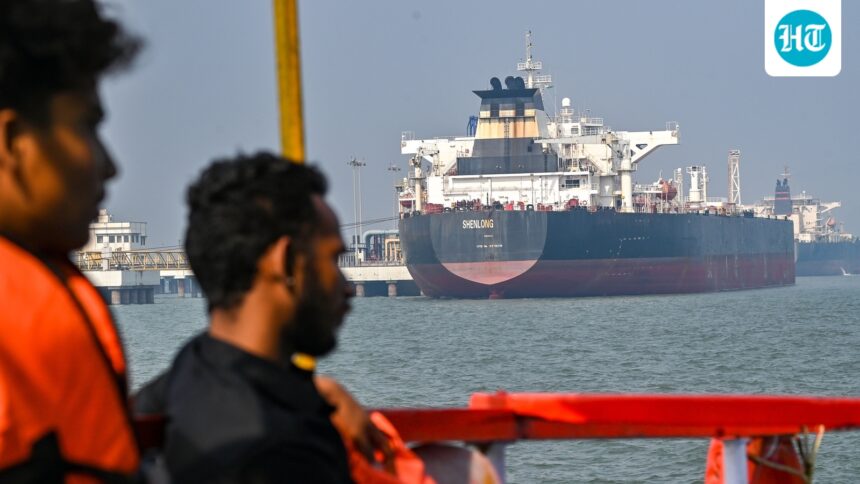
It is a voyage that took a ship to India through the Strait of Hormuz. It was also one that moved through the pre-digital era as the oil-rich West Asia region was engulfed by a digital war of drones and missiles.

The Liberian-flagged oil tanker Xinlong Suezmax docked at Jawahar Dwip Port in Mumbai on Wednesday, March 11, after relying on manual navigation and a complete digital blackout as it faced the conflict sparked by the US-Israeli attack on Iran on February 28.
He follows: Live updates on the US-Iran war
Here’s how Shenlong arrived in India
The ship is the first to successfully deliver a cargo of crude oil to India through the Strait of Hormuz since the conflict began on February 28, turning the vital waterway into a war zone.
The tanker, carrying 1,35,335 metric tons of crude oil from Saudi Arabia, arrived at Butcher Island terminal at 6:06 pm on Wednesday, reports said.
The successful crossing comes at a time when energy supplies are under pressure as the scope of the war expands to include the Arab world as well, affecting supplies from the world’s richest region in oil. India is witnessing Panic over LPG supplies in particular.
Navigating the digital void
The journey started from Ras Tanura station in the Kingdom of Saudi Arabia.
The ship departed on March 3, just as regional tensions reached breaking point.
As the ship approached the Strait of Hormuz — a 33-kilometre-wide passage through which nearly a fifth of the world’s crude oil passes — the crew encountered a complete shutdown of electronic navigational aids.
Someone familiar with the matter He told HT that signals from the ship’s Automatic Identification System (AIS) and transponders were not detected for much of the voyage, a tactic often used by ships to avoid detection in hostile waters.
Marine tracking data showed that the ship was in the Strait of Hormuz on March 8 before it temporarily went out of tracking systems. It reappeared on tracking systems on March 9.
The transceiver is a mandatory marine VHF radio system that automatically broadcasts a vessel’s identity, position, speed and course to nearby vessels and shore stations to prevent collisions and improve navigation.
However, the “dark” crossing was not just a choice. Sources from India’s Ministry of Ports, Shipping and Waterways told HT that the Shenlong was subjected to constant GPS spoofing and jamming, a form of electronic warfare that renders modern satellite navigation useless; Or worse, makes it misleading.
“Seamanship and pure courage”
With the loss of GPS signals, the crew was forced to rely on traditional marine skills.
The ship’s captain, Sukshant Singh Sandhu, described the journey as filled with “many uncertainties.”
“The ship lost GPS signals several times along the way,” said Captain Sandhu, a resident of Mohali. Second Officer Abhijeet Alok told HT on Thursday that the bridge team has reverted to “secondary options”. “Captain Sandhu is an experienced officer and knows how to navigate when there are no GPS signals. We navigated the same way in an era when there were no signals,” Alok said.
The 29-member crew comprises nationals of India, Pakistan and the Philippines.
The third officer, Usman Arshad, a Pakistani national from Karachi, noted that Sandhu remained steadfast. He added: “The captain assured us that we will be alerted during the emergency period.” Arshad’s contract expires next month, and he plans to take four months off to “relieve stress.”
Arshad noted: “We saw fighter planes flying in the skies of Saudi Arabia, but there was no direct military conflict against us.”
The return leg remains
The tanker is now scheduled to sail to the port of Fujairah in the United Arab Emirates on Friday evening after transporting its cargo to refineries in Mahul, east of Mumbai.
Although Fujairah lies outside the Strait of Hormuz, it has not escaped conflict. On March 9, debris from a drone intercepted by the UAE Defense Forces caused a fire in the port, and an oil storage terminal was hit by falling debris last week.
Meanwhile, another ship, Smyrni, is expected to arrive in Mumbai on March 14.
Putting Indian interests at sea
while Shenlong The ship is safely docked, and the conflict continues to expand. During a press conference on Thursday, Rajesh Kumar Sinha, Special Secretary of the Ministry of Shipping, confirmed that three Indian sailors were killed and another was still missing after attacks on foreign-flagged ships in the region.
One casualty occurred on board the Marshall Islands-flagged ship Savesi Vishnu near Iraq, while another casualty was reported on board the Thai-flagged ship Mayuri Nari, which was bombed near the port of Basra on 11 March. The State Department has expressed deep concern, noting that commercial shipping is being unfairly targeted.
Currently, there are still 28 ships flying the Indian flag in the Arabian Gulf region, and these ships have 778 Indian sailors on board.
The government has identified 22 priority ships, including 13 Indian-flagged vessels, for potential naval escort if the security situation deteriorates further.
The Strait of Hormuz has become a focal point in the conflict. Following the February 28 strikes, Iran effectively took control of the corridor.
While some reports suggested that diplomatic talks between Indian Foreign Minister S Jaishankar and his Iranian counterpart Abbas Araqchi had ensured safe passage for Indian ships, ministry spokesman Randhir Jaiswal termed such reports “premature” during a press conference. Weekly briefing On March 12th.
An Indian-flagged tanker loaded with Iraqi crude is currently on its way to Paradip in Odisha, as the government continues to monitor the 28 stranded ships through a 24-hour control room.
Expected: 22 ships in 72 hours
Deendayal Port Authority, Kandla, Gujarat, is gearing up to handle 22 vessels in the next three days. “We will be dealing with 22 vessels in the next 72 hours,” she said on the X Post website on Friday.
“The systems are working efficiently to accommodate the reconfigured flights and provide services to the best possible standards,” the post said.
Among the ships expected to arrive at Kandla port is the Thai-flagged Mayuri Nari, which was attacked in the Strait of Hormuz on March 11. Some of the expected ships are likely to carry crude oil to India.