

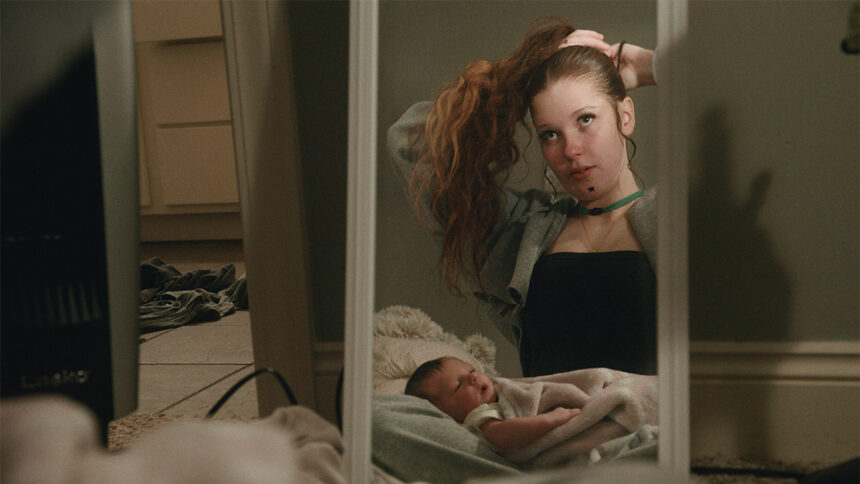
The joys and challenges—but mostly the challenges—of young motherhood are explored Children/girlsa traditionally constructed, sympathetic documentary directed by Alice Walsh and Jackie Jesko that premiered at SXSW this year.
Revolving around a group of white teenage girls who spend time at Compassion House in Springdale, Arkansas, a charitable Christian group home that helps troubled children cope with parenting, the film exposes the sadly cyclical nature of teenage pregnancy. Not surprisingly, the teens we meet are all daughters of teenage mothers. Additionally, it is clear that patterns of addiction, neglect, and exposure to sexual abuse are likely to continue to recur in these families, along with mental health issues, passed down through generations like a hand-stitched heritage quilt of misery.
Children/girls
Bottom line Sympathetic, though frustrating.
place: SXSW Film Festival (Documentary Spotlight)
Managers: Alice Walsh, Jackie Jesco
1 hour and 35 minutes
Directors Walsh (TV series house) and Jesco (Barbara Walters: Tell me everything) Filming began after the Supreme Court’s 2022 Dobbs decision struck down the constitutional right to abortion and enabled Arkansas to ban abortions altogether, making this seem like a particularly timely choice of subject matter. Interestingly, as it turns out, this ruling did not lead to the spike in unwanted pregnancies around these parts as some had predicted. To sum up one interviewee who works at Compassion House, anti-abortion beliefs are now well-established in areas like this after years of pro-life messaging.
In fact, in this church-heavy area, “contraception” is itself a curse word, and none of the young mothers I met here had received any kind of sex education at school, leaving them ignorant not only about how to prevent pregnancy but also about basic facts of biology. (Abstinence is the only advice the state allows to be dispensed in public schools.) Olivia, a pregnant 15-year-old girl, casually recounts that she had just learned a few days ago that her body has three holes in the bottom instead of two, and that the baby coming out of it is not the same one that is used to passing urine.
Indeed – and this may be a controversial position – sometimes the profound ignorance of the young people gathered here may make it difficult for some viewers to feel all the sympathy they deserve for them. Yes, you can see that the state and institutions like their churches have failed to educate them. But at the same time, some of these children seem intent on ruining their chances at a better life. Ariana, for example, who appears as one of the three brightest people the film primarily focuses on (and who at one point says she’d like to be a lawyer herself), finds herself pregnant again with a second child by the end of the film, having decided for reasons that are not explained to have her IUD removed. Fortunately, her partner Brian, or “baby daddy” as she calls him, seems emotionally supportive and willing to reasonably co-parent. But they don’t seem entirely optimistic about the decision to have a second child, especially in light of their previous protests that it was too much of a problem to have the first child before Ariana even graduated high school.
At least to the filmmakers’ credit, they show people, without any judgment, making what some might consider grave mistakes in their lives. Grace, for example, is another example of someone who is herself the daughter of a teenage mother (Audra) and finds herself following in her mother’s footsteps. However, in this case, Audra is clear enough now that she’s in her 30s to see that Grace, who loves to party and wants above all to hang out with other teens, is unable to care for her infant daughter Emerson on her own. Audra tries to parent herself, but she has four other children to care for, at least one of whom is a pre-teen and has multiple sclerosis to deal with. She reasonably convinces Grace to put Emerson up for adoption in the final minutes of the film. But before viewers have enough time to cheer for this rare display of meaning, the final titles reveal that they end up filing a lawsuit to get the adopted child back and win. [Heavy sigh.]
Those closing credits cheerfully try to suggest that the three girls we met are growing up and perhaps making better decisions now, but who knows how long that will last? Some may regret that the film doesn’t spend more time hearing from the people who work at the Compassion House with the exception of Crystal, one of the key workers there who is a teenage mother herself. Without more mature, far-reaching perspectives, the doc risks playing a little like depressing reality TV, and its compassion fatigue isn’t entirely alleviated here by any kind of cinematic exuberance that might break up the dreariness.
