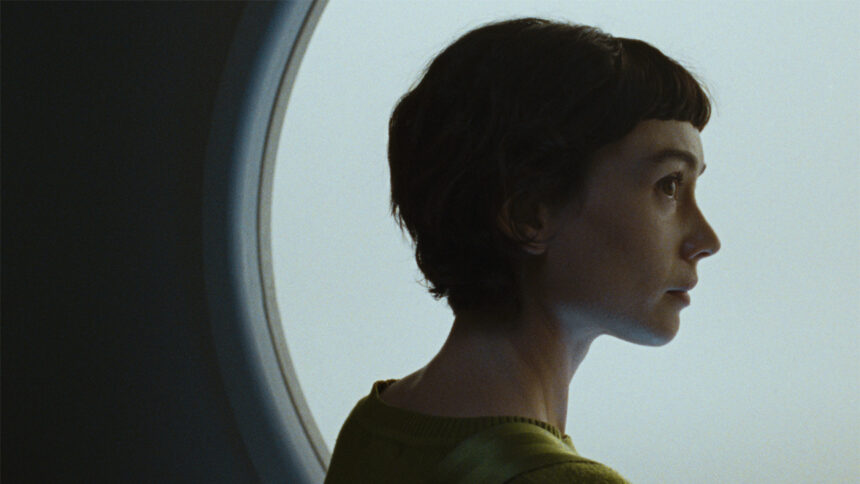
Like many films before it, Anima It places two strangers together in a car and sets them on a path fueled by codependency, separation, and repressed emotion. It’s as tried-and-true a story template as you can find, and one that writer-director Brian Tetsuro Ivey has gently twisted, to wonderful, low-key effect, with a dash of icy sci-fi and tender, retro longing.
Indie actors Maria Dizia and Lili Taylor, and director Tom McCarthy and Marin Ireland, all contribute well-etched supporting roles, but this is essentially a two-parter, with Takehiro Hira (Shogun(and Sidney Chandler)Alien: Earth) are largely unsentimental as unlikely traveling partners: a dying man and the person hired to deliver him to his deadline. Set about five minutes in the future, Anima It is about the possibilities of virtual reality and, at its heart, is a story of age-old concerns – the bond between parent and child and the transcendent power of music. As the central duo moves through New England towns, it is also a film whose architectural gaze recalls Kogonada Columbus.
Anima
Bottom line Puts a sharp twist on a popular genre.
place: SXSW Film Festival (Feature Spotlight)
ejaculate: Sidney Chandler, Takehiro Hira, Marin Ireland, Lili Taylor, Tom McCarthy, Maria Dizia, Maximilian Li Piazza
Director and screenwriter: Brian Tetsuro Ivy
1 hour and 30 minutes
Chandler plays Beck, who lives in a small New York apartment and has just been laid off from her job at a company that makes robotic pets. Her resume attracts the interest of Anima Technologies (whose headquarters plays a stunning 21st-century building on the Bard College campus). The expensive product Anima sells is a cloud version of the dearly departed that preserves the “deepest part” of customers’ identities after they’re physically dead. The CEO (Ireland) who hired Beck assured her that what they were offering was not just an algorithm or a chatbot, even though it looked like one.
For reasons that have written consistency but not superficial clarity, Beck is matched with Paul (Hera), an important (read: deep-pocketed) client. The company does not want to risk the possibility that he will back out of his scheduled “asset transfer,” and the task that Beck cannot afford to refuse is to transport him from his home to Anima for this procedure. As for the efficacy of Anima’s offering, she is skeptical, while her mother, Jo (Dizzia), a recently widowed bohemian who hates the devices, refers to the company as “death capitalists.”
Whether his waterfront home is on a real island or not, Paul is an emotionally isolated soul. Beck’s mission is to get him to Anima as quickly as possible, but he has a trip plan that includes a few stops, and insists on going in his old Nissan, a fitting choice for a man who made his fortune as a manufacturer of buttons, which are mostly analog goods.
Between his boss-level confrontation and her Gen Z outlook, they hit a dead end. Their road trip takes them south through Connecticut on I-95, where Matthews Bustos’ camerawork blends with the rich greenery of the northeastern woods and a variety of locations, including a New Haven auto shop, a themed hotel, and, in a sequence full of comedic silliness, the secluded home of a talkative former employee (McCarthy) and his wife (Aya Ibaraki).
An angry homage to ’90s indie pop culture throughout the film, with significant references to Twin Peaks and the bands Morphine and Sparklehorse. Set in a used record store (the real-life Merle’s Record Rack in Connecticut) the script first makes an obvious reference to Morphine’s song “In Spite of Me,” which later appears in a wonderful scene that turns words into a form of dialogue and melody into balm. The charged mixture of deadpan detachment and naked pain in Chandler and Hera’s faces proves to be an eloquent match for a killer song.
Music is essential to Beck’s character, but it’s also something she pushed aside, after seeing how much it consumed her late father, a touring musician who put his art first. When Paul pays her a small fortune to attend a club concert with him, she doesn’t know it’s because he’s looking for the teenage son he’s never met. Facing the lo-fi electronica of Yummy Bear (a version of Montell Fish’s DJ Gummy Bear), the evening turns into a disaster, but something opens up between Beck and Paul.
The emotional colors of the story deepen when Paul’s son, Ryan, played with maximum vulnerability and resilience by Maximilian Le Piazza, is located. He’s an only child who works at a pet store that specializes in virtual birds rather than flesh-and-blood birds, adding another facet to the film’s theme of death-defying connection. For Ryan’s mother, Julia (Taylor), Paul’s surprise visit unleashes a guarded bitterness that has held her in check for a long time.
Working from a story he wrote with Brave Moss, Tetsuro Ivie imbues familiar cinematic tropes with new angles and involving energy. The editing, by director Sam Kohn, finds the pulse of every scene, and the music is, appropriately, a vital element, ranging from the dream state of Montel Fish’s compositions to a dazzling array of old-school Japanese folk rock. Production designer Katie Rose Ballon’s expressive work includes elaborate motel interiors, packed stores, and, most importantly, the contrast between the artistic sensibilities of Joe’s colorful home and the cool, antiseptic architecture of Anima’s offices.
Aspects of Beck and Joe’s story could be clearer, though the ambiguity functions, to some extent, as a reflection of how Beck has set aside her grief for her father, and how the wounds remain raw. As Paul’s physical and emotional pain became more apparent, she found her bedside manner, albeit with gallows humor. Anima It becomes clearer and more powerful as it progresses and as its characters, who have closed themselves off to protect themselves, discover the immortality that money cannot buy.