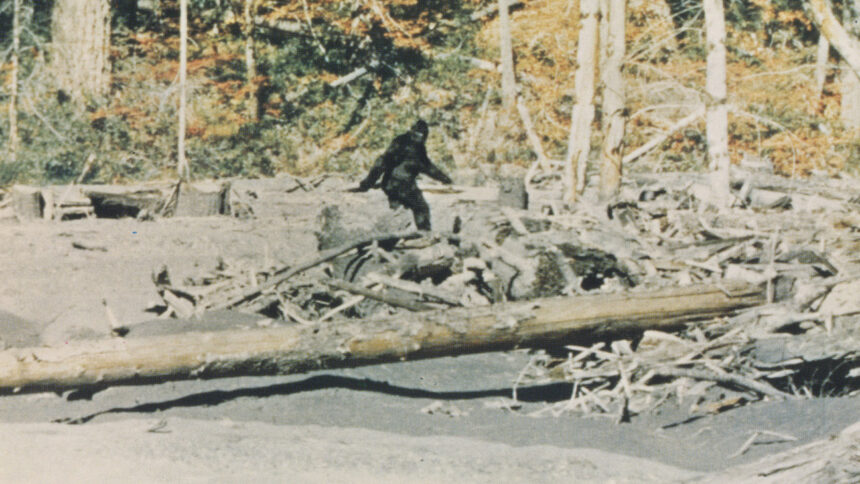
Google “Bigfoot,” as I just did, and you may be surprised to find news reports of new sightings. Who knew? But whatever your level of awareness regarding legendary riders, Mark Evans’ new documentary is a fascinating exploration of a very specific piece of Americana, focusing on a colorful group of elderly cowboys in Yakima, Washington. At the heart of the doc is the source material that kicked off a half-century of hopeful believers, tireless hunters, and the industry that grew up around them: a 1967 cut of film clocking in at 59 seconds, its authenticity long debated, and its grainy images meticulously analyzed.
Filmed in the dense forests of California in the Far North and known as the Patterson-Gimlin film, it depicts the vision of a female Bigfoot lumbering across a sandbar. For many, including some of the people interviewed in Evans’ film, that shaky minute of 16mm footage is the holy grail, indisputable proof that Bigfoot — also known as Sasquatch, Yeti, or the Abominable Snowman — walks the Earth.
Capture Bigfoot
Bottom line Full of compelling characters.
place: SXSW Film Festival (Documentary Spotlight)
exit: Mark Evans
Screenwriters: Mark Evans, Michelle M. Witten
1 hour and 43 minutes
After presenting the basic events and theories, Capture Bigfoot reveals a bolt of relevant evidence that recently fell into the hands of documentarian Evans (Clyderem). If you’re not interested in the question of whether the 1967 footage is real or just an elaborate hoax, you won’t find the newly discovered explosive, but nonetheless, its significance is resoundingly clear. It’s compelling not just in the context of the film’s cast of characters and their conflicting testimonies, but because of what their reaction to it reveals about the need for faith. For some, this belief has become not just a lifelong interest, but a sense of purpose that defines life.
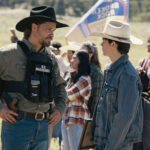
Among those who appear in interviews new and old are people who were in that riparian patch of woods 59 years ago, and others who were directly affected by the fallout. This is the story of family, friends and neighbors – their bonds and differences. At the center of the doc is Clint Patterson, who was a schoolboy when his father, a former rodeo racer, led the making and promotion of the Bigfoot movie.
Roger Patterson wasn’t the first person to speak publicly about this creature, but he was the first to become officially obsessed with it. After reading sightings on logging roads in Northern California, he began embarking on “expeditions” to obtain evidence. Clint, who idolized his father, was his sidekick on those trips in a Volkswagen that had been updated to make room for two horses.
Patterson hated the 9-to-5 life but with a family to feed, he decided that his Sasquatch hunting adventures could be a source of income, and set out to make a documentary about the mission, albeit one that put Bob Gimlin, his filmmaking partner and fellow Caucasian, in an “Apache” garb. Patterson self-published book, Do America’s Abominable Snowmen Really Exist?After publishing his one-minute guide to the massive creature, he was featured on national television shows and was the subject of magazine articles. With his other partner in the project, businessman brother-in-law Al Diatley, he took his film on a whirlwind tour, decking it out in halls and theaters. In the pre-Internet era, curious locals would buy tickets to see the famous footage.
But while all this was taking off, Patterson fell ill. He would die of Hodgkin’s lymphoma before he was forty. The person who benefited from the film was Diatley, who, by all accounts here, including the archival audio of his own comments, was a bad character. One of his nephews recalls that the man’s business philosophy was “Please help.” DeAtley, who had no interest in searching for Bigfoot except for the money-making potential he saw in it, made a fortune, the better to fuel his faltering asphalt company and rise to the top of Yakima society. Evans includes drone footage of the massive fruits of his winnings, a stunning monstrosity also known as a house. (Diatley died in 2019, and his widow makes a significant, if brief, appearance in the doc.)
Regardless of diatly, the numbers contained Capture Bigfoot It’s very easy to like, even as the constantly shifting sense of who to believe, which is one of the most interesting aspects of the documentary. The people who consider the Patterson-Gimlin film to be the real deal, at least the ones Evans spoke to, are not just smart people but experts, including anatomy professor Jeff Meldrum and Hollywood makeup and visual effects expert Bill Munns. Meldrum detects the presence of real mammalian muscles in the creature filmed, and Munz says it was not technically possible at the time to make a Bigfoot costume as convincing as what we saw in the film.
Then there’s Bob Hieronymus, the self-proclaimed “Toughest Man in Yakima,” who came forward in 1999 claiming to be the man who dressed like that to play Bigfoot for Roger Patterson’s camera. The believers did not like him. Gimlin, his former neighbor and friend—and perhaps the Doctor’s most attractive and mysterious subject—has stopped speaking to him. Greg Long was similarly hated and demonized by Bigfoot followers after the 2004 publication of his book, Making BigfootWhich concluded that Patterson was a con artist and that his film was a hoax.
Excerpts from audiotapes of Long’s interviews are a strong element of Evans’ doc, and playful music cues underscore the humor and emotion running through this particularly American epic, along with plenty of pain. Roger Patterson’s widow, who appeared on camera to discuss the matter for the first time, considers the 1967 film “the curse of hell.” Larry Lund, the charming man who calls himself Sasquatch Sleuth, has spent 60 years searching for Bigfoot. He notes, with some regret, that his mentor René Dahinden, the Swiss-Canadian cryptozoologist who died in 2001 and who has been a vivid and vocal presence here in the archival materials, had left his wife and children to devote himself to research.
By devoting his time to both sides of the short film debate, Evans presents plausible conflicting arguments. He reveals that it is not always easy to use Occam’s razor when faced with a dilemma. In trying to reconcile the new material presented to him by Evans with what he already knew and believed, Meldrum (who died in late 2025) somewhat distraughtly notes that “the simpler explanation is inconvenient to arrive at.”
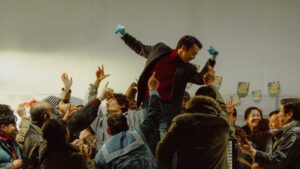
The antagonist of Patterson-Gimlin’s film is one thing; Disproving the existence of giant humanoid creatures is another matter. Leaps between reason and conviction are nothing new, though we may be living in a particularly troubling time on this front, and it’s likely that many true believers will reject Evans’ film just as they did Long’s book. The entire culture and industry revolves around Bigfoot. There are museums in Oregon and California, as well as conventions where Gimlin, now in his 90s, became a beloved player — and where Hieronymus and Clint Patterson pay him a surprise visit, captured on film before event organizers turn them away.
With his openness, compassion, and willingness to forgive, Clint Patterson anchors the program Capture Bigfoot. As a child, he and his siblings kept their dying father company in a shed on their property, where he gave himself radiation therapy using a cobalt machine. Fifty-nine years after Clint’s buck-riding father became famous for a movie set in the wilderness, it’s easy to see the child in him, the young boy who has lost his hero — more than once.