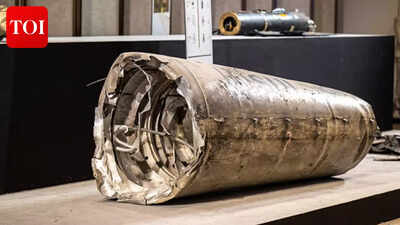
The Ministry of Interior has issued urgent safety guidance on the risks of handling fragments after accidents or explosions. The Ministry of Interior explained, in a statement on Tuesday, the necessity of maintaining a safe distance from the fragments and avoiding touching them.
The Ministry noted that the fragments are often irregular and sharp, which may lead to deep wounds or bleeding if handled or moved.
“Shrapnel tore his liver apart”: Hezbollah hits the son of extremist Israeli minister Smotrich in an ambush in Lebanon
How dangerous are splinters?
Shrapnel refers to fragments of bomb, shell or missile parts scattered after an explosion, and are designed to cause injury. They are often irregular in shape and can cause deep wounds or severe bleeding in most cases.Since they are parts of attack missiles or bombs, there is always a possibility that they may not have fully exploded and may explode if moved.
Moreover, it is part of the official attacks carried out by one party on another, and represents official news and evidence. Handling them, while touching or moving them, can distort evidence and complicate the process of narrating attacks and the work of specialized teams.
Effects of touching fragments
After recent attacks, the fragments can be very hot due to friction or blast impact, thus causing deep burns. In addition, they may also contain explosive chemicals or compounds such as fuels, oils, and even heavy metals that can have the same effect, along with other health and environmental risks.
How to deal with Falling debris ?
The UAE’s National Emergency, Crisis and Disaster Management Authority (NCEMA) recently posted a warning on social media advising citizens of what they should do if they are exposed to falling debris. I advised:
- Stay away from the accident area and leave a safe distance
- Do not approach the debris because the fragments may contain explosives or hazardous materials, stay away from them
- Avoid taking photos of the accident site or posting photos on social media
- Avoid gathering in the accident area to enable the competent authorities to reach the site
- Obtain information from official sources in the country and avoid spreading rumors or unconfirmed information
- Ensure the safety of your family members and make sure to minimize panic
- Inform the competent authorities and call the emergency number 999
Death due to falling debris
In an alert issued by the National Disaster and Emergency Management Authority on February 28, it advised the public to stay away from fragments and similar objects, not to photograph them, and to allow the authorities to take the necessary measures.This came after the UAE Ministry of Defense announced that the country was exposed to a blatant attack by Iranian missiles, noting that the UAE air defense systems dealt with it with high efficiency and succeeded in intercepting a number of missiles. The statement added, “The authorities in the UAE also dealt with some missile debris falling in a residential area, which led to some material damage.” The fall of rubble in the residential area led to the death of an Asian civilian. Hence, highlighting the importance of maintaining a safe distance from fragments and escaping to safety if faced with falling debris.