

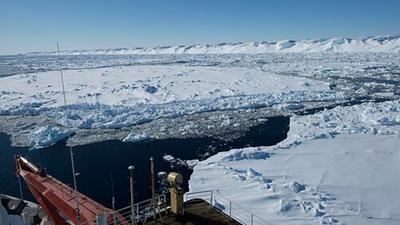
Picture a frozen giant drifting silently across icy waters, big enough to cover London twice. This is the A23a glacier. According to the European Space Agency, it is one of the largest islands in the world, and is now stranded near South Georgia, a stunning sub-Antarctic island known for its penguins, seals and jagged peaks.
Beached like a whale, this 3,460 square kilometer monster (twice the size of Greater London’s 1,572 square kilometres) could spell disaster if it collided completely. Scientists warn that this could block vital feeding areas, starving wildlife in a ripple effect from climate change. Emerging from the Filchner-Ronne Ice Shelf in Antarctica in 1986, A23a’s odyssey captivates us with the raw power of nature.
Iceberg A23a is stranded near a remote island
Born in 1986 from the Filchner-Rhone shelf, it spent decades “stationary” as an iceberg twice the size of London, grinding to a halt off a pristine Antarctic island.
This is the A23a iceberg now in shallow waters near South Georgia, a British overseas territory famous for its penguins and seals. Covering an area of about 3,460 square kilometres, it drifted for decades, was recently refloated and is now stranded where it could cause problems for local wildlife.
Scientists warn that the collision could destroy the island’s ecosystem, blocking the feeding routes of penguins and seals.
However, nature is doing its job, as the mountain is quickly disintegrating.
Iceberg A23a size: twice the size of London
The Iceberg A23a isn’t just big, it’s a beast. Its area is 3,460 square kilometres, dwarfing the Greater London area which extends over about 1,572 square kilometres, including all the boroughs. That’s enough ice to cover the capital from Heathrow to the Thames Estuary twice. It was clearly captured by the European Space Agency’s Copernicus Sentinel-3 satellite on April 5, 2025, and showed it hugging the northern coast of South Georgia.
“A23a covers an area of 3,460 square kilometres, twice the size of Greater London in the UK,” notes ESA’s Earth from Space report, which compares it directly to the island’s area of 3,528 square kilometres.As shown in a British Arctic Survey YouTube video, for 30 years it lay in the Weddell Sea, warm waters broke free in 2023. By late 2024, currents had pushed it toward South Georgia, 1,800 kilometers east of the Falkland Islands. As of May 2025, it is divided into thousands of pieces; One block, A23c, extends over 50 square kilometres, about one eighth of London.
This natural separation reflects the existence of earlier giants like A76a, but A23a’s longevity, nearly 40 years, highlights the slow melting of Antarctic ice.
Risks of collision with South Georgia
South Georgia is a wildlife gem: king penguins waddling on the beach by the millions, elephant seals and fur seal pups basking in vast colonies. But the A23a congestion in the Gulf threatens everything. Shallow shelves surround the mountain, with its towering cliffs tens of meters above the water, and hundreds below scouring the sea floor.
“As it reaches shallow waters, there is the potential to disrupt local wildlife around South Georgia,” British Antarctic Survey researchers noted while monitoring from RRS Sir David Attenborough.If they completely collide or hit the ground, they can block their foraging paths. The BBC noted that penguins and seals swim miles offshore in search of krill and fish. An ice wall may starve chicks and pups. Professor Geraint Tarling, a BAS ecologist at RRS Discovery, who was inspecting a similar mountain A76a, described the scene: “The visible slopes rise above the waterline by tens of metres, meaning that the ice extends below…
“Hundreds of metres.” A23a weighs trillions of tons, and would likely flip or break apart on impact, ejecting pieces like cannonballs.There are no human settlements, but research stations such as Grytviken face navigational problems; Ships are already avoiding farmers. ESA’s Sentinel-1 radar tracks its drift daily, confirming that it will stop as of March 2026. Climate changes are exacerbating the risks: Warmer seas are accelerating the separation process, pushing more mountains northward.
Threat to wildlife in the glacier: Penguins and seals are in danger
Real heartbreak? A23a shadow over South Georgia creatures. Adult king penguins travel 30 kilometers inland to breed, but their chicks dive seaward for their first swim. Seals are transported to beaches; Pups learn to dive nearby. A grounded mountain can block these sites for years, as seen with A68b in South Orkney, which remained standing after the 2017 calving.British Antarctic survey scientists, studying from the Halley 6 station, confirm that “researchers have raised concerns, saying that as it reaches shallow waters, there is a possibility of turbulence.”
Dr Mike Meredith, from the BAS ice shelf team, added during the birth of A81 in 2023: “The birth process was natural… but its path is important for ecosystems.” Models predict that A23a could persist for months, slowly melting into 1°C waters, reviving seas, and phytoplankton thriving, but that’s small consolation if wildlife dies first.Fragmentation offers hope: By early 2026, it will shrink to a fraction, according to satellite records. However, it highlights climate change.
Antarctica has lost 150 billion tons of ice per year recently. The A23a saga, from its emergence in 1986 to its collapse in 2026, reminds us that these giants are not enemies, but merely harbingers of a warmer tomorrow.
Giant Iceberg Journey: From Antarctica to a Dead End
The A23a’s odyssey began 40 years ago, turning upside down on its way, revealing barnacle-covered bellies. It was grounded until 2023, then spun freely, racing 1,000 kilometers in months through the vortexes. Near South Georgia by December 2024, stalled, trapped, with Indian headline reading: “Stuck Here”, threatening destruction.The European Space Agency asserts: “An iceberg the size of Greater London has broken off… due to a natural process called ‘calving’, although A23a predates recent processes such as A81 (1,550 km2 Brunt Shelf). Ongoing British Antarctic Survey expeditions are chronicling their fate, urging vigilance.In the end, this juggernaut that has multiplied London teaches us humility. Forces of nature dwarf our cities. A misstep can destroy paradise, yet resilience shines through, the penguins adapt, the ice melts, and life goes on.