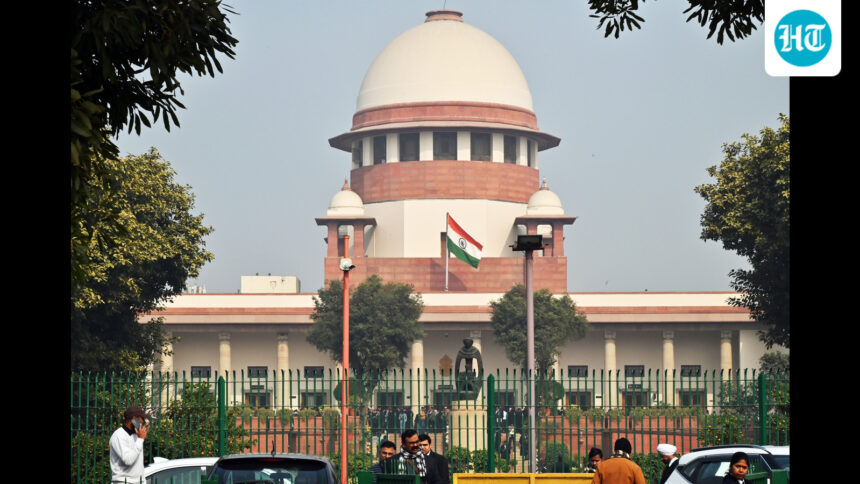
The Supreme Court on Tuesday witnessed an unusual exchange in the courtroom when Chief Justice of India (CJI) Surya Kant questioned one of the petitioners on a public interest litigation (PIL) which the court suspected was not drafted by him but filed on behalf of someone else.

The petition, relating to the PM CARES Fund, was filed before a bench comprising the CJI and Justices R Mahadevan and Joymalya Bagchi. Within minutes of the hearing starting, the court began investigating whether the petitioner — a hosiery trader from Ludhiana who said he studied only up to Class XII — actually authored the legal document before the court.
First, CJI Kant asked Rajneesh Sidhu about his educational qualifications and profession. Sidhu said he was 12th and was a dealer in hosiery goods. The court then asked about his income and tax payments, and he replied that he had paid them $5.25 lakh in income tax in the previous year.
When asked whether he had previously filed any case before any high court, Sidhu said this was his first attempt to file a case and he had approached the high court directly.
“Bada bahaduri ka kaam kiya, seedha Ludhiana se chalke aa gaye! (Very brave of you… you have come straight from Ludhiana to the Supreme Court),” the IJC remarked, sparking laughter in the courtroom.
However, the bench soon expressed doubts as to whether the petitioner had actually drafted the petition himself. Given that the petition contains complex legal language and constitutional terminology, the CJI said the court was not convinced.
“Main aapka ek exam karwaunga yahan (I will ask you to take an English test here),” the CJI told the petitioner, adding that if he scored even 30% in this test, the court might think that he had drafted the petition.
Then the court asked him to frankly reveal who prepared the document. Otherwise, the court warned, it may have to consider other details, including attaching his income tax records.
Sidhu maintained that the petition was his own and showed his mobile phone to the court. He said the document was initially printed by a copyist called “Mr. Das”.
The explanation did little to satisfy the bench. At one point, the ICJ asked Sidhu to explain the phrase “credit risk of corporate donors,” which appeared in the petition. Sidhu could not explain the term.
At this, the ICC observed: “Sidhu sahab, yeh toh aapne kagaz par likh rakha hai. Kisi vakil ne aapko likh ke dya hai,” suggesting that the petitioner appeared to be reading from something prepared by a lawyer.
The bench warned that if it is not revealed who drafted the petition, the court may direct the Punjab Vigilance Bureau to examine the matter.
Sidhu insisted that he had not hired any lawyer, adding that he did not trust lawyers even though he had some lawyer friends. Ultimately, he said he drafted the petition himself with the help of “three or four AI tools” because he could not afford to hire a lawyer.
He added that the printer had requested $1000 an hour for work he couldn’t pay. Instead, he said he gave the writer four jackets.
After exchanging opinions, the court rejected the petition, criticizing the way in which the political isolation law was presented.
The court in its order said that the petitioner filed the petition “without any sense of responsibility” and made “vague, wild, frivolous and scandalous allegations”.
The court recorded that during the interaction, it found that the petitioner was a petty trader who was educated up to 10+2 level from a school in Ludhiana and that the language and constitutional arguments in the petition could not have been his own.
“The tone, style, expressions, terminology and so-called ‘constitutional principle’ cannot be the brainchild of the petitioner,” the bench said.
While dismissing the petition, the CJI advised Sidhu to focus on his works instead of filing such cases.
“Jaao Ludhiana mein do-teen aur Sweater becho (Go, sell two or three more sweaters in Ludhiana),” Justice Kant said, adding that those who specialize in filing such petitions may ultimately harm him by exposing him to court-imposed costs.
This episode highlighted the Supreme Court’s growing frustration with politically motivated or proxy acts of impeachment that consume judicial time. Over the years, the Court has repeatedly warned litigants that extraordinary jurisdiction for public interest cases cannot be used as a platform for propaganda, vendettas or indirect litigation on behalf of ulterior interests.