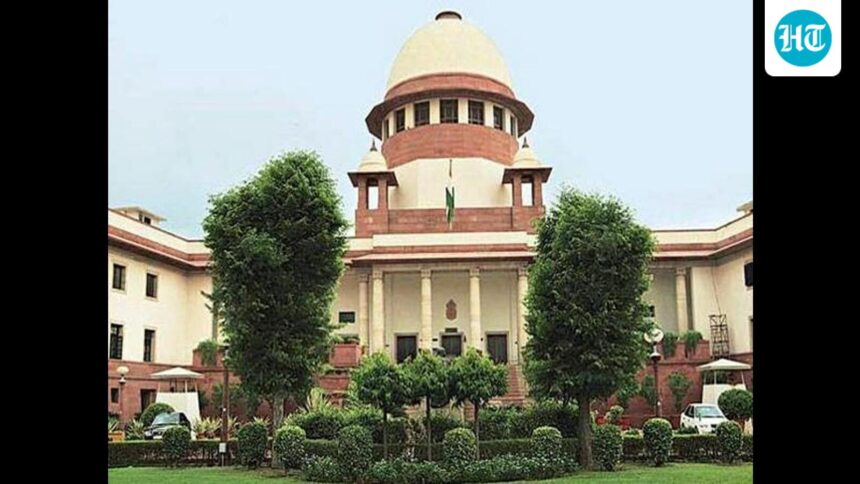
The Supreme Court on Monday accepted the Union government’s proposal to allow retired members and presidents of the court to continue for another six months as an interim arrangement, even as the Center said it was considering a law to govern future appointments to the court.

A bench headed by Chief Justice of India (CJI) Surya Kant passed the order on a batch of petitions filed by bar associations in various courts, raising concerns about the large number of vacancies that threaten to render these forums non-existent.
Public Prosecutor R Venkataramani, representing the Centre, told the court that a new law was being contemplated and would be presented in Parliament during the ongoing monsoon session. To ensure that the work of the courts is not affected, he proposed a one-time measure to allow all retiring chiefs and members of the courts to receive an extension of their term until September 8.
“We have evaluated all the courts to come up with this working arrangement. A bill is under consideration and it is likely to be introduced in the monsoon session,” he said. Until then, every person appointed under the TRA (Court Reforms Act, 2021) will continue.”
In November last year, the Supreme Court struck down key provisions of the TRA, including a standard four-year term for TRA members and a minimum joining age of 50 – measures the court found arbitrary and damaging to the independence of the judiciary.
“In view of the decision, in principle, taken to extend the tenure of the sitting chairpersons or members till September 8, 2026 or until they attain the maximum age limit prescribed under CRA 2021, we allow the Government of India to proceed accordingly,” the bench, also comprising Justice Joymalia Bagchi, said.
The court said that increasing the term of membership is not sufficient because legislative policy must include a mechanism to evaluate the performance of court members. “Why should an extension be granted when there is no mechanism to evaluate their performance? On the one hand, you cannot have courts operating under the control of the government because there will be interference. You also cannot put them under the control of the judiciary either,” he added.
On February 26, the court highlighted persistent dysfunction within the courts and pointed to instances where technical members allegedly did not write judgments, leaving judicial members to bear the burden. “There should be an immediate mechanism to hold these members accountable. If they are capable, they should continue to perform,” the bench noted, asking the Center to find a solution.
The Central Administrative Tribunal Bar Association, represented by senior advocate Sanjay Jain, said that in 2026, about 31 members will retire. He said the court’s previous rulings stipulated that the member should be given a five-year guarantee period. He added that a six-month extension is not a solution given the growing uncertainty regarding the work of the two courts.
The Attorney General said the Center was also concerned that the courts should not become non-functional.
Under the TRA, the maximum age for chairpersons is 70 years and for members 67 years. The Center also decided that if any chairpersons or members of the court continue under any interim order passed by the court, their tenure should also continue till September 8.