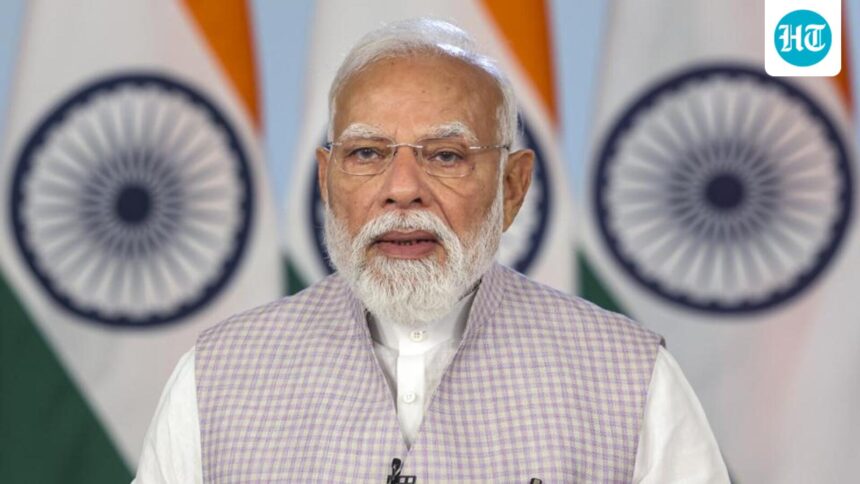
NEW DELHI: Fulfilling the aspirations of the people is not just a topic of discussion but the primary objective of the Union Budget presented by the government, Prime Minister Narendra Modi said on Monday, addressing a webinar on post-budget discussions.

The Prime Minister emphasized that sectors such as health, education, skills development, tourism, sports and culture are some of the areas that serve as a means to achieve people’s aspirations and made suggestions to enhance them.
The Ministry of Information and Broadcasting (MIB) organized the webinar titled “Sabka Saath, Sabka Vikas – Realizing People’s Aspirations: Education, Skills and University Cities”, in collaboration with the Ministry of Higher Education. It brought together policymakers, industry leaders, academia, startups and students to discuss implementation pathways to strengthen education, skills and creative economy ecosystem in India.
Noting that India has taken great strides in providing universal healthcare, the Prime Minister stressed how initiatives like telemedicine have made care accessible to those living in remote areas.
“The health sector has been strengthened. Ayushman Bharat Yojana and Arogya Mandirs have increased penetration of health services in rural areas. However, we need to focus on the care economy as well. As the number of senior citizens increases, the demand for caregivers will also rise. Therefore, there will be a need to develop new training models,” he said.
The Prime Minister said that there is a need to strengthen the training ecosystem and create more awareness.
“The mentality of young people has changed now…even in far-flung places they want to do something new – this is our biggest strength, and in order to stimulate that, we need updated approaches linked to the real global economic system,” he said.
The Prime Minister also called for accelerating the process of linking the education system to the real economy.
“The focus should be increased on artificial intelligence, automation, the digital economy and design-based manufacturing,” he said.
He suggested that academic institutions should develop their campuses in ways that would allow students to learn about the real world.
“Another important sector is STEM: science, technology, engineering and mathematics. It is encouraging to see that the daughters of our country have a keen interest in science, technology, engineering and mathematics. Today, when we talk about future technologies, it is important that no daughter is held back by lack of opportunities,” he said.
The Prime Minister also called for the creation of a research ecosystem in which young researchers get ample opportunities to work on new ideas.
Speaking about sports infrastructure, he said that in the past few years, the government has included sports in daily life to create a new ecosystem.
“Youth power only becomes a national power when they are healthy, disciplined and full of self-confidence. That is why, in the past few years, sports have been viewed as an important stream of national development,” he said.
“Initiatives like Khelo India have injected new energy into the country’s sports ecosystem. Sports infrastructure is being strengthened across the country,” he said.
He also called for focusing on creating tourism ecosystems with an emphasis on cleanliness and hospitality.