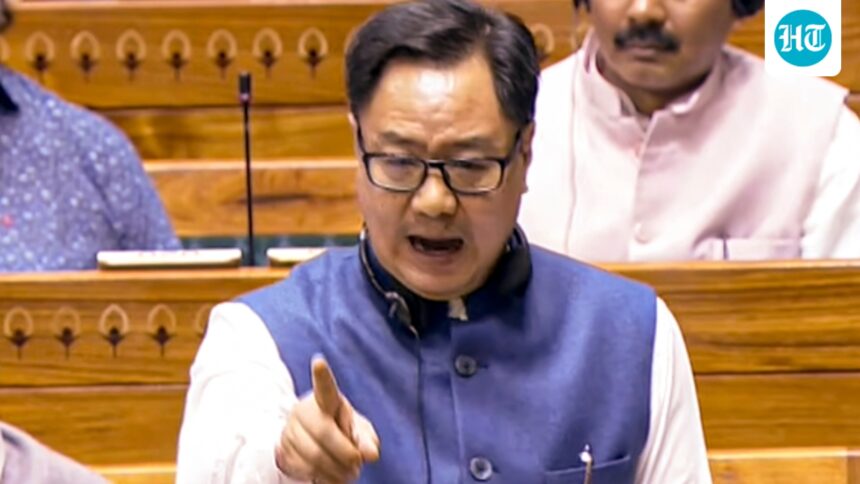
“I have never seen such a leader, who hugs the Prime Minister, then returns to his seat and winks at his fellow party MPs,” Rijiju said. Rahul, Modi were not present.

Congress MP Rahul Gandhi’s hug and wink entered the debate in Lok Sabha on Tuesday as Parliamentary Affairs Minister Kiren Rijiju cited previous instances of claiming that the Opposition leader is “not serious” in his behaviour.

“I have never seen such a leader who comes and hugs the Prime Minister and then returns to his seat and winks at his fellow party MPs (‘)Ankh marta hai“),” said Rijiju, speaking in Hindi. Rahul was not present, nor was Prime Minister Narendra Modi.
Rijiju was speaking against the no-confidence motion moved by the Congress-led opposition against Speaker Om Birla for his alleged biased behaviour.
The hug and wink he mentioned dates back to 2018, when Rahul Gandhi said he intended to “purge your hearts of hate, and kindle love instead,” describing the Congress as a “party for every Indian” and the BJP as a “divisive force.” At the time, the BJP slammed the gesture as “childish”, and it was later ridiculed by Prime Minister Modi as well, who awkwardly hugged Rahul and shook his hand.
Watch below: Hug moment video
Priyanka makes fun of Nehru’s mention
Rahul’s sister and fellow MP Priyanka Gandhi Vadra responded after Rijiju finished his speech. “They are unable to digest what the opposition leader (Rahul) is saying, because in the last 12 years (of Narendra Modi as Prime Minister), he was the only one who refused to bow down,” she said.
“They (MPs of the BJP-led NDA government) say I keep smiling when they talk. I smile and laugh because suddenly they are praising Jawaharlal Nehru – whom they are abusing – for his speech when a motion was moved against the then LS president (in the 1950s),” she added.
Rijiju had asked the Congress-led opposition to “at least remember” what Nehru said – a reference to his defense of the then Speaker of Parliament G V Mavalankar.
Read also | Motion of No Confidence against Om Birla by UP led by Rahul Gandhi: When Great-Grandfather Nehru defended Speaker of the House in 1954
A clip about the Mongol ruler
There was some poetry too. Rijiju ended his speech with a passage by Mukhtar Khairabadi, written in the context of the last Mughal ruler Bahadurshah Zafar before the British seized the throne of Delhi: “Na kisi ki aankh ka noor hun, na kisi ke dil ka qaraar hun; Jo kisi ki kaam na aa saki, mein woh ek misht-e-ghar hun“.
A rough translation shows that it is written in a fatalistic tone: “I am not the light of any eye, for me no one cares; I am of no use to anyone, I am just a scattered handful of dust.”
Earlier, responding to Congress leader Gaurav Gogoi’s assertion that Rahul Gandhi was not allowed to speak in the House, Rijiju had said: “The other day I was disturbed by the fact that the opposition MP said, ‘I don’t need anyone’s permission to speak in Parliament’. This is on record.”
In further mocking the opposition MPs amid the sloganeering, Rijiju said he had “no remedy” if someone believes he is “above the speaker” in the House. Accusing the Congress MPs of trying to “determine who will sit in the chair,” Rijiju added, “It is unfortunate that they want to steal this right (from the ruling party).”
As the debate on the no-confidence motion began, Congress member Gaurav Gogoi criticized Rijiju, saying: “In the future, when there is research on parliamentary records and looking at the texts, statistics will tell us that it was Kiren Rijiju who was the Minister of Parliamentary Affairs, who boycotted the opposition more than others.”
Defending Rijiju, Union Home Minister Amit Shah maintained that such interruptions are necessary only when someone does not adhere to parliamentary rules.
Union Home Minister Amit Shah will on Wednesday speak in the Lok Sabha during the debate on the motion seeking Om Birla’s removal from the post of Speaker of the Lok Sabha.
Birla has stayed away, and since there has been no Deputy Speaker since 2019, other senior NDA members have sat on the Lok Sabha management chair.
What is the essence of Oppn step?
At the heart of this conflict over Birla’s behaviour, which has since widened, is Rahul Gandhi’s flashback to an unpublished memoir titled ‘Four Stars of Destiny’ written by former Indian Army chief General MM Naravane.
During the first half of the Budget session, Rahul Gandhi cited excerpts from the manuscript, claiming that it “exposed” Prime Minister Modi’s failure to take responsibility during the 2020 border dispute with China.
The government said that referring to a manuscript that has not yet been approved by the Ministry of Defense is illegal and violates parliamentary rules. Defense Minister Rajnath Singh said the alleged contents were “incorrect” and the writer (Naravane) could have gone to court if he did not agree with the Defense Ministry, which has withheld its approval since at least 2023.

Arish Chhabra is an associate editor on the Hindustan Times online team, where he writes news reports and explanatory features, as well as overseeing the site’s coverage. His career spans nearly two decades across India’s most respected newsrooms in print, digital and broadcast. He has reported, written, and edited across formats—from breaking news and live election coverage, to analytical long-reads and cultural commentary—building a body of work that reflects editorial rigor and a deep curiosity about the community for which he writes. Areesh studied English Literature, Sociology and History along with Journalism at Punjab University in Chandigarh, and began his career in that city, eventually moving to Delhi. He is also the author of Little Big City: What Life is Like from Chandigarh, a collection of critical essays originally published as a weekly column in the Hindustan Times, which examines the culture and politics of a city that is much more than just its famous architecture – and in doing so, holds up a mirror to modern India. During his stints at BBC, The Indian Express, NDTV and Jagran New Media, he has worked across formats and languages; Mainly English, as well as Hindi and Punjabi. He was part of the crack team for the BBC Explainer project which was replicated around the world by the broadcaster. At Jagran, he developed editorial guides and trained journalists on integrity and quality content. He has also worked at the intersection of journalism and education. At the Indian School of Business (ISB) in Hyderabad, he developed a website to streamline academic research in management. At Bennett University’s Times School of Media in Noida, he taught students the craft of digital journalism: from newsgathering and writing to social media strategy and video storytelling. Having moved from small town to larger town to megalopolis for education and work, his intellectual passions lie at the intersection of society, politics, and popular culture—a perspective that guides his writing and worldview. When he’s not working, he’s constantly reading long-form journalism or watching cerebral content, sometimes both at the same time.Read more