India on Monday once again supported dialogue and diplomacy to end the Iran-US war, with External Affairs Minister S Jaishankar calling for de-escalation and restraint while emphasizing that the government is focused on the security of 10 million Indians living in West Asia and ensuring energy security and unhindered trade flows.

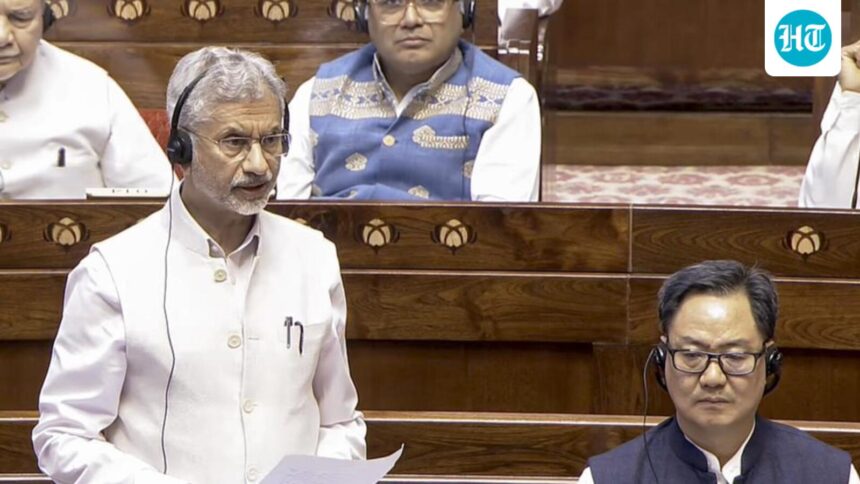
Jaishankar, who made a statement on the situation in West Asia in the Rajya Sabha, said the war that began on February 28 is a “cause for deep concern”, especially as hostilities continue to escalate and the security situation deteriorates significantly.
Jaishankar listed the factors guiding India’s approach and said that India supports peace and wants to return to dialogue and diplomacy. He added: “We call for stopping the escalation, restraint, and ensuring the safety of civilians.”
He added that India would work with regional governments to ensure the well-being and security of Indian citizens in the region, and that the country’s national interest, including energy security and trade flows, “will always be paramount.”
The government is also committed to ensuring the country’s energy security, taking into account the availability, costs and risks of energy markets. “For us, the interests of the Indian consumer have been and will always be the top priority. Wherever required, Indian diplomacy has supported the endeavors of our energy companies in this turbulent situation,” he said.
Oil prices rose to above $100 a barrel as a result of the fallout from the US-Israel war on Iran, surpassing that level for the first time since the Russian invasion of Ukraine in 2022. Fears of a long-term disruption to global energy supplies have also increased with Iran effectively closing the Strait of Hormuz, which is used to transport 50% of India’s oil imports. These developments have heightened concerns in India, the world’s second-largest buyer of crude oil, where about 85% of its needs are met through imports.
Another major concern for the government is the safety of the 10 million Indians living in West Asia, with more than eight million concentrated in Saudi Arabia and the United Arab Emirates, which have been targeted by Iranian missile and drone attacks.
“We believe and continue to believe that dialogue and diplomacy should continue to de-escalate tensions and address fundamental issues. It is also necessary to respect the sovereignty and territorial integrity of all countries in the region,” Jaishankar said.
“While any development that negatively impacts world peace and security is deeply concerning, this ongoing conflict is of particular concern to India. We are a neighboring region, and it is understood that we have clear interests in West Asia remaining stable and peaceful,” he said.
Trade between India and West Asian countries is worth nearly $200 billion annually, and there have been significant investments from the region in the Indian economy over the past decade. “Therefore, it is the serious disruptions in the supply chain and the climate of instability that we consider to be serious issues,” Jaishankar said.
Jaishankar said that as of Sunday, nearly 67,000 Indian nationals had returned from West Asia on commercial flights, including non-scheduled flights, after the partial opening of airspace. Indian airlines operated 15 inbound flights on 7 March, there were 49 flights on 8 March and 50 flights on 9 March.
Indian diplomats are assisting stranded transit passengers in hubs such as Dubai, Doha and Abu Dhabi and facilitating international border crossings, including from the UAE to Oman and from Qatar, Kuwait and Bahrain to Saudi Arabia.
“I want to assure the council that every effort is being made for those stranded in the area, those who are transit passengers…those who need to urgently return from this area, and we are making every effort for them to do so,” he said.
Jaishankar also expressed concern about attacks on commercial ships as Indian citizens constitute a large proportion of the crews of these ships. “We have unfortunately already lost two Indian sailors and another is still missing in such incidents,” he said, adding that shipping companies have been asked not to send Indian sailors to Iran.
He also spoke about the three Iranian warships that were in territorial waters in connection with an international fleet review and multi-nation exercise hosted by India last month, and said: “The Iranian side had requested permission on February 28 for three ships in the region to dock at our ports. This was granted on March 1.”
“The IRIS Lavan ship has already docked on March 4 in Kochi. The crew is currently at Indian naval facilities. We believe this was the right thing to do and the Iranian Foreign Minister expressed his country’s thanks for this humanitarian gesture,” Jaishankar added.
The IRIS Dena, one of the three warships, was torpedoed and sunk by a US submarine on March 4, while Sri Lankan authorities allowed the IRIS Booshehr to shelter in the country and house its 208 crew in a naval camp.
Giving a detailed summary of warnings issued by Indian embassies in Israel, Iran, UAE, Bahrain, Qatar, Kuwait and Saudi Arabia between February 28 and March 8, Jaihankar said the Ministry of External Affairs has set up a special monitoring room dedicated to monitoring the situation and responding to queries.
He added that while some Indian nationals in Iran responded to advice to leave the country, “many others” ignored them and remained there. The Indian Embassy facilitated the transfer of many Indian students in Tehran to places outside the capital, while their internal movement was facilitated for Indian pilgrims. He said that Indian nationals who were in Iran for business reasons were helped to cross into Armenia and return home.
Both Prime Minister Narendra Modi and he maintained close contacts with relevant stakeholders, Jaishankar said. Modi spoke to the President of the UAE, the Emir of Qatar, the Crown Prince of Saudi Arabia and Kuwait, the King of Bahrain and Jordan, the Sultan of Oman and the Prime Minister of Israel and received assurances that the welfare of Indian citizens would be the priority.
He added: “With regard to the United States, we have maintained regular contacts through diplomatic channels.” He added, “Despite the attempts that have been made, it is clear that contacts with Iran at the leadership level are difficult at this time. But I spoke with the Foreign Minister.” [Seyed Abbas] Araghchi on February 28 and March 5. We will continue these high-level conversations in the coming days.