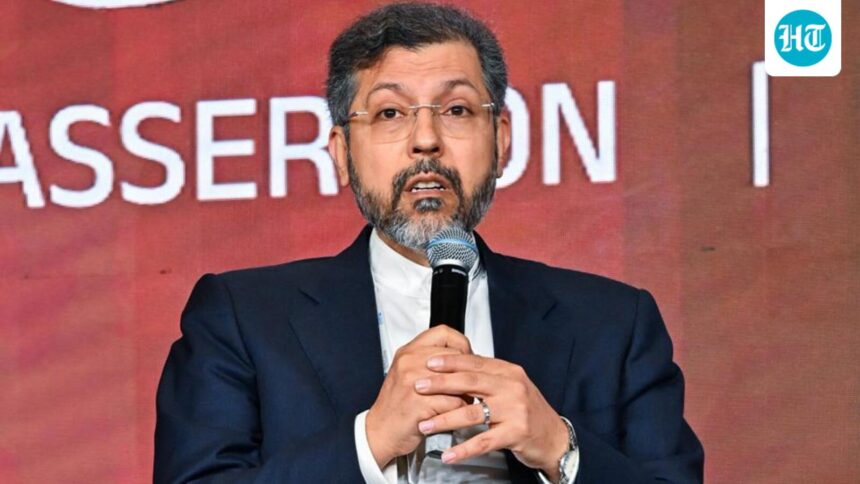
New Delhi:Iranian Deputy Foreign Minister Saeed Khatibzadeh said on Friday that the US sinking of an “unarmed” Iranian warship far from the combat zone cannot be allowed to pass “with impunity,” and Iran has no choice but to resist to the last soldier in the “existential war” that Israel and the United States started while negotiations were still ongoing.

Khatibzadeh, who arrived in India hours after a US submarine torpedoed and sank the frigate Iris Dena off the coast of Sri Lanka on Wednesday, insisted that the warship was in a non-combat configuration as it returned from a multi-nation exercise hosted by India.
“This is a very unfortunate accident. That ship was like that.” [here] Invited by our Indian friends…it was a celebration [event]“It was unarmed and the only precedent for that was in the Nazi era, when they attacked unarmed ships far from the combat zone,” Khatibzadeh told reporters on the sidelines of the Resina Dialogue.
He said: “The Americans were practicing the practices of Nazi Germany when they attacked a ceremonial, unarmed and unloaded ship… Many young Iranian sailors who attended this exercise lost their lives and those who did this cannot escape punishment.”
IRIS Dena participated in the international fleet review and multi-nation exercise hosted by India last month. Nearly 90 sailors were killed in the attack, which marked a significant expansion of the conflict between Iran and the United States beyond the Persian Gulf.
Khatibzadeh said that Iran’s priority is “final resistance against the aggressors.” He added: “We are under attack by the Americans and Israelis, and they are trying to inflict the greatest amount of damage on Iran… Tehran is under constant attack and we have no choice but to resist until the last bullet and until our last soldier.”
Khatibzada also met External Affairs Minister S Jaishankar on the sidelines of the Raisina Dialogue. Jaishankar posted a photo of the meeting on social media, but there was no official reading. Khatibzadeh told reporters: “I had a short meeting with the Foreign Minister of India… The important thing is that everyone supports international law, and we hope that we will not choose international law.”
While participating in a discussion on the situation in West Asia at the Raisina Dialogue, Khatibzadeh said that Iran has no choice but to resist after Israel and the United States launched attacks in the midst of negotiations over the Iranian nuclear program in Geneva last month. He added, “This is an existential war for Iran. They want to end Iran’s existence, and we are waging a heroic and nationalistic war to repel the aggressors.”
Khatibzadeh also sought to justify attacks by Iran on US bases in neighboring West Asian countries such as Jordan, Kuwait and the United Arab Emirates, a move that drew criticism from Arab countries. He added: “We have no choice but to strike the place from which the Americans’ attacks originate,” adding that the Iranian response aims to “put an end to their attacks.” [US] Its presence in the region.
“They don’t want to coexist with Iran, so this is what they get,” he said.
When journalists asked Khatibzadeh about a possible way out to end the hostilities, he said: “We are resisting. This is resistance to history, the region, the world, the principles of international law, morals and ethics… the moment they will win.” [Israel and the US] Stop the aggression, we will have a new dynamic in the region.”
Khatibzadeh criticized the United States for killing Iranian Supreme Leader Ali Khamenei, and told reporters: “The Americans assassinated the head of another country. If this is the new norm, then no one and no country on earth can establish normal diplomatic relations with other countries.”
In response to a question from journalists about India’s position on the West Asian crisis, he said that the two countries are linked by civilizational ties. “we [part of the] “Indo-Persian culture and civilization…we attach great importance to Iranian-Indian relations,” he said.
Khamenei was killed in military strikes by Israel and the United States on February 28, and India responded to the development on Thursday when Foreign Minister Vikram Misri visited the Iranian embassy to sign a book of condolence. India had earlier expressed its concern over the escalating tensions in West Asia and supported dialogue and diplomacy to find a solution.