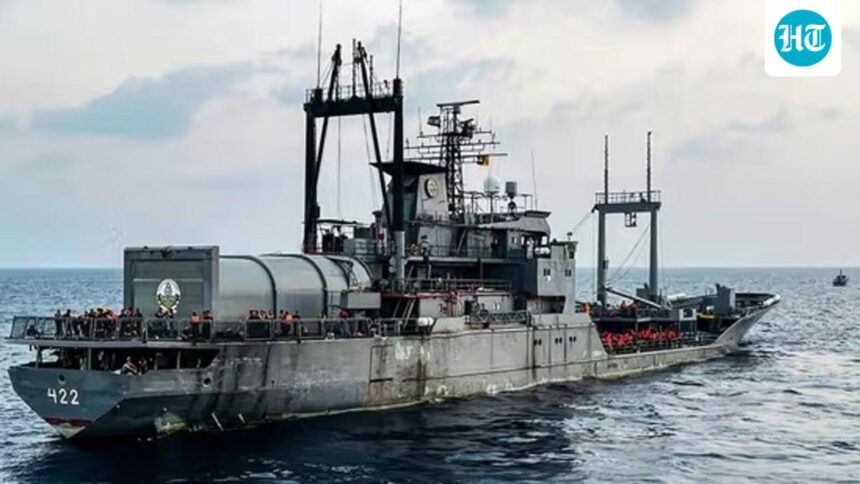
New Delhi: Government officials said on Friday that India allowed an Iranian warship to dock in the southern port of Kochi at the request of Tehran, and the ship’s 183 crew were accommodated in naval facilities, two days after an Iranian frigate was torpedoed and sunk by a US submarine near the coast of Sri Lanka.

The amphibious warship, IRIS Lavan, was in the region to participate in the international fleet review hosted by India last month. The ship docked in Kochi on Wednesday, the same day the frigate IRIS Dena sank about 19 nautical miles off the coast of Sri Lanka, killing 87 sailors and dramatically expanding the US-Iran conflict.
On Thursday, Sri Lankan authorities allowed another Iranian warship – the IRIS Booshehr – to take shelter in the country and house its 208 crew in a sea camp. IRIS Booshehr also participated in India’s international fleet review and requested permission to enter a Sri Lankan port after experiencing engine problems.
“Iran has contacted India to receive IRIS Lavan, which was in the region to review the international fleet, on February 28,” an official said, requesting anonymity. “The berthing was approved on March 1 and the IRIS Lavan docked in Kochi on March 4,” he said.
The request from the Iranian side indicated that the berthing in Kochi was “urgent” because IRIS Lavan faced “technical issues,” the officials said. They added that the 183 crew members of the warship were being accommodated at naval facilities in Kochi.
Sri Lankan President Anura Kumara Dissanayake said on Thursday that his country bears a “humanitarian responsibility” to receive the crew of the ship Iris Bushire, which will be transported to the port of Trincomalee on the east coast. “We have to understand that this is not a normal situation. It is a request from a ship belonging to a party to enter our port. We have to take this into account in accordance with international treaties and agreements,” he told reporters.
The sinking of the IRIS Dena has raised concerns in India, Sri Lanka and other countries in the Indian Ocean about the expanding scope of the Iran-US conflict and its impact on maritime trade in regional waters. People familiar with the matter described the Indian government’s handling of the crisis related to Iran, with which India has civilizational relations, and the United States, a crucial strategic partner, as “practical and realistic” and consistent with long-term national interests.
The Indian side was forced to achieve a delicate balance in its dealings with the matter, especially in the face of growing criticism from opposition parties, former diplomats and military leaders of New Delhi’s silence after the sinking of the Iranian frigate in India’s strategic backyard.
In this context, the people pointed to the one-month exemption granted by the US administration to India to continue purchasing Russian oil as part of efforts to ensure the country’s energy security against the backdrop of concerns about unrest resulting from Iran’s effective closure of the Strait of Hormuz, which is used to transport approximately 50% of India’s oil imports.
The people also pointed out that previous US administrations provided sanctions waivers so that India could buy oil from Iran. This included one taken by former Secretary of State Hillary Clinton in 2012 and another by former Secretary of State John Kerry in 2013. Both orders from US officials stated that the waivers were allowed after India “substantially reduced” the volume of its purchases of crude oil from Iran.