HBO’s non-fiction hit neighbor He presents a seemingly simple premise: What if you brought cameras into a community where two (or more) individuals were in the midst of a conflict, and followed both sides to the end point? That’s what friends and creators Harrison Fishman and Dylan Redford brought to their show initially, and they went on to direct all six episodes, but as they delved deeper into finding stories to tell with casting director Harley Shaw, larger themes began to emerge: about how society has changed since Covid. About what home ownership means today. About America.
Maybe that’s why the intriguing reality series, which launched as HBO Max’s biggest unscripted debut ever with 1.6 million viewers tuning in, seems to have struck such a chord. With an executive producing team that includes Marty Supreme Oscar nominees Josh Safdie, Eli Bush, and Ronald Bronstein, the series upends expectations of reality television by combining such scope with immersive and surprisingly sympathetic filmmaking—and some wild twists that can only be attributed to the uniqueness of human behavior.
Halfway through the show, Fishman, Redford, and Shaw joined Hollywood Reporter To illustrate how the show came to be – and how it only revealed itself to them as they embedded themselves in communities across the country.

Origin story
Harrison Fishman: My brother Sam started showing Dylan and I rags videos online, and this was right before the coronavirus. He started editing compilations with them, and then we got excited about them and started making fake videos about neighbor disputes to try to convince people that they were real, because we come from the world of making online videos and comedy videos and all that stuff. We hired actors and pretended to be neighbors.
Dylan Redford: We were making these fake neighbor videos in the pre-coronavirus era. Once Harrison and I were no longer living in the same place, and everyone was isolated and we were all on our phones all the time, the risks of online conflict suddenly became much greater and more real — like something a lot of Americans were consumed with because it was one of the few things you could do on your phone during 2020 and 2021, just watch people argue with each other in real life. Suddenly, the idea of people getting into viral confrontations and talking about Karens and all of that was part of the zeitgeist. This also made us think, well, “What if we followed these neighbors’ struggles in real life?”
Fishman: When we were actually doing the show, we started to realize more and more, “Wow, COVID has really ignited this thing.” There has been a lot of fire in our country, but specifically the way people interact and with the space they are given. All the things you learn about the country and the people just through this window – the end point of a neighborly dispute seems so innocuous, but it really opened the doors to learning about so many other things about our country.
Casting
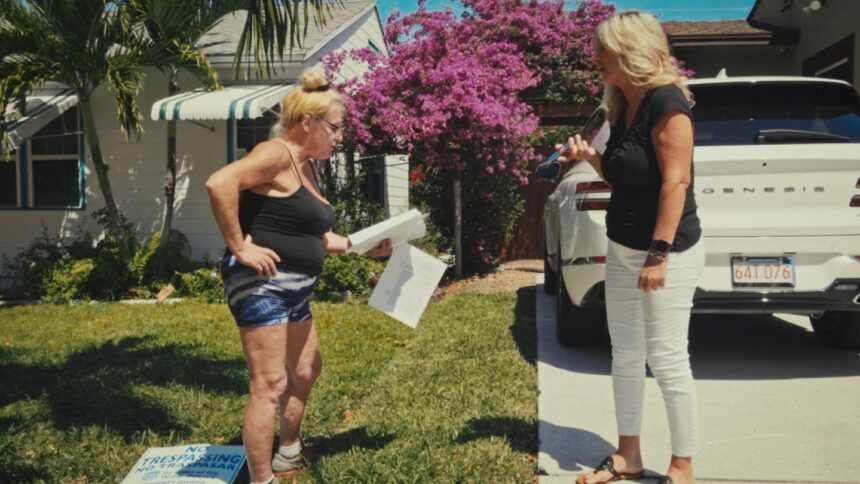
Harley Shaw: The pilot is actually the third episode, the one that takes place all in Florida. It was four years ago when we first connected with these people and those stories that required Harrison and I to show up and knock on doors to get the second side of both stories. There were so many doors we knocked on and spent time with that didn’t end up being on the show. As far as all the other stories go, they come from a wide network of places, and I had a great team working with me who were putting lines everywhere. We were looking through small claims [court]We were searching local Facebook groups, Craigslist, and social media. TikTok is where we found one.
Fishman: Entering into these conflicts is not easy, and it is not easy for these people. It’s the biggest thing in their lives, and it’s really controversial and requires a lot of listening. It was as if the staff and staff were just making phone calls – the hotline was for neighbors, from 8:00 AM to 10:00 PM every day, just talking to people about their problems.
what: It all involved very long phone calls and just listening to the neighbors argue and learning a lot about each individual we spoke to. If we couldn’t be there in person for budgetary reasons, to spend time with them and knock on their door, there were hours and hours of phone calls and Zooms that had to be made before they were okay with the guys going out there to document their conflicts.
Redford: The producers of the story had to be Swiss Army collaborators because they had to be essentially journalists and therapists. They had to listen to people on the phone and be able to hear them. They also had to be really intense researchers. They had to have a sense of humor. My sister Lena, who’s a story producer on the show – while she was going through the Facebook groups, she was also going through small claims files and talking to HOA leaders outside of the Facebook group. The skill set needed to find these stories and the team that Harley ran was insane. You had to understand the style of presentation, which is very distinct and kind of complex, and then you had to have all these basic practical skills.
Fishman: One of our favorite ways to find stories of these neighbor disputes was through local newspapers, because obviously it had gotten to the point where it was at least a big thing in the city, but not big enough to get to where it caught on or something.
Bets
Redford: The risks seem incredibly high, because in many cases they are We are Really high. Most of our neighbors on the show own their homes, and right now it’s very difficult to buy or pay for a home – just being a homeowner in the US right now is a very precarious situation for most people. What most people will say to a neighbor in conflict is like, “Well, why don’t you just move on?” This just isn’t an option for most people. It’s where all their life savings are tied up, sometimes generationally. They are struggling to keep their ancestral home.
Fishman: The paranoia in general across our show is big as well, because when you’re in conflict with anyone, it’s all-consuming — but especially when you’re in conflict with someone who lives right next door to you. It takes it up a notch.

Redford: It’s a small thing that starts out, but it carries this torrent of emotion and intensity even though it’s on top of a recycling bin. Both things can be true. That’s why the language around it becomes so big and so exaggerated — the most dramatic thing is to say, “I’m going to die for this.” There’s some drama that’s infused into the way people talk about their differences, because I think it’s also a way to gain empathy and connect with people about how important that is. We never felt that any of our people would do anything violent or hurt themselves or anyone else, but this language is very common.
what: It was an interesting thing to filter and decode in the selection process for all of us as well. We wanted to completely avoid things that would get really violent or get to that level of violence, but a lot of the stories from the people we talked to didn’t imply that. We had to ask: What is a rumor? What will actually reach this level? What sounds too bleak and raw?
Redford: Which [violent] Language is a way for people to take things seriously that most people would not take seriously. It’s a very effective way for their friends, family and the public to take it seriously, which on paper most people would think, “Why bother with that fence?”
Twists and turns
Redford: Often times we would watch things escalate. In episode three with Melissa and Victoria, you’ll get to watch things escalate in a unique way throughout the broader season. When we first got there, we knew they had a confrontation because we watched A cell phone video of them getting frustrated with each other. But while we were there, it was unexpected the intensity and the amount of arguments that they were constantly getting in the front corridor and then in mediation and other things.
Fishman: [Victoria angrily throwing Melissa’s potted plants out of her driveway] It’s the most surprising and shocking thing we’ve ever shot: it was a really energetic scene. Our whole show is about people saying bad things about each other all the time, but to see someone physically do something like that was absolutely wild and really showed how far Victoria was willing to go.
Redford: The way we’ve often thought about it is that one person is maybe emotionally wrong but actually wrong, and then another person is actually completely right, but maybe the way they’re handling it is disgusting and feels wrong. With Jan and Maris [in episode two]Jane has all those cats and the way it affects Maris on paper, and according to county laws and things like that – she could be wrong. But emotionally, she really loves cats and really cares about them, really wants to take care of them and has a really big heart and has taken care of them for a really long time. The measure of who is right is balanced around facts and emotions. That alchemy is the sweet spot for our show. It was something we really wanted to challenge with the way we structured and structured our episodes.
what: Those conversations were an integral part of the acting process. There were a lot of stories that came out that were clear that, “This side is the instigator and does bad things and is kind of beyond repair,” and we’re not going to pick on stories like that.
Redford: It was a conversation about: “Okay, can you understand where they’re both coming from?” We usually follow the story we all agreed upon. I mean it’s hard.
Fishman: We really start to love everyone we shoot with. The conflict itself often falls into the background. When you’re acting, obviously we try to look for different conflicts, but also as people they have to be interesting and compelling, and I mean, really interesting to shoot with. When we film, we don’t think: “Obviously one of these people is crazier than the other.” Because as Dylan was saying, emotionally they’re fine. Moreover, it is great to spend time with them. They are very interesting.

American story
Redford: Because we always had a neighbor conflict framework, it allowed us to get a deeper understanding of people as they were trying to solve a problem, or as they were trying to resolve a conflict, which made them feel more real and not just our little games. They have tons of agency. They make all these decisions themselves, and we are there to be there and document them. This allows us to enjoy who these people are.
Fishman: People being interesting and compelling and living such amazing lives outside of conflict ended up being more important. I don’t think anyone is going to watch our show and say, “I want to learn more about this patch of grass, or I want to learn more about this portal.” It’s really about the people.
Redford: We have a Halloween episode and that was something that we thought would be a really fun and interesting world to delve into. Harley and Lena worked together to try to find a story like this. There were some really targeted casting decisions. And then throughout the series itself, we were trying to make the season and the way the episodes were structured more familiar in terms of how a reality TV episode would be structured, and then push and challenge some of those things — so we could start to have a more cosmic relationship with the neighbors’ feud and harmony, but still within the theme. We can expand this definition of what a neighbor is and what it means. That was a big part of how we thought about the stories that were put together.
Fishman: From the beginning we were like “neighbor It has to be a mosaic of our country.’ There was a lot of criteria, ‘I don’t know if we can really do this show about America — we only have to do it on the East Coast because of our criteria.’ But it was very important for us to have a hand in every region, place and person.
—
neighbor New episodes air Friday nights on HBO and HBO Max.