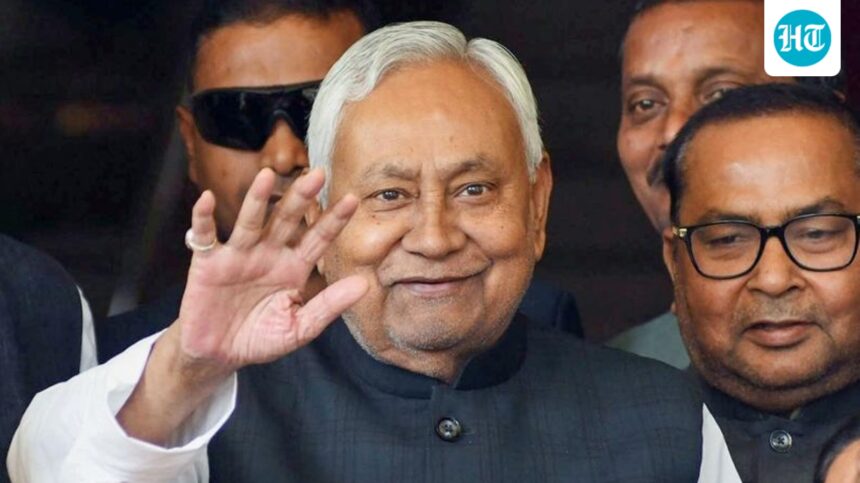
Nitish Kumar, Bihar’s longest-serving chief minister, filed his nomination papers for the Rajya Sabha on Thursday. This amounts to his effective resignation from the position of Chief Minister of the state. The next chief minister may be from the Bharatiya Janata Party (BJP), the senior partner of the National Democratic Alliance (NDA) in the state. Kumar’s transition as Chief Minister of Bihar is one of the most important milestones in the political history of the state since independence. What has more than 20 years of Nitish Kumar’s rule meant for the country, its politics, economy and society? Here are three graphs that answer this question.

Also Read: Nitish Kumar announces Rajya Sabha nomination, Bihar gets first BJP CM
HT’s database of Chief Ministers contains 23 unique Chief Ministers of Bihar starting from the first, Shri Krishna Sinha to Nitish Kumar. Kumar alone, during his 10 terms in office, spent 7,232 days as chief minister of the state (till March 5), which is 28% of the total working days of Bihar chief ministers. Even at the national level, Kumar’s personal days in office ranks third among chief ministers from major states (those with at least 10 Lok Sabha seats). The top two in this ranking are Odisha’s Naveen Patnaik (who served for 8,860 days) and West Bengal’s Jyoti Basu (who served for 8,534 days). (See chart 1)
Kumar’s political dominance in Bihar depended on an alliance of extremists
Nitish Kumar did not have a polarizing ideology like Hindutva or communism. He did not have a massive caste base like other Mandal politicians like Lalu Yadav, Mulayam Singh Yadav or Mayawati. His policy was based on the alchemy of reconciliation with a subtle variation of his predecessor Lalu Yadav’s formula for what was then a very formidable Muslim-Jaff mix. The NDA flourished under Kumar on the basis of an alliance of upper castes, lower OBCs and Dalits. The latter was neglected by Lalu’s politics. Previously, Lalu was alienated and dethroned. And this is where Kumar’s alliance with the BJP helped. His party, the Janata Dal (United), retained its social justice character while outsourcing primarily the upper caste to the BJP. This was most evident in the 2015 elections, when the JD(U) joined the ranks of the RJD, and the BJP was left with largely only upper caste support.
The dynamics of the alliance are evident in the caste composition of the Bihar Assembly which saw a significant increase in the representation of non-Yadav OBCs and upper-caste MLAs compared to the Lalu years. (See chart 2)
Poverty of Sushan (good governance) under Nitish Kumar
Although social engineering formed the basis of Nitish Kumar’s invincibility in the state, her rhetoric was always characterized by good governance. When Kumar took over as chief minister in 2005, standards of governance and development were very low. Law and order, roads and general economic growth were largely in disarray. The data speaks for itself.
Read also: The Sukhoi 30 plane that went missing after taking off from Jorhat, Assam, crashed 60 kilometers away, and the fate of the pilots is unknown
Bihar faced a lost decade and a half in terms of economic growth under the Lalu regime. Kumar has made a real difference here and Bihar is among the best performing states in terms of growth in the post-Nich era. But high growth has not made Biharis richer than their peers in the rest of the country. They remain among the poorest in terms of per capita GDP and average levels of consumption. Kumar’s recent election victory on the back of cash transfer to women in the state was the biggest evidence of the effectiveness of the upward mobility of accelerating growth in per capita GDP during his reign from 2005 to 2025. (See Chart 3).