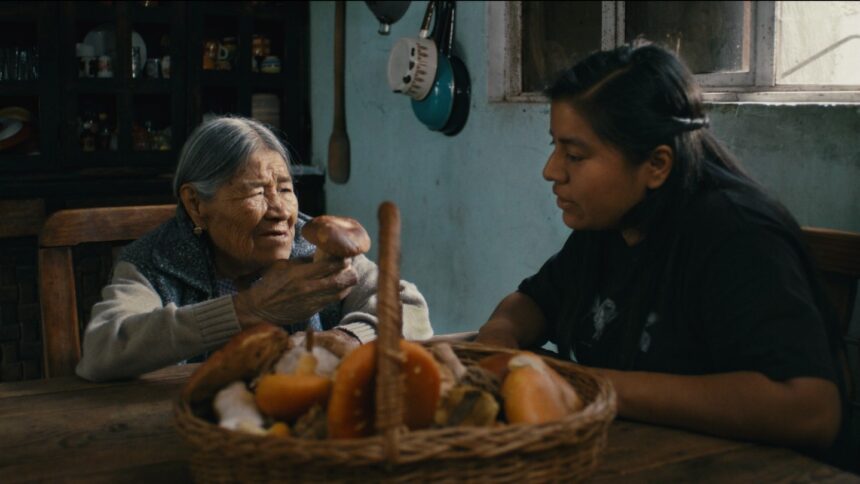
Deep in the jungles of Mexico, two indigenous mycologists, or experts on fungi, look to reconcile past and present, science fiction and ancient practices, as they reimagine the future for themselves and the changing world in which they live. Otilia Portillo Padua (Three votes) invites us on a triptych to join them in their explorations through her feature-length documentary Jungle girls.
The film makes its world premiere at the Copenhagen International Documentary Film Festival CPH:DOX on March 13 in the DOX:Award Main Competition section, followed later that day by its North American premiere in the Visions section of SXSW in Austin, Texas. The aerial documentary from Oscura Producciones and Sandbox Films is co-executive produced by Argentinian actress Mia Maestro.
The film’s main voices are Elisette and Giulietta, two young scientifically trained mycologists with one foot in modern science and the other in their families’ indigenous ways of seeing nature and themselves.
“Jungle girls It is a story of entanglements: between humans and mushrooms; “The visible and the invisible, the knowledge of generations and modern science,” highlights the summary. “This immersive science fiction documentary takes us on an unexpected, sometimes meditative journey of exploration to reconsider the perceptions and experiences of both humans and non-humans in our world.”
The CPH:DOX website promises: “With elements of science fiction and sensory immersion in the wonders of nature, it is an experience of the rarest and finest kind. It is a story of ecological coexistence, but also a report from a world threatened by deforestation and human arrogance.”
Produced by Paula Arroyo, Elena Fortes and Portillo Padua. Jungle girls Featuring cinematography by Martin Puig, music by Hannah Bell, and sound design by Javier Ompérez.
Lorenzo Mora Salazar is the editor.
“Mushroom hunters often say that mushrooms find you. In my case, mushrooms found me just as I was looking for ways to confront the apocalyptic narratives of the present,” Portillo Padua said in a statement to the outlet. “The apocalyptic story is one we know all too well. It slaps us in the face every time we turn on the news or look at our phones: genocide, mass extinctions, climate emergencies, an arc of history that seems to bend toward fascism. And our present increasingly resembles a science-fiction dystopia. If we want to imagine other possible futures, we must imagine other kinds of stories. This film starts with listening to the fungus.” “They suggest that there is a renewal in the death and decay that we humans have become accustomed to fearing,” she offers.

The director pursued her goal of creating a “cinema of interdisciplinary alliances,” in this case, “a collaboration between foragers, indigenous communities, scientists, filmmakers, artists, and mycologists.”
says Portillo Padua THR This is a book by Ursula K. Le Guin The carrier bag theory in fictionwhich redefines technology as a cultural transmission bag, inspired the film. “This story began with questions rather than answers—with Ursula K. Le Guin’s idea of the carrier bag, and the mysteries it contains: what’s inside it, and who’s carrying it,” she shares. “We want to take the audience on an unexpected journey, one that invites them to listen and experience the world around them in a completely different way.”
Pointing out that the film uses an “innate lens,” producer Arroyo echoes this. “We want to invite the audience to be guided by the mushroom and its female allies through a story of cooperation between humans and non-humans – a woven web of interdependence,” she highlights.
Producer Fortes, founder of Fiascocrafts, also emphasizes the goal of changing conventions through a feminine lens. “We set out to change the way we tend to experience and navigate the world with this film,” she says. “At its heart stands a woman carrying a basket, spreading germs and knowledge – a bastion of resistance and renewal. In contrast to the man wielding a sword, ravaging the land and claiming it, she reclaims and reimagines the future. In collaboration with the beings with whom she shares her world, she cultivates possibilities, rooted not in domination, but in reciprocity, renewal, and care.”
Executive producer Caitlin May Burke, head of production and development at Sandbox Films, sees the film as a perfect fit with the company’s mission of “expanding perspectives,” saying it “challenges a single or linear path of knowledge, embracing the interconnectedness of academic learning, generations and cultures in gaining understanding of our natural world.”
Executive producer Maxine Franklin adds: “By weaving together ancestral knowledge and science, Otilia’s broad, visionary direction invites us to see the world in alternative ways.”
Maestro shares how the audio and visual elements of the film are brought together in the production Jungle girls An extraordinary sensory experience. “Otilia has made a film of rare artistic skill – as mysterious as the kingdom of Funja itself,” she says. “Through poignant, evocative images and richly layered sound design, it weaves together science and Indigenous knowledge, revealing them not as opposing forces but as wisdom traditions moving side by side.”
Are you ready to join the director to explore whether what you’re seeing and hearing is a talking mushroom? Or just curious about a trippy cinematic journey? Whatever your motivation, you can check out an exclusive trailer for it Jungle girls here.