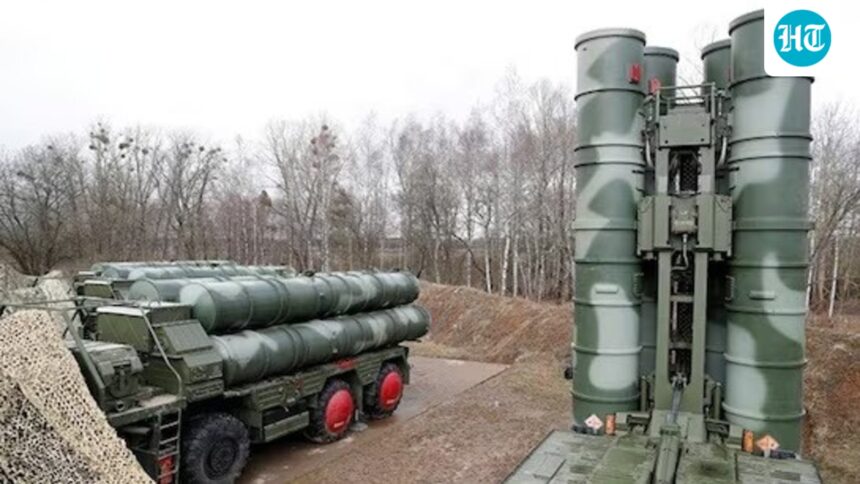
New Delhi: The Defense Procurement Board (DPB) on Monday approved the Indian Air Force’s (IAF) proposal to buy five more S-400 air defense systems from Russia, according to people familiar with the matter – a move that comes as West Asia witnesses a conflict dominated by ballistic missiles and drones.

The Council, headed by Defense Minister Rajesh Kumar Singh, has accepted the IAF’s proposal which will now be referred to the Defense Acquisition Council (DAC) headed by Defense Minister Rajnath Singh for Acceptance of Necessity (AoN).
Only after the DAC awards the AoN, will a cost negotiation committee be formed to determine the price of the new acquisition before the matter is given the final green signal by the Inter-Cabinet Committee on Security (CCS) through the Ministry of Finance.
India currently has three S-400 systems and two more are expected to be inducted into the Indian Armed Forces this year. The S-400 system performed admirably during Operation Sindoor, ensuring that Pakistani fighters, airborne warning aircraft and electronic intelligence aircraft did not take to the skies on May 10 when India bombed enemy air bases, air defense radars and command control systems.
Read also | India: The spread of the Iran-US war to the Middle East raises “great concern”
Early in the morning of 10 May 2025, an Indian BrahMos strike destroyed the Pakistan Air Force’s (PAF) Northern Command and Control Network at Chaklala Air Base in Rawalpindi. Pakistan sued for peace soon after.
The Defense Ministry is now awaiting the Indian Air Force and Indian Army’s offer to purchase 13 Russian Pantsir S-1 self-propelled missile systems, which counter medium-range surface-to-air missiles, short-range missiles and kamikaze drones, the people cited above added. While 10 Pantsir systems will be procured by the Indian Air Force to protect the 10 S-400 systems that the Indian Armed Forces will eventually acquire, three will be procured by the Army to handle cruise missiles, attack helicopters, loitering munitions, armed drones and short-range rockets and missiles on the border.
Although the modalities for the acquisition of the S-400 will be negotiated, HT has learned that all five systems will be purchased outright with MRO being undertaken by Indian private sector players.
Another route will be followed in the case of Pantsir – there will be an initial direct procurement under the fast track route but some systems will be manufactured in India by private companies as the requirements are urgent.
The Pantsir system is currently being used by UAE forces – proven effective in its ability to shoot Iranian kamikaze drones out of the sky.
India’s size, the presence of adversaries on its western and northern borders, and its 11,000 km of coastline mean that the country needs advanced air defense systems not only to counter enemy fighters and bombers beyond visual range, but also to neutralize ballistic missiles. The coastline is now 11,000 kilometers long according to the government, which updated the figure from 7,500 two years ago.
The ongoing war between Iran and the United States has highlighted the need for anti-ballistic missile systems globally due to the proliferation of long-range Chinese missiles in the Indian subcontinent and West Asia. Apart from this, Türkiye is supplying low-cost suicide drones and loitering munitions to Pakistan, Iran, Azerbaijan, Maldives and Bangladesh with the strategy of saturation bombing of the enemy.