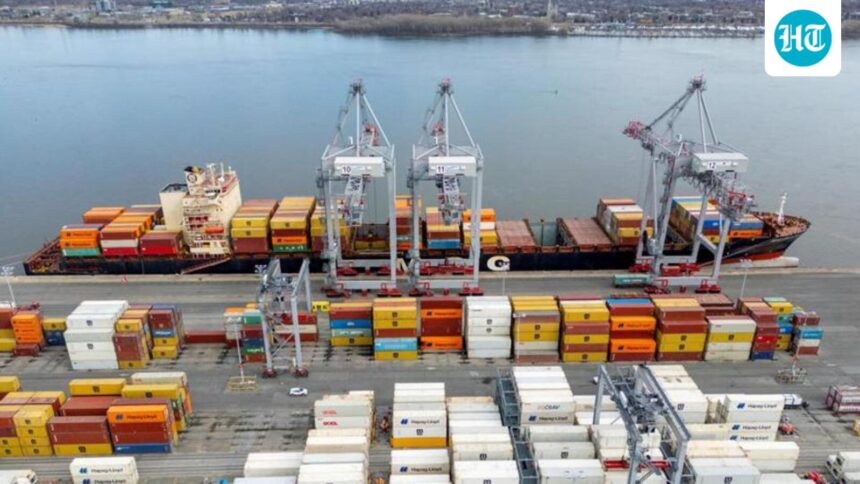
Barely days after the announcement of this year’s Union Budget $10,000-crore plan to build shipping containers Union Ministers Sarbananda Sonowal and Ashwini Vaishnao oversaw the signing of an agreement between five national companies and ports to manufacture one million twenty-foot equivalent units (TEUs) in the next 10 years.

With such investments, a quiet race is underway at 12 major ports and a new port under construction along India’s 7,500 km coastline to end China’s near monopoly on shipbuilding and commercial containers, the bedrock of modern sea shipping lines.
The ambition is to make the country one of the top five shipbuilding nations, with a gross registered tonnage (GRT) of four million tons per year by 2047, the deadline set by the country to become an advanced economy. The country also plans to add 1,000 Indian-made flag bearers by 2036.
Read also:Prime Minister Modi says relations between India and Canada have been “energised” as Mark Carney makes maiden visit
Over 95% of India’s foreign trade volume is transported by sea, underscoring the importance of ports and ships. batch, with a total investment of approx $4 lakh crore, is part of the government’s efforts to expand maritime infrastructure, secure maritime trade and reduce dependence on foreign-made vessels in a sector currently dominated by China.
Besides, state oil companies are working with the Shipping Corporation of India on a plan to buy locally made crude oil tankers to replace India’s aging fleet chartered from abroad. The long-term goal is to have 112 ships by 2047 for a total cost of 112 ships. $Rs 85,000 crore, a shipping ministry official said.
“India’s shipbuilding sector creates a strong economic impact; each investment boosts jobs 6.4 times and returns capital 1.8 times, demonstrating its potential to drive growth and development,” the Ministry of Shipping’s note on India’s Sagarmala (Offshore) Initiative said.
In September last year, the Federal Cabinet approved the largest single investment plan, worth… $Rs 69,726 crore, to enhance long-term financing, encourage development of new and built shipyards, and support technical capabilities. It included an extension of the US$1.5 billion shipbuilding financial assistance program $24,736 crore till March 2036.
“We have made significant progress in growing the maritime sector towards achieving the goal of FEXIT Bharat as per the vision of Prime Minister Narendra Modi. India is poised to be among the top five shipbuilding nations in the world by 2047,” said Union Shipping and Ports Minister Sarbananda Sonowal.
However, India currently produces less than 1% of the world’s commercial ships, and manufacturing costs are higher than global averages in a sector rife with financing challenges. To facilitate access to finance, policies now offer 15% assistance to vessels below this value $100 Crores financing and 20% for ships of above value $100 Crores. Separately, eligible shipbuilders will receive access to a $Interest incentive fund worth Rs 5,000 crore.
However, experts say the country’s maritime ambitions will require more than just viability gap financing and capital support. India will need to cut domestic manufacturing costs, especially raw materials such as specialty steel, boost private investments and build a global certification ecosystem if it is to capture global markets and compete with China, said Dharma Rajan of e-Port Logistics.
Officials say the government aims to build a strong ecosystem, not just provide support, and the strategy of initially pumping in public investments to attract the private sector is gradually bearing fruit.
In December last year, South Korean shipping major HD Hyundai struck a deal with Tamil Nadu state to build a new shipyard in Thoothukudi (Tuticorin), favoring the state over Gujarat and Andhra Pradesh. Earlier that year in February, a subsidiary of the South Korean company delivered a 600-ton Goliath crane to Cochin Shipbuilding Corporation, India’s largest state-owned shipbuilder, enhancing its cargo handling capacity.
Officials also point to an overhaul of India’s maritime legal framework, with a record five new laws passed last year to make ports efficient, which could push their share of GDP to more than 18%, according to state-run think tank Niti Aayog.