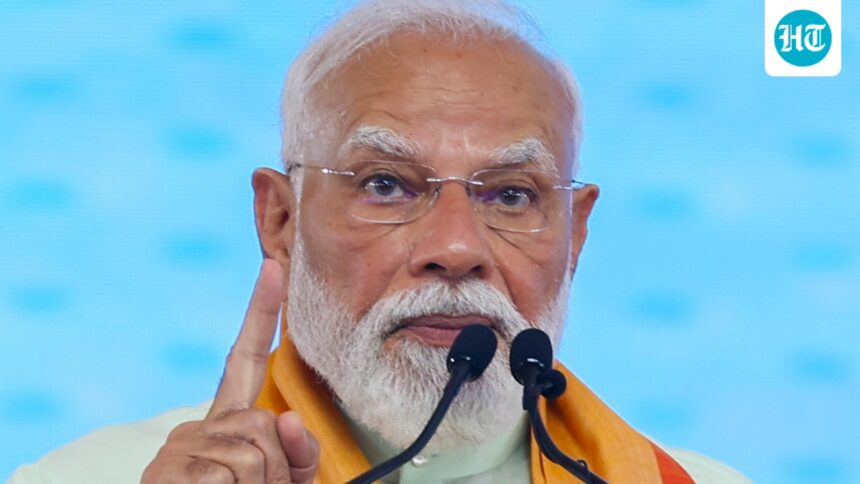
In light of the conflict in the Middle East sparked by US-Israeli strikes on Iran, Indian Prime Minister Narendra Modi will chair a meeting of the Cabinet Committee on Security (CCS) on his return to Delhi on Sunday evening, HT has learnt.

“He is expected to land in Delhi after a two-day tour at around 930 pm,” a person aware of the developments said. The Prime Minister was in Tamil Nadu to inaugurate some projects earlier in the day.
The focus of the meeting will be on developments in Iran. Indians stranded in the UAE and other parts of the Middle East; And related developments, further learning.
Prime Minister Modi traveled to Israel on February 25 and 26, a visit marked by great diplomatic warmth.
In his speech before the Knesset in the Israeli parliament, in a first of its kind for any Indian leader, Modi received a warm welcome after he declared that “India stands by Israel firmly, and with complete conviction, at this moment and beyond.”
Prime Minister Benjamin Netanyahu responded in kind, saying: “You are a great friend of Israel, Narendra. You are more than a friend. You are a brother.”
The two countries signed 16 agreements – covering artificial intelligence, defence, agriculture, energy and cultural exchange – and elevated their relations to a special strategic partnership.
India regarding the US-Iranian conflict
India’s Ministry of External Affairs issued a statement on Saturday saying the country was “deeply concerned” about the conflict situation, and urged all parties to “exercise restraint, avoid escalation and prioritize the safety of civilians.” She added that “dialogue and diplomacy should continue to calm tensions and address fundamental issues,” and that “the sovereignty and territorial integrity of all countries must be respected.”
External Affairs Minister S Jaishankar spoke separately by phone with Iranian Foreign Minister Seyed Abbas Araqchi and his Israeli counterpart Gideon Saar. After the call with Araqchi, Jaishankar said that he “shares India’s deep concern about the recent developments in Iran and the region.” After speaking with Saar, he said he reiterated India’s “call for dialogue and diplomacy to calm tensions.”
Indian embassies in Tehran, Tel Aviv, Abu Dhabi, and Damascus issued advisories on February 28 asking Indian citizens to avoid non-essential travel, keep travel documents ready, register on the Madad portal, and follow local security guidelines.
India also advised its nationals in Iran, Israel, Jordan, Qatar, the United Arab Emirates and Palestine to exercise utmost caution and vigilance.
New Delhi did not immediately consider evacuating Indian nationals from any country in the region, given that the airspace was closed and dangerous.
Nearly 10,000 Indian citizens live and work in Iran, while the number in the West Asia and Middle East region is about 9.6 million.
The Middle East Airlines said that Indian missions across the region are in constant contact with citizens and help lines have been activated.