

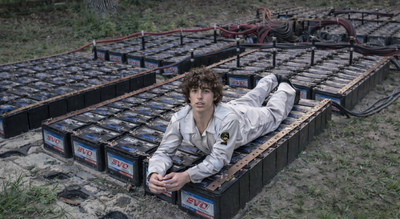
Drake Anthony Sterobero experiments with 400 car batteries that unleash extreme currents of up to 160,000 amps in his backyard/Photo: YouTube
A YouTuber known for building massive lasers and experimenting with high-voltage equipment is back with a long-awaited project: connecting 400 car batteries together to explore what happens when an intense electrical current is released outside a laboratory environment. Drake “StyroPyro” Anthony, a chemist who describes himself as a “professional mad scientist” and “science geek,” spent two months assembling the system, using more than 1,000 pounds of copper wire and creating a custom switch capable of handling currents exceeding 150,000 amps. He claims that the result is unlike anything he has photographed before.
From 100 batteries to 400
Anthony had previously demonstrated the capabilities of 100 series-connected car batteries, and had been touting for years that he would expand the scope of the project.
The new video delivers on that promise, quadrupling the number of batteries in an experiment driven, as he puts it, by curiosity and a desire to explore “the physics of extreme currents.” While the common setup runs at a relatively modest 65 volts, the current is enormous. At peak performance, the Anthony regularly exceeds 150,000 amps, with some estimates putting the total potential output above 160,000 amps. To illustrate, he explains at one point that “one shot from these batteries is worth the equivalent of lightning bolts fired by an entire thunderstorm.”
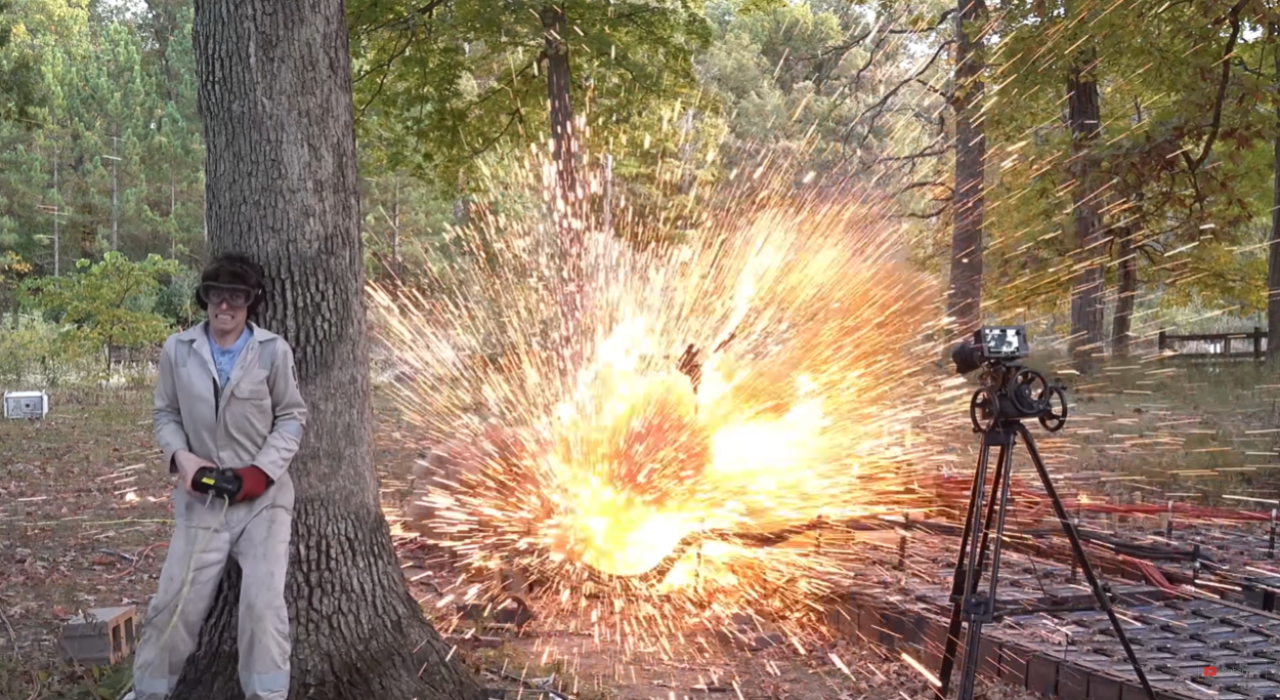
Drake Anthony Sterobero used 400 car batteries to melt metal, deform pipes, and cause a massive ferrofluid explosion/Photo: YouTube
He also claims that the system can outperform natural phenomena in some other way. “With these batteries, I can draw electrical currents much further than a typical lightning strike, and for much longer periods as well,” he says. “I can guarantee you that this video will be unlike anything you’ve ever seen.” The project required custom engineering from the ground up. No commercially available transformer could handle such a current, forcing Anthony to build his own heavy-duty switching mechanism using extensive copper components.
Why car batteries and not capacitors?
Given the amount of current involved, some viewers may expect capacitors to be used. Anthony addressed that directly. “When it comes to producing huge currents, most people think of capacitors,” he said. “But interestingly, car batteries don’t lag far behind in terms of maximum currents. The benefit of car batteries is that they can put out those currents for a much longer period than a short pulse.” This continuous discharge capability has become central to the demonstrations.
Anthony describes the project as working on scales “like the ones you find at the national laboratory,” albeit conducted in his backyard. “The purpose of this video is to explore the physics of extreme currents,” he explains. “I’m talking about the metrics you find at the national lab, but since this is all in my backyard, I’ll have a little fun with it.
To be honest, a lot of this will just be me putting random things between contacts to see what happens.
Metal melting and magnetic force
The results are exciting. Placing a small steel rod between the switch’s contacts causes it to glow intensely before vaporizing in a blinding flash. Anthony shows how concentrated energy can deform metal tubes, although early attempts result in completely destroying the tube rather than precisely bending it. Using magnetic pulses, he eventually succeeded in deforming and then destroying the tube. It tests a range of materials including titanium, tungsten, bismuth and copper, each of which produces violent reactions and, in many cases, explosive effects. Despite the scale of the currents involved, Anthony insists he approaches the work carefully. “I know this must be the most ironic thing I’ve ever said, but I don’t approach anything potentially dangerous without fully understanding and mitigating the risks involved,” he says. Even a single car battery can cause serious damage “if you get it wrong enough,” he adds, acknowledging the absurdity of the need to warn viewers against repeating the experiment. Anthony’s relationship with YouTube has been fraught in the past, with some videos being canceled or removed, and at one point his channel appeared to be in danger of being shut down. The extremism of his projects has led to an ongoing joke among fans who comment on new uploads that they are happy to see him still alive. At the beginning of the 400 Battery video, Anthony addresses this perception head-on, explaining that he’s “not a risk taker.”
Conclusion of ferrofluids
Eventually, Anthony pours ferrofluid into the experimental setup, creating a massive fireball-like explosion that he later describes as “the most amazing thing I have ever photographed.” “Within a tenth of a second, the ferrofluid platter almost completely impacted the tube while the total circuit power rose to more than 10 million watts,” he explains. The resulting explosion, although small compared to industrial explosions, elicits cinematic comparisons for viewers.
Remarkably, 400 car batteries remained intact after the explosion and could still be used for other purposes, underscoring the controlled nature of the demonstration despite its spectacle.
400 car batteries connected together!!
Anthony, whose previous video titles include “Building a Death Machine Using Soviet Military Technology” and “The 200-Watt Laser Bazooka I Made at Home!!!!”, continues to push the boundaries of what high-voltage experiments look like in the age of social media. His latest project may fall firmly into the “don’t try this at home” realm, but it also serves as a stunning demonstration of just how much power can be extracted from something as common as a car battery when stretched to the max.