Alejandro Jodorowsky never believed in artistic limits. “No art is better than another,” he told me when we spoke recently, moving seamlessly between French, Spanish and English. “Theatre, literature, cinema, they are all paths.” At 95 years old, this Chilean-born polymath still resists easy definition: surrealist filmmaker, playwright, mime, comics engineer, poet, and mystic. Calling him a director seems reductive. Calling him a cult figure ignores the extent of his influence.
His 1970 acid western El Topo It ignited the midnight movie phenomenon in the United States, with John Lennon among its heroes. “He understood my work,” Jodorowsky says of Lennon. “He liked it.” Holy mountain (1973) remains one of the most daring visual experiments ever seen on screen. His adaptation is not made of Sand dunes — which enlisted the biggest science fiction artists of the era including H.R. Giger, Moebius and Salvador Dali — became one of cinema’s most legendary projects, seeding ideas that would spread across modern science fiction.
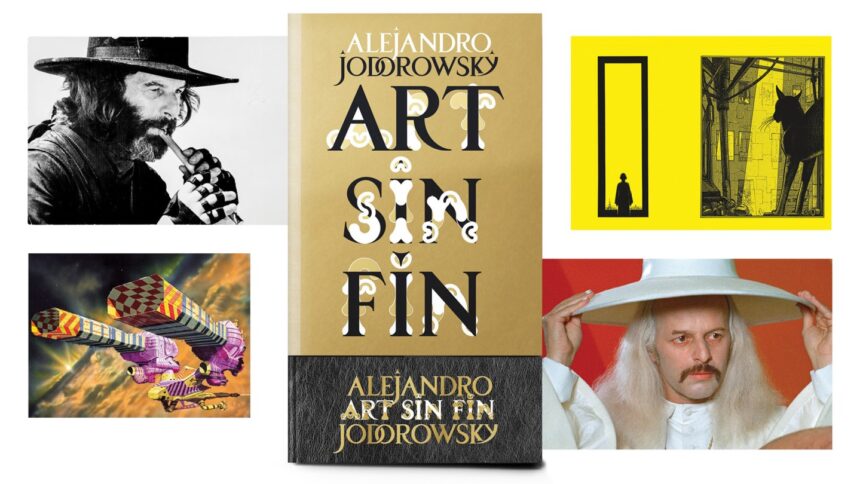
Now Jodorowsky has put together what may be his most impressive creation to date: Alejandro Jodorowsky. Art sin fena massive two-volume publication from Taschen that weighs 26 pounds and arrives in a sculpted glass case. The collection is part retrospective, part declarative, drawing from more than 70 years of archival material. It is less a book than an artifact.


The first volume is a visual torrent: spreads, film stills, performance documents, comic art, collages and rare photographs personally selected and arranged by Jodorowsky. “It’s made of pieces,” he explains. “Poetic pieces. They form a unit.” Instead of following a chronology, he constructs what he calls a “sensory narrative,” selecting images “one by one” to create something new from the past.
Volume Two serves as an audio commentary for Volume One, collecting his thoughts and confessions about each image. In philosophical prose, mischievous and direct, he reworks his own mythology. “Cinema is another form of expression,” he says. “But I prefer creation.” He has written more than 100 books and worked in theater and comics, but insists he has no preferred medium. “I want to be an artist. Voilà.”

©1973 ABKCO Films, INC./Courtesy of Taschen

Our fascinating conversation goes from his early work with Marcel Marceau to the dreams that inspired him Holy mountain. “I wanted to make something that felt like a dream dictated to me,” he says. Even unfinished projects retain an emotional charge. To see the latest versions of Sand dunesHe shrugs gently. “Every artist creates his own interpretation.”
True to his belief in cycles, Art sin fen It ends not with a late-career triumph, but with a photo of Jodorowsky when he was 6 months old. “The end is the beginning,” he says. “It’s a cycle.” In that gesture lies the essence of the book’s ambition: not a museum piece, but a renewal. For an artist who has spent his life breaking down the distance between art and life, this director’s cut is both a recapitulation and a new evocation.

This story appeared in the February 23 issue of The Hollywood Reporter magazine. Click here to subscribe.