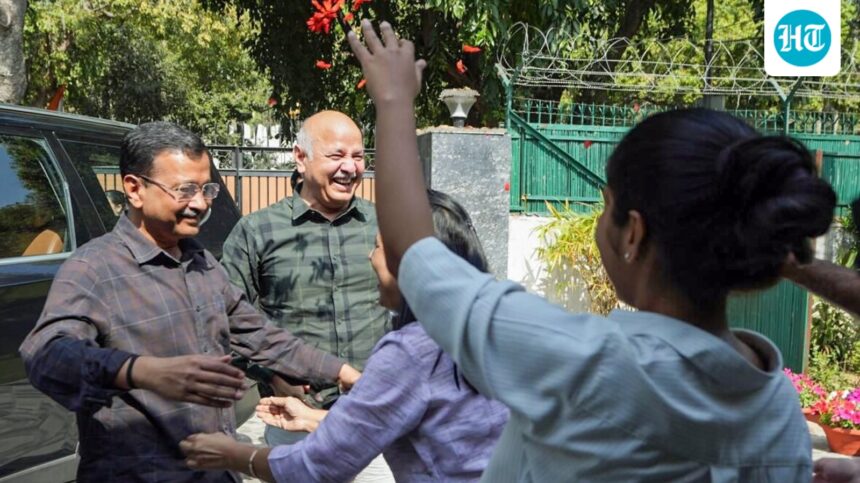
A Delhi court on Friday, while discharging former Delhi chief minister Arvind Kejriwal and 22 others in the RBI tax policy case, made sharp remarks about the probe agency itself, questioning its decision to classify an alleged group of liquor businessmen from south India as the “south group” in its charge sheet.

The court even pointed to a case in the United States where the court objected to the use of a regional marker – in that case “Dominican” to refer to alleged drug traffickers who happened to be from the Dominican Republic.
What the court said about the use of the territorial mark
“The court finds it necessary to place on record its concern over the repeated and deliberate use of the phrase ‘southern group’ by the investigating agency to describe a group of accused persons, ostensibly on the basis of their regional origin or place of residence,” the order passed by Special Judge Jitinder Singh of the Ross Avenue court said.
The judge also commented verbally: “If the same charge sheet had been filed in a court in Chennai, it would have been considered insulting.”
“Such a designation has no basis in law, does not conform to any legal classification, and is completely alien to the legal framework governing criminal liability,” the order said.
There is no benefit to the “Nordic group,” notes the judge
The subsection titled “Use of the phrase ‘Southern group’” also said: “Equally important is that no similar regional description was used for the remaining defendants; The prosecution’s account does not mention any “Northern group” or similar classification. Thus, the selective adoption of a geographically specific designation is clearly arbitrary and unjustified.”
The court noted that “the concern is not limited to semantics.”
He added, “Area-based labeling carries an avoidable tinge and is capable of creating a prejudicial impression. It detracts from the well-established requirement that criminal proceedings must remain impartial, evidence-centered, and insulated from extraneous considerations.”
The court noted that this expression had been used repeatedly in successive indictments, and “for this limited reason alone, the court was forced to refer to it while summarizing and analyzing the prosecution’s case.”
But the court noted that “in a constitutional system based on equality before the law and the unity and integrity of the nation, descriptions rooted in regional identity serve no legitimate purpose in investigation or prosecution, and are clearly inappropriate.”
She also added: “However, this reference cannot be construed as approval or endorsement of the term itself. The continued use of this label, despite the absence of any sustainable legal basis, carries a real risk of coloring perception, causing unintended bias, and diverting focus from the evidentiary material.”
Reference to the case of the United States
In making its view on the use of such labels, the court cited a case from the United States (United States v. Cabrera) from 2000, in which the US Court of Appeals for the Seventh Circuit “treated the case as relating to the roots of a fair criminal trial.”
The US court “went so far as to set aside the conviction itself due to the repeated use of identity-based terminology…as such identity had no bearing on the elements of the crime,” the Delhi court’s order said.
It cited the US court’s comments: “The court registered its disagreement in no uncertain terms: ‘The government’s repeated references to the defendants as “Dominican drug traffickers” were inappropriate. The racial or national origin of the accused has no relation to proving the elements of the crime. Such references invite the jury to draw impermissible inferences based on nationality rather than the evidence, and they risk being challenged by bias rather than reason.”
The court also said prosecutors had previously also been warned “that injecting race into a criminal trial, when it has no bearing on the issues at hand, is a mistake.” “Criminal trials should be about what the defendant did, not who the defendant is.”
What is the “Southern Group” or “Southern Lobby”?
The “Southern group” – or “Southern lobby”, as it was variously referred to in CBI and Enforcement Directorate (ED) documents – was the name given to a group of liquor businessmen, mostly from South India, who the agencies alleged paid bribes to key Aam Aadmi Party (AAP) leaders in exchange for preferential treatment under Delhi’s 2021-22 excise policy.
The agencies alleged that the money was channeled through hawala transactions and shell companies, which ultimately led to funding the RJD’s election campaign in Goa.
K Kavitha, Telangana Jagruthi Party president and daughter of former chief minister K Chandrasekhar Rao, was among the people named in connection with this alleged group. A prominent name from one of the southern states, she was arrested by the Emergency Department in March 2024 and spent months in detention before being released on bail.
On Friday, she was also released by the court.
The ED alleged that Kavitha was a key link between the so-called southern group and the AAP leadership, alleging that a conspiracy was hatched at her residence in Delhi. The agency claimed that the liquor businessmen, through Kavitha’s alleged facilitation, “agreed to pay”. $100 crore as commission to AAP for benefits not accrued under the policy.
The label is under scrutiny
Kavitha’s lawyer, Nitish Rana, pointed out after the release order was issued that the court and the judge objected to the use of the term referring to “the South”.
The release order was comprehensive in its dismissal of the CBI case. The court found “no evidence at all” against the accused to support the prosecution’s evidence, concluding that “the case does not survive judicial scrutiny.” She pointed out “misleading expectations in the indictment” and noted that it contains “many loopholes that do not support the evidence,” HT reported.
The court also criticized the agency’s reliance on consent statements, warning that using a pardoned defendant to fill investigative holes and rope in additional people is constitutionally improper.
Describing the entire incident as “part of a political vendetta,” Kavitha said: “Who will be held accountable for the time I wasted with my children, and who will be held accountable for the time I wasted with my family?”
Kavitha’s lawyer said the separate ED case looks set to be affected: “Once the original offense is dropped, the money laundering case cannot be further pursued.”
The CBI decided to go to the Delhi High Court against the Ross Avenue court decision.
Kejriwal also received support from the chief minister of the southern state of Tamil Nadu, where elections are scheduled to be held soon.
“The BJP government should not mortgage the integrity of investigative agencies for short-term politics,” CM MK Stalin, a prominent anti-BJP voice from the opposition ranks, said on Channel X. He praised Kejriwal and Sisodia for “standing firm through it all and letting the truth speak for itself.”