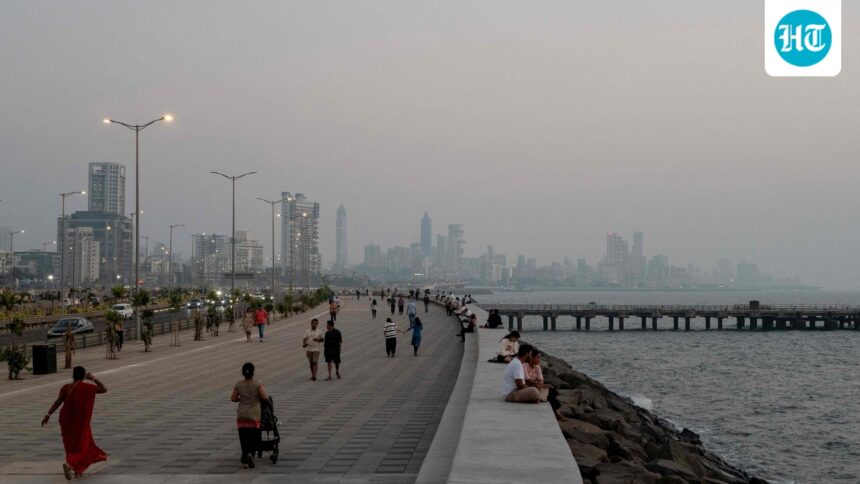
Mumbai has been witnessing a rise in air pollution levels recently, which has been increasingly linked to widespread construction and infrastructure activity across the city.

Mumbai’s overall air quality index stood at 113 as of Thursday morning, according to… Aqi.inWhich puts the air quality in the “poor” category. Several areas were in the ‘unhealthy’ category such as Borivali East, Borivali West, Chauri Wadi, Kandivali East, Lois Wadi, Malad West, Om Siddhivinayak Society and Sarvodaya Nagar, with Mithchoki and Mirachi Nagar Valley in the ‘dangerous’ category with AQI score above 200.
However, data available on the website of the Central Pollution Control Board (CPCB) showed that Borivali East in Mumbai recorded an ‘satisfactory’ AQI of 67, while Ghatkopar also remained in the same category with an AQI of 88. Kandivali East recorded an AQI of 65, followed by Malad West at 73, both rated as ‘satisfactory’. In contrast, Shivaji Nagar reported relatively worse conditions, with AQI slipping into the “moderate” category at 101 (CPCB).
Read also | $Budget of Rs 80,952 crore”>BMC reveals record figure $Budget of Rs 80,952 crore
According to the air quality bulletin issued by the Indian Institute of Tropical Meteorology (IITM) in Mumbai, the air quality is expected to be in the “moderate” category between February 26 and 27.
Environment Minister Pankaja Munde said that no adverse health effects have been officially recorded among vulnerable groups such as children and the elderly despite these fluctuations, news agency PTI reported.
However, health concerns are increasing. Findings from the Maharashtra Health Department’s screening campaign showed that high levels of pollution in Mumbai contribute significantly to lung cancer, which accounts for 57 per cent of the cases diagnosed, the Legislative Council was informed.
Delhi comparison: Air quality is poor
In comparison, air quality levels in Delhi remained much worse. According to IITM, the overall AQI in the national capital stood at 201. Data released by the Central Pollution Control Board showed that Anand Vihar recorded ‘very poor’ air quality with an AQI of 307, while Dwarka Sector 8 remained in the ‘poor’ category at 214. However, Aya Nagar fared comparatively better, recording a ‘moderate’ AQI of 151 (CPCB).
Read also | High pollution levels in Mumbai contribute significantly to lung cancer: Maharashtra government
According to Aqi.inDelhi saw an overall Air Quality Index (AQI) of 190, in the ‘unhealthy’ category with only two areas under the ‘moderate’ and ‘poor’ categories, while the rest were in the ‘unhealthy’ and ‘severe’ categories. Four areas witnessed “severe” air quality – Aya Nagar Extension, Gunti, Mayur Vihar station and Pandav Nagar – where the air quality index crossed 300.
What is the government doing to contain pollution in Mumbai
During a discussion in the Maharashtra Legislative Assembly, CM Devendra Fadnavis said air quality cannot be effectively monitored without advanced technology and directed the Brihanmumbai Municipal Corporation (BMC) to develop a dynamic pollution tracking system based on artificial intelligence (AI) and Internet of Things (IoT) to identify sources of pollution in real time.
The issue was raised by MLC Anil Parab, who pointed out pollution hotspots like Kherwadi in Bandra and cited construction dust from buildings and infrastructure projects as a major contributor, according to a PTI report.
Stop-work and compliance notifications for sensors
The Maharashtra government has intensified enforcement action against polluting construction sites, with more than 1,000 projects issued stop work notices for violating environmental norms, Environment Minister Pankaja Munde told the association, according to PTI. Between October 2025 and January 2026, authorities issued 1,981 review notices and 1,047 stop-work orders under the Clean Air Initiative.
Read also | Minister: More than 1,000 construction sites in Mumbai have served stop work notices
Official data shows that 1,952 of Mumbai’s 2,224 active construction sites, nearly 88 per cent, had installed low-cost air quality sensors as of January. The government also deployed 126 water tankers and 25 spray machines to wash more than 14,400 kilometers of the city’s roads to reduce dust pollution.
(With inputs from PTI and ANI)