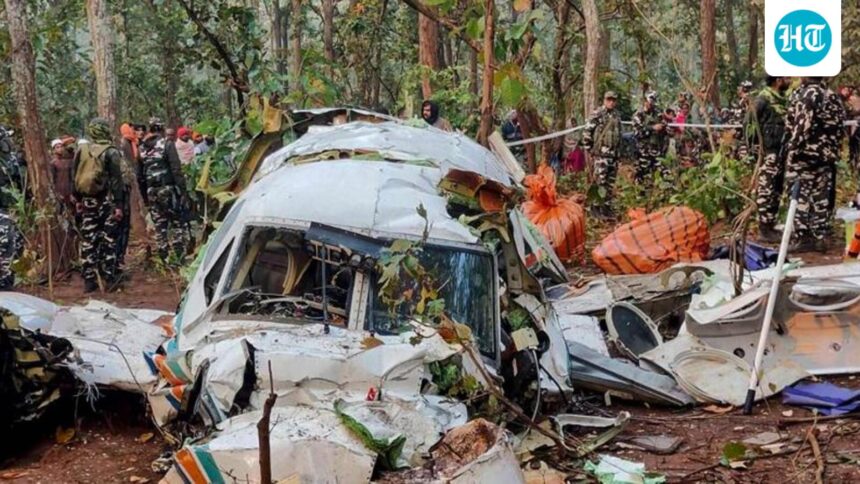
The plane that crashed near Ranchi in Jharkhand, killing all seven people on board, was a 39-year-old Beechcraft with more than 6,600 flight hours, officials familiar with the matter told HT.

The seven-seater plane crashed in Jharkhand’s Chatra district on the night of February 23 while on a medical evacuation flight from Ranchi to Delhi.
The dead include patient Sanjay Kumar, 41, a doctor, a paramedic and two attendants, pilot Vivek Vikash Bhagat, who had about 1,400 flight hours, and First Officer Savrajdeep Singh, who had more than 450 flight hours.
“The aircraft, a Beechcraft C90A (King Air) twin-turboprop, registered VT-AJV and manufactured in 1987, was operated by Redbird Airways and had accumulated approximately 6,610 hours of airframe time at the time of the accident,” an official said.
Read also: What led to the air ambulance crash in Ranchi-Delhi? Officials reveal possible cause
“It was powered by P&W PT6A-21 engines and logged approximately 2,900 hours on the left engine and 2,800 hours on the right engine,” he added.
“Both the helicopters have completed around 2,500 hours and the last Airworthiness Review Certificate (ARC) was issued on January 21 this year and was valid for a year,” another official said.
The plane departed Ranchi’s Birsa Munda airport at around 7:11 pm for Delhi’s Indira Gandhi International Airport (IGIA).
According to a second official, the crew sought a change in weather shortly after takeoff.
“Contact and radar were lost about 23 minutes after departure. The plane later crashed in a forest area near Semaria in Chatra district,” he added.
The maximum take-off weight of the crashed plane was 4,583 kg and it did not have a black color, for example. It did not have a cockpit voice recorder (CVR) and digital flight data recorder (DFDR).
“In this aircraft, the CVR and FDR were not fitted as per CAR (Civil Aviation Requirements). The first Certificate of Airworthiness (C of A) for the aircraft was issued in 1987. There was no mandatory regulatory requirement for fitting of CVR or FDR at the time of its original certification,” said another official.
Read also:Air ambulance crash in Jharkhand: Family brought together $8 lakh to transport the burn victim to Delhi
The regulatory provision for the FDR, in accordance with the CAR, (Section 2, Series I, Part V, Paragraph 4.1.2) which states for general aviation aircraft states that “All multi-engined turboprop aircraft with a maximum certified take-off mass of 5,700 kg or less and for which an individual certificate of airworthiness was first issued on or after 1 January 1990 must be equipped with an FDR which must record at least the first 16 parameters listed in Table 1 of Appendix I.”
The word “shall” in taxis certainly implies a mandate while the word “should” is optional.