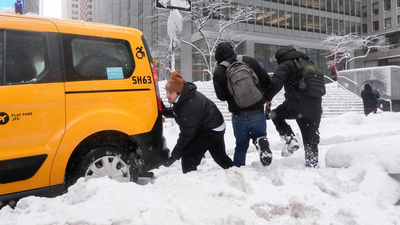
A man tries to push a taxi stuck in the snow during a blizzard (Photo/AP)
A massive winter storm hit the northeastern United States on Monday, bringing airports to a near standstill, disrupting public transportation, closing schools and leaving hundreds of thousands of people without power.
The storm, which meteorologists described as the strongest in a decade, dumped record snowfall across New York, Boston, Rhode Island and surrounding states, creating dangerous conditions and prompting a state of emergency to be declared.
Flights were disrupted across major hubs
The storm caused widespread flight cancellations. More than 10,000 flights had been canceled as of Tuesday, with airports in New York, New Jersey, Boston and Philadelphia seeing the highest number of flight cancellations, according to ABC News, citing FlightAware data.
Almost all arrivals and departures have been suspended at major airports including Kennedy, LaGuardia, Newark Liberty International and Boston Logan. At LaGuardia, 98% of flights have been cancelled, while more than 90% of operations have been suspended at Kennedy and Newark, according to the New York Times. Nationally, cancellations affected approximately 1 in 5 flights, a stark contrast to the typical daily cancellations of 1%. Airlines including American, Delta, Southwest, United and JetBlue have suspended operations in major hubs in the Northeast.
Travel waivers have been issued, allowing travelers to rebook without fees or requesting a refund under Department for Transport rules.“Delta teams are in close contact with local airport authorities as they focus on significant snow removal, and we will safely resume flights as soon as weather and airport conditions allow,” a Delta spokesperson said. “Our top priority is the safety of our customers and crew,” JetBlue added.
Snow storm breaks records and halts transportation
Meteorologists described Monday’s storm as a “classic bomb cyclone/Noreaster,” which forms when Arctic air collides with warmer coastal air, dumping heavy, wet snow over the region.A bomb cyclone is a fast-intensity storm that forms when atmospheric pressure drops sharply within 24 hours. This rapid strengthening fuels hurricane-force winds, heavy snow, ice, and flooding rain.Central Park in New York City recorded 19 inches of snow, while Warwick, Rhode Island, received 3 feet of snow.
Nantucket saw wind gusts up to 83 mph, with a tornado blowing across Cape Cod.
Public transportation was severely affected. New York City’s subway and commuter rail lines experienced delays and Long Island Railroad services were suspended. NJ Transit has suspended bus, rail and light rail operations. The Port Authority of New York and New Jersey has discontinued AirTrain services at Kennedy Airport, replacing the trains with shuttle buses.
Delivery services, including DoorDash, have also temporarily suspended operations.
Power outages and emergency response
The storm caused widespread power outages, leaving more than 500,000 utility customers across the East Coast without power, according to PowerOutage.us. The authorities in New York, Philadelphia and many states declared a state of emergency. Outreach workers sought to help vulnerable residents, including directing homeless residents to shelters and warming centers, according to the Associated Press. Schools were closed in New York City and Boston, with Philadelphia shifting to online learning. Mayor Zahran Mamdani announced that classes would resume on Tuesday, urging students to “stay comfortable.” Officials warned that fallen trees and power lines, caused by strong winds and heavy snow, could prolong the power outage.
Despite the unrest, some residents and tourists embraced the snowy conditions.
In lower Manhattan, snow shovelers outnumbered office occupants, while tourists danced in Times Square amid falling snow. Central Park and neighborhood streets became temporary play and exercise areas, as people milled about on an “old school” snow day for the first time in six years.Historic sites and cultural institutions, including New York’s Museum of Modern Art and Arlington National Cemetery, were closed due to hazardous conditions.
In Connecticut, crews at the Mystic Seaport Museum manually removed snow from historic ships to prevent damage to the machinery.“Winds like that, combined with heavy, wet snow, are a recipe for tree damage and prolonged power outages,” said Bryce Williams, a meteorologist in Boston. “That’s what we’re most concerned about, is the combination of those extreme amounts of snow with those winds.”