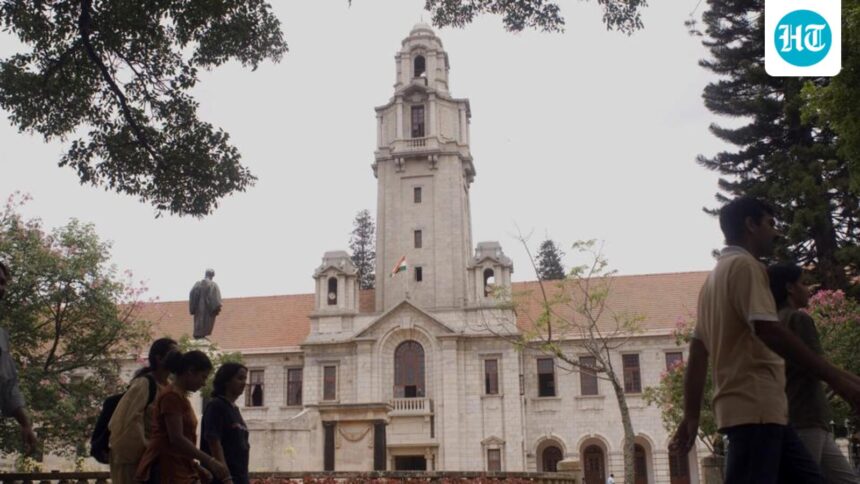
On March 7, the Indian Institute of Science (IISc) will host its much-anticipated annual Open Day, a day when the general public will be welcomed into the hallowed halls of the 117-year-old research institute and, through lectures, live experiments, demonstrations and exhibitions, showcase the cutting-edge, socially and industrially impactful research in which its 40 departments are currently engaged.

India’s first true example of a public-private partnership—in this case, between the institute’s promoter, the Bombay-based industrialist and philanthropist J. N. Tata, who pledged a significant portion of his personal fortune to the cause, the philanthropist Maharaja Nalvadi Krishnaraja Wadiyar, who made a grant of just over 370 acres of land in Bangalore, and the colonial government, which provided the remaining funds after it had taken a very long time to clear them. Paperworks – The International Institute of Science (IISc) continues to occupy the top position among scientific research institutes in India. Although strictly adhering to G. N. Tata’s instructions, the institute never officially bore his name, the memory of his generosity lives on; Old-time Bengalureans – and motorists – still refer to it as the Tata Institute.
The institute’s first cohort of 24 students, who joined two years after its official opening in May 1909, had a choice between only four departments – three under general and applied chemistry, and one in electrical technology.
Advances in industrial, agricultural, and medical fields – plastics, fertilizers, antibiotics – ensured the popularity of chemistry, but the choice may also have been a matter of personal taste, experience, and networks; The institute’s first director was the famous British chemist Maurice Travers, who worked with Nobel Prize winner Sir William Ramsay in discovering rare gases such as xenon, neon and krypton. As for electrical technology, since electricity supplies all industries with energy, it had an immediate and equal priority.
The year 1909 proved to be hugely significant for Mysore on another front – native son Mokshagundam Visvesvaraya (Sir MV – knighted 1915), India’s first civil engineer, returned home after a brilliant international career to take up the post of Chief Engineer of Mysore State. In 1913, embodying his deep commitment to industrialization, he founded the School of Mechanical Engineering in Bangalore which in 1917 became the Government Engineering College (today, Visvesvaraya University College of Engineering), the first college of its kind in a princely state. In the same year, as Diwan of Mysore, Sir MV was nominated to the Board of Directors of the IISc, where he steered the Institute away from pure research towards applied research.
This critical path would lead to IISc’s investigations into setting up at least six factories across India, including a bamboo straw board factory in Bangalore, over the next five years. Three of these factories would have a major impact on Mysore’s fortunes.
In 1914, when World War I ensured that the lucrative export of sandalwood to Europe ceased, it was the Institute of Islamic Studies that came up with the technology of extracting oil from sandalwood, enabling the establishment of sandal oil factories in Bangalore and Mysore. The process of incorporating this intoxicating oil into a beloved product – Mysore Sandal Soap – was a contribution from the IISc. The historic Mysore soap factory is still thriving a century later, but has little chance of fading from public memory; It is now a metro station on the Green Line.
Decades later, as its first chief justice (1937-47), Sir MV continued to guide the fortunes of the Institute – and Mysore -. On his recommendation, the Institute established the Department of Aeronautical Engineering in 1942, to take advantage of another wartime opportunity – the repair of American warplanes in the Indo-Burma theater of World War II, at the recently founded Hindustan Aircraft Company Limited in Bangalore.
Once Sir MV and IISc, working in tandem, open the first gates of industrialisation, there will be no looking back for Mysore.
(Rupa Pai is a writer who has had a long-lasting love affair with her hometown of Bengaluru)