WASHINGTON: President Donald Trump has told advisers that if diplomacy or an initial targeted U.S. attack doesn’t get Iran to give in to his demands to give up its nuclear program, he will consider a much larger attack in the coming months aimed at removing that country’s leaders from power, people familiar with the administration’s internal deliberations said. Negotiators from the United States and Iran are scheduled to meet in Geneva on Thursday in what appear to be last-minute negotiations to avoid a military conflict. But Trump was considering options for American action if the negotiations failed. Although no final decisions have been made, Trump is leaning toward launching a first strike in the coming days with the aim of proving to Iran’s leaders that they should be willing to agree to give up the ability to make a nuclear weapon, the advisers said. The targets under consideration range from the headquarters of Iran’s Revolutionary Guard to the country’s nuclear sites to its ballistic missile program. Trump told his advisers that if these steps failed to convince Iran to meet his demands, he would leave open the possibility of a military attack later this year aimed at helping oust Ayatollah Ali Khamenei, the supreme leader. There are doubts even within the administration about whether this goal can be achieved through air strikes alone.
Behind the scenes, both sides are considering a new proposal that would create a way out of the military conflict: a very limited nuclear enrichment program that Iran could only implement for the purposes of medical research and treatments. It is unclear whether either side will agree. But the last-minute proposal comes as two aircraft carrier strike groups and dozens of fighter jets, bombers and refueling planes are now gathering within striking distance of Iran. Trump discussed plans to strike Iran in the White House Situation Room on Wednesday. The meeting included Vice President J.D. Vance; Secretary of State Marco Rubio; Gen. Dan Kaine, Chairman of the Joint Chiefs of Staff; CIA Director John Ratcliffe; and Susie Wells, White House chief of staff. This article is based on conversations with several U.S. officials with knowledge of the meeting — including officials with different views on the best course of action.
None of them allowed their names to be used, citing the sensitivity of discussions regarding military operations and intelligence assessments. During the meeting, Trump pressed Cain and Ratcliffe for comment on the broader strategy in Iran, but neither official generally defended a specific policy position. Keane discussed what the army could do operationally, while Ratcliffe preferred to discuss the current situation on the ground and the likely outcomes of the proposed operations. During discussions about the operation last month to capture Venezuelan President Nicolas Maduro, Caine told Trump there was a high probability of success. But Kaine was unable to offer the same reassurances to Trump during discussions on Iran, largely because it is a much more difficult target. Vance, who has long called for greater restraint in military action abroad, did not oppose an air strike, but he was intensely skeptical of Keane and Ratcliffe in the meeting.
He pressed them to share their views on options and wanted to further discuss the risks and complexities of carrying out a strike against Iran. Earlier, the United States was considering options that include deploying teams of special operations forces on the ground that could carry out raids to destroy Iranian nuclear or missile facilities. This included manufacturing and enrichment operations buried underground, outside the scope of American conventional munitions. But any such raid would be extremely dangerous, as it would require special operations forces to remain on the ground much longer than they were in the raid to capture Maduro. For now, plans for a commando raid have been shelved, several US officials said. Army, Navy and Air Force officials have also raised concerns about the impact that a prolonged war with Iran, or remaining on standby for such a conflict, could have on the readiness of Navy ships, the Patriot’s scarce anti-missile defenses, and overstretched transport and surveillance aircraft. The White House declined to comment on Trump’s decision. “The media may continue to speculate on the president’s thinking all they want, but only President Trump knows what he may or may not do,” White House spokeswoman Anna Kelly said in a statement. Even before the Iranians presented what appeared to be their latest proposal — officials said they expected to refer it to the Trump administration on Monday or Tuesday — both sides appeared to be hardening their positions.
Steve Witkoff, the president’s special envoy, said on Fox News that Trump’s “clear guidance” to him and Jared Kushner, his co-negotiator and the president’s son-in-law, is that the only acceptable outcome of a deal is that Iran will move to “zero enrichment” of nuclear materials. But Iranian Foreign Minister Abbas Araqchi insisted again in an interview with CBS’ “Face the Nation” on Sunday that the country was not ready to give up what he said was its “right” to produce nuclear fuel under the Nuclear Non-Proliferation Treaty.
With this statement, the decision on whether the United States is about to attack targets in Iran — with the express aim of further weakening Khamenei’s government — appears to come down to whether the two sides can agree on a face-saving settlement on nuclear production, which both Washington and Iran can describe as a complete victory. One such proposal is being discussed by both the Trump administration and Iranian leadership.
According to a number of officials, this decision was issued by Rafael Grossi, Director General of the International Atomic Energy Agency, a United Nations organization that inspects Iranian nuclear facilities. Under the proposal, Iran would be allowed to produce very small quantities of nuclear fuel for medical purposes. Iran has been producing medical isotopes for years at the Tehran Research Reactor, a nearly 60-year-old facility outside the country’s capital that was first supplied, in one of the bizarre twists of modern nuclear history, to the pro-American Shah of Iran by the United States under the “Atoms for Peace” program. If this treaty is amended, Iran could claim that it is still enriching uranium. Trump can make the case that Iran is shutting down all facilities that would enable it to build a weapon — most of which were left open, and operating at low levels, under the 2015 agreement between Iran and the Obama administration. Trump exited that agreement in 2018, eventually leading the Iranians to block inspectors and produce near-bomb-grade uranium, setting the stage for the current crisis. But it is not at all clear that the Iranians are willing to reduce what is now a massive industrial production nuclear program, on which they have spent billions of dollars, to a miniscule effort on such a limited scale. It is also unclear whether Trump would allow nuclear production to be limited to cancer treatment studies and other medical purposes, in light of his public statements about “no enrichment.” Araqchi did not directly refer to the proposal when speaking from Tehran.
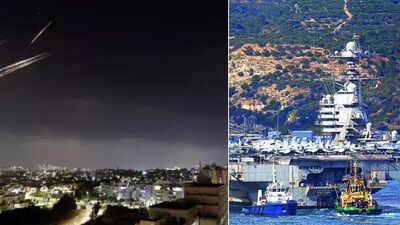
But he said, “I think there is still a good chance of reaching a diplomatic solution,” adding, “So there is no need for any military mobilization, and the military mobilization can neither help nor put pressure on us.” In fact, pressure is the key to these negotiations. What Trump calls the “mega-fleet” the United States has built in the seas around Iran is the largest military force it has concentrated in the region since it prepared to invade Iraq, nearly 23 years ago. Two aircraft carrier groups, dozens of fighter planes, bombers, refueling planes, and anti-missile batteries have poured into the area, a display of gunboat diplomacy even greater than ever. This preceded Maduro’s forced expulsion from Venezuela in early January. The second aircraft carrier, the Gerald R. Ford, was sailing south of Italy in the Mediterranean Sea on Sunday and will soon be off the coast of Israel, military officials said. Further complicating any final decision on military strikes, Arab leaders are calling their counterparts in Washington to complain about comments by Mike Huckabee, the US ambassador to Israel. In an interview with Tucker Carlson, a conservative commentator, that aired on Friday, Huckabee said Israel has a right to much of the Middle East, angering Arab diplomats in countries that the United States hopes will support, or at least not publicly oppose, a US attack on Iran. Administration officials have not been clear what their goals are vis-à-vis Iran, a country with a population of more than 90 million. While Trump often talks about preventing Iran from being able to produce a nuclear weapon, Rubio and other aides have described a host of other justifications for military action: protecting protesters killed by the thousands by Iranian forces last month, eliminating the missile arsenal Iran could use to strike Israel, and ending Tehran’s support for Hamas and Hezbollah. But American military action may also result in a nationalist backlash, even among Iranians eager to see the end of Khamenei’s brutal grip on power. European officials attending the Munich security conference this month said they doubted military pressure would force Iran’s leadership to abandon the program that has become a symbol of resistance to the United States.