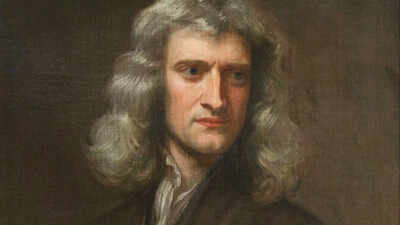
Sir Isaac Newton (Image source: Wikipedia)
Sir Isaac Newton is widely remembered as one of the greatest scientists in history, best known for his laws of motion and work on gravity. However, what is less commonly known is the fact that Newton spent decades studying theology, biblical texts, and historical chronology.
Much of his writing was not about physics or mathematics, but rather about religion and the interpretation of ancient scriptures. One such document, written in 1704, has gained renewed attention because it contains calculations that seem to point to the year 2060 as the end of a historical era.The document is often described as a “letter,” but it is more accurately a handwritten theological manuscript. It was never published during Newton’s lifetime and was not intended for general circulation. The manuscript is part of Newton’s private papers, which he wrote in his own handwriting and are today preserved in the academic archives.
In this text, Newton applies numerical interpretations to passages from the Book of Daniel and Revelation, using a method popular among scholars of his day.More importantly, Newton did not expect the Earth to be destroyed. Instead, he was trying to calculate the possible end of what he believed to be a corrupt or unstable phase of human history. He also warned against setting specific dates or making inflammatory claims.
His work was cautious, mathematical, and rooted in historical interpretation rather than prophecy in the modern sense.
an act Isaac Newton Predict the end of the world in 2060
In the manuscript, Newton focused on the biblical phrase “a time, times, and half a time,” which he interpreted to mean three and a half years. Using the prophetic method known as the day-by-year principle, Newton treated each day mentioned in the Bible as representing one year. This converted the period to 1260 years.Newton then chose a historical starting point: AD 800, the year associated with the consolidation of power under the Holy Roman Empire. By adding 1260 years to this date, Newton reached the year 2060.The exact wording of Newton’s manuscript states:“And the days of the short-lived beasts that were established for the years of the long-lived kingdoms, the period of 1260 days, if dated from the complete conquest of the Three Kings AC 800, will end in 2060 AD. It may end later, but I see no reason for it to end soon.”This passage is frequently quoted in modern accounts, but it is important to note that Newton did not describe this date as the end of the world.
Newton’s warning against false predictions
In the same manuscript, Newton explained that he was not encouraging people to predict the end of time.
He openly criticized those who repeatedly set dates and caused fear when their predictions failed. His calculations were intended to show a possible end to a historical period, not to announce a catastrophic event.Newton’s words show restraint and caution, emphasizing that history could happen later, but he saw no evidence of it happening earlier.
Where the original manuscript is preserved
According to reports, Newton’s 1704 manuscript has been preserved as a primary historical source. It is part of the Judean Manuscript Collection, which contains many of Newton’s unpublished theological writings. These documents are located in the National Library of Israel.The text has been transcribed and verified by historians through the Newton Project, an academic initiative that works to digitize and publish Newton’s original writings for scientific study.