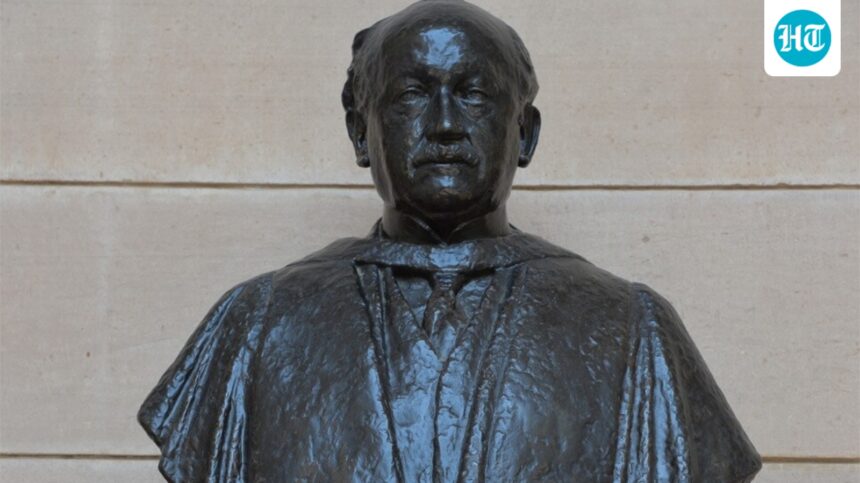
Prime Minister Narendra Modi on Sunday announced that the statue of British architect Edwin Lutyens at Rashtrapati Bhavan will be replaced with a statue of Rajagopalachari, the first Indian governor-general of independent India.

The announcement was made by Prime Minister Modi during his monthly radio address ‘Mann ki Baat’. He pointed out that statues of British officials remained standing in the Rashtrapati Bhavan even after India’s independence, while statues of India’s great leaders were “not properly honoured” by being given a place there.
Stressing that the country is moving away from “symbols of colonialism” and “beginning to embrace symbols of Indian culture”, the Prime Minister said that the statue will be replaced with that of C Rajagopalachari.
“A statue of British architect Edwin Lutyens was also standing in Rashtrapati Bhavan. Now, this statue will be replaced by a statue of Rajaji (C. Rajagopalachari),” he said.
Read also: Nishikant Dubey criticizes Congress: “Nehru showed snake dance, PM Modi shows artificial intelligence”
The Prime Minister also recalled that during the ‘Azadi Ka Amrit Mahotsav’, he discussed the ‘Paanch Pran’ of the Red Fort, highlighting the importance of freeing oneself from the slavery mentality. In this regard, he said that Rashtrapati Bhavan is taking an important step forward.
Highlighting Rajagopalachari’s achievements, the Prime Minister said he was among those who “saw power not as a position but as a service”, adding that his self-restraint and independent thinking were an inspiration to Indians.
Rajaji Utsav will be celebrated on February 23
He announced ‘Rajaji Utsav’ celebrations on February 23, during which a statue of C Rajagopalachari will be unveiled in the central courtyard of Rashtrapati Bhavan.
Besides, an exhibition on Rajagopalachari will be held during the Rajaji Utsav festival, which runs from February 24 to March 1. “Visit there, to have a look, whenever possible,” Modi said.
Also Read: OpenAI Sam Altman praises PM Modi’s efforts to democratize AI at Impact Summit 2026
Who was Edwin Lutyens?
Edwin Lutyens was a British architect and city planner who, in collaboration with Sir Herbert Baker, designed many of New Delhi’s monumental buildings, including the Rashtrapati Bhavan, North Block, South Block and India Gate.
In recognition of his contribution, part of New Delhi is also known as Lutyens’ Delhi. This label is often deployed in political circles to refer to elites in Delhi and India.