For decades, the developing world’s story has been one of structural disadvantage. Countries like India were expected to export raw materials at a cheap price and import finished goods at exorbitant prices, so they remained trapped in a cycle that kept the “common man” poor. But a quiet revolution took place in New Delhi.

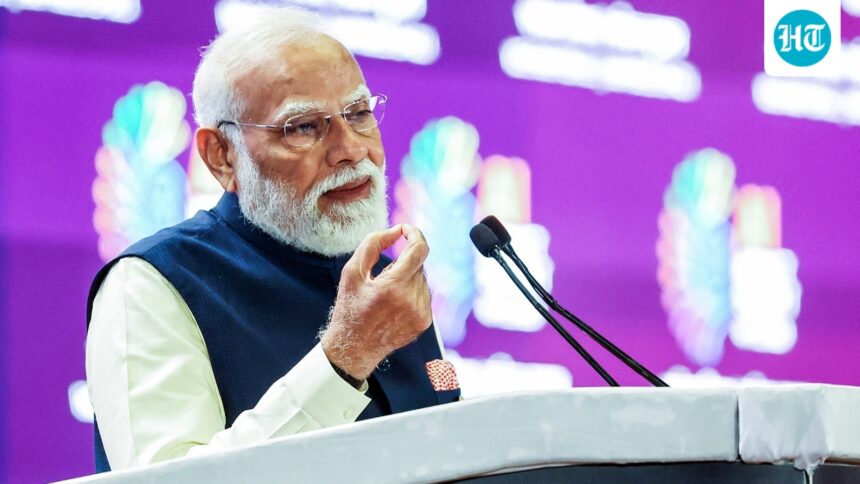
By concluding high-stakes free trade agreements with the UAE, Australia and New Zealand, and securing the “Mother of the Deals” with the European Union, Prime Minister Narendra Modi has radically changed this equation.
These are not just diplomatic papers. It serves as a blueprint for how a developing economy can demand and achieve parity on the global stage.
The brilliance of current foreign policy lies in its sequencing.
When India signed the India-EU FTA in January 2026, it not only opened up a market of 450 million high-income consumers; It sent a shock wave through Washington.
For many years, the United States remained a supporter of protectionism, assuming that India had no other “large-scale” options. By concluding the EU deal – which removes tariffs on 99.5% of Indian goods – Prime Minister Modi has effectively forced the US hand. The result was the Rapid Temporary Trade Framework with the United States in February 2026, which capped tariffs at 18% and set a trade target of $500 billion. This is classic geopolitical leverage: by diversifying partners, India has created a “fear of missing out” (FOMO) that has forced the world’s largest economy to come to the table on our terms.
However, business deals may seem like abstract victories until we see how they change daily life.
Beyond the jargon, these agreements are about stability, savings and dignity for millions.
Consider here the factory worker. For many years, garment factories in Erode or leather centers in Kanpur have suffered. High taxes in the US and EU have made Indian shirts more expensive than those from Bangladesh or Vietnam, leading to lower orders and seasonal layoffs.
With the new India-EU Free Trade Agreement and the US Temporary Framework, this tax wall has ended. Now, a shirt stitched in Tirupur or shoes made in Agra can compete globally in terms of price.
For Mumbai’s gold artisans, the European Partnership and Cooperation Agreement between India and the UAE has already proven successful: access to duty-free access has boosted exports, ensuring steady business beyond just the wedding season. For a worker who supports a family, this means ensuring a steady salary.
The benefits extend beyond the factory floor to include our professionals and farmers. Trade is not limited to goods only; It’s about people.
Previously, an IT consultant from Pune working in London lost a major portion of his salary to British Social Security without any benefit. The new agreements correct this injustice, ensuring that those savings stay with his family.
Similarly, agreements with Australia and New Zealand recognize Indian degrees, paving the way for nurses from Kerala or engineers from tier-II cities to work abroad.
But perhaps the biggest win is what didn’t happen.
During the negotiations, the United States pressured India to open its dairy markets. For Suresh, a small farmer in Andhra Pradesh, competing with heavily subsidized American industrial farms would be impossible. The Modi government has drawn a red line, protecting sectors that support nearly 46% of our workforce. Suresh’s livelihood is secure. Instead, India agreed to purchase energy components and high-tech from the United States, which stabilized energy prices at home – protecting the farm while reducing costs to the joint family.
Critics often ask: “What’s different now?” The difference lies in the details that protect our sovereignty.
Trade agreements in the United Progressive Alliance era, especially the 2010 Association of Southeast Asian Nations (ASEAN) agreement, were structurally flawed. They created an “inverted duty structure,” where finished goods enter from abroad with a 0% duty, but the raw materials are taxed. This has encouraged trade to industrialize and allowed third-party goods, often from China, to flood our markets, swelling the trade deficit by more than 300%.
The Modi government has fixed this.
The new deals impose strict “rules of origin” (40% value addition), ensuring that benefits go only to trusted partners, not backdoor entrants. This constitutes a strategic firewall: by building supply chains with the United States, the European Union, and Australia, we are clearly reducing our dependence on hostile neighbors and opaque Chinese imports, making our economy safer, more resilient, and truly self-sufficient.
The market knows the difference between hype and substance. HDFC Securities has described 2026 as a “goldilocks” year – ideal conditions as India, which now drives 16% of global growth, is poised for a breakthrough. They expect the Nifty index to reach 28,720 by the end of the year, supported by a strong 6.7% GDP forecast and the expectation that these trade deals will spark a massive investment boom.
The government’s mission is certainly not finished yet. The challenge now turns to implementation, ensuring that the SME owner in Ludhiana actually knows how to claim these tariff benefits and meets the stringent quality standards in Europe or America. But the foundation has been laid.
These agreements signal a shift from a defensive India to a confident India. By securing the interests of our farmers, opening doors for our youth, and protecting our borders from unfair dumping, Prime Minister Modi has ensured that globalization is finally working for the world. Uncle humanthe average person. The world has realized that India is no longer just a market for sale; It is a partner to grow with.
—
[TheopinionsexpressedarepersonalAbouttheauthor:[ViewsexpressedarepersonalAbouttheauthor:Siddhartha Chipuri is a national member of the Bharatiya Janata Yuva Morcha or BJYM (Policy Research and Training). BJYM is the youth wing of the Bharatiya Janata Party (BJP). Chepuri is also a management graduate from IIM Lucknow.]