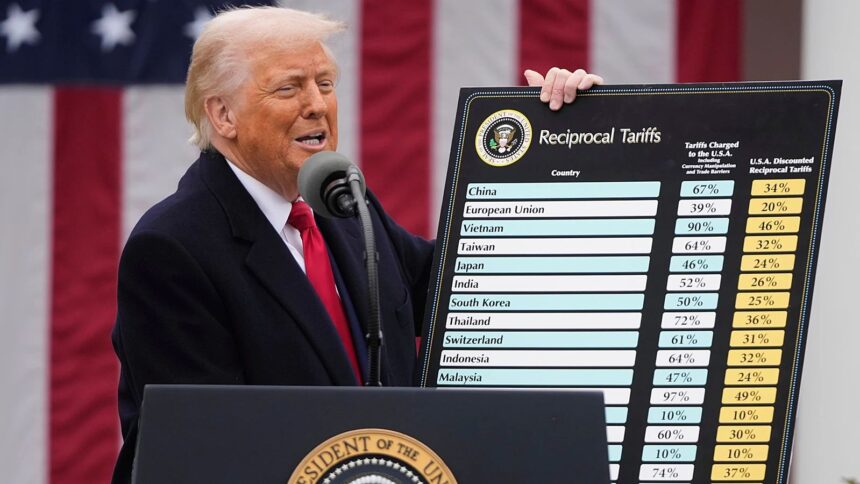
After a day US Supreme Court invalidates tariffs The Ministry of Trade and Industry said on Saturday that it was ‘studying’ the implications of the decision, imposed by President Donald Trump using the International Emergency Economic Powers Act (IEEPA).
“We have noted the US Supreme Court verdict on tariffs yesterday. President Trump also addressed a press conference in this regard. The US administration has announced some steps. We are studying all these developments for their implications,” the ministry said.
It assumes significance as the Indian delegation is expected to travel to Washington on Sunday for three days of talks to finalize the legal agreement. The legal text envisages a further reduction in tariffs from 25% to 18%. However, after a US court order, the US tariff on India will come down to 15%. Washington has already rolled back the additional 25% tariffs it imposed citing Russian oil purchases.
The US Supreme Court’s order was particularly consequential for India, which earlier this month agreed to sign an agreement under which India would buy US products worth US$500 billion, and Washington agreed to reduce tariffs on India from 50% to 18%. However, the trade agreement is yet to be formally signed. Market access-related concessions agreed under the trade deal will be granted from India only when a legal agreement is signed, Indian government officials said.
Hours after the Supreme Court ruling, Trump announced a 10% global tariff, later raised to 15% on nearly all imports to the US, known as Section 122. In addition, two other provisions – Section 232 and Section 3071 of the Trade Expansion Act of 1962 deal with lawful use. will remain in place, the White House clarified after the SC ruling. Section 232 of the Trade Expansion Act of 1962 on national-security grounds. These have already been enforced on steel, aluminum, semiconductors and other products—and the Trump administration is looking to impose even more.
Former trade officer and founder of Delhi-based think tank GTRI, Ajay Srivastava, said the elimination of reciprocal tariffs would free 55% of India’s exports to the United States from India’s 25% tariff (including the yet-to-be-implemented 18% rate in the interim framework announced in the February 6 joint statement).
“On remaining exports, (i) Section 232 tariffs will continue – 50% on steel and aluminum and 25% on some auto components – while (ii) products accounting for about 40% of export value, including smartphones, petroleum products and medicines, will be exempted from US tariffs,” Srivastava said.
The story continues below this announcement
A US-India joint statement dated February 6, 2026 said: “The United States and India agree that the other country may revise its commitments if any changes occur in either country’s agreed tariffs”.
Srivastava said that as the US tariffs change, India should use this provision to withdraw from the trade deal or delay negotiations or seek fresh terms so that the trade deal appears equitable.
“This verdict should prompt India to reconsider its trade agreement with the US. After making concessions such as reducing MFN tariffs, adjusting economic policies to suit US interests, easing regulations affecting US goods and suggesting larger purchases of US products – India is expected to receive a reciprocal tariff rate of 18% goods, making negotiations ineffective,” Srivastava said.
Kurt M. Campbell, chairman and co-founder of the Asia Group, said: “The truth is that the Trump administration anticipated these actions and is already seeking various executive officers who can achieve the same goals and continues to make clear that continued exports from other countries in the United States are unacceptable”.
The story continues below this announcement
“Congress has already signaled its discomfort with the tariff policies. If anything, I believe key players on Capitol Hill, some Republicans and the entire Democratic Party, will reiterate this decision and pass legislation that would rebuild these authorities,” Campbell said.