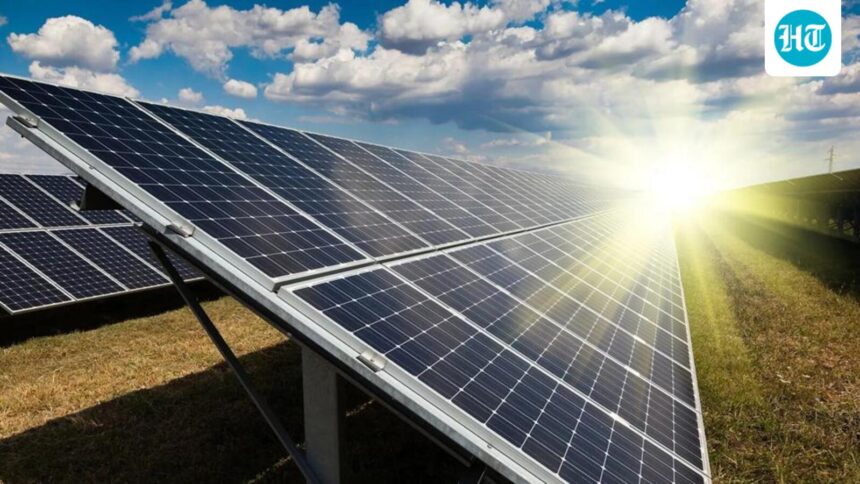
The Union Ministry of New and Renewable Energy (MNRE) on Friday held a discussion on the draft potential assessment report on floating solar photovoltaics (FSPV) and the draft floating solar policy with stakeholders, with officials familiar with the details saying the draft policy will soon be made available to the public.

The floating solar potential report has been prepared by the National Institute of Solar Energy (NISE) and the policy by IIT Roorkee, respectively. “Given the prevailing land constraints faced by renewable energy projects, FSPV has emerged as an alternative route. However, only around 700 MW of FSPV projects have been commissioned in India, so far. This is mainly due to lack of data on potential sites and a clear framework for project implementation,” MNRE said in a statement on Friday.
In order to overcome this bottleneck, MNRE in collaboration with NISE and IITR has prepared these documents, the statement said.
According to the release, MNRE has asked all states/union territories to conduct internal consultations with all state level stakeholders like water resources/irrigation, revenue, fisheries, forests, agriculture, DISCOMs/Transcoms, PWD, tourism, pollution control etc. and submit their comments and feedback on the draft policy and potential. “The discussion focused on providing innovative solutions like delivery and payment models, allotment of water bodies with all necessary approvals etc. to de-risk developers and investors. Based on the potential and policy, states/union territories can also identify and prioritize locations for development of FSPV projects,” he added.
Officials familiar with the details said the draft policy would be made available to the public soon.
The MNRE will also hold detailed consultations with the Ministry of Environment, Forest and Climate Change (MoEFCC), Wetlands Authority, National Dam Safety Authority, etc. on the floating solar policy, based on the feedback received from the states, the ministry said.
Read also: Haryana agrees $402 cr Small scale solar powered irrigation projects
The consultation was attended by senior officials of the Ministry of New and Renewable Energy, state renewable energy agencies, representatives of states/union territories, Solar Energy Corporation of India, NISE, IIT Roorkee etc.
According to a report on the environmental impact of floating solar by BayWa re – a renewable energy company – depending on the system design, floating photovoltaics (FPV) have been shown to reduce evaporation losses, potentially saving water in arid regions. But uncertainty about the consequences for water quality and the environment in general is hampering the spread of FPV projects, especially in Europe. Social acceptance also plays an important role. Greater public knowledge of the positive environmental impact of FPV is key to expansion.
According to a paper published in IOP Science in 2024, FPV deployments on freshwater bodies are growing rapidly, as they avoid land-use change, operate with increased efficiency, and may even improve water availability by reducing evaporation and the frequency of algal blooms. However, understanding of the environmental consequences on water bodies is very limited despite the variable and far-reaching range of potential impacts.