
New Delhi: One in seven stroke patients in India is under 45 years of age. Nearly two in five arrive at hospital more than 24 hours after symptoms appear. After three months, more than half of them die or suffer significant disability.These findings come from the largest analysis of a hospital stroke registry in India, published in the International Journal of Stroke. The study was led by Prashant Mathur of the National Center for Disease Informatics and Research (ICMR-NCDIR) in Bengaluru, in collaboration with researchers from the National Stroke Registry Programme.The analysis reviewed 34,792 stroke cases registered at 30 hospitals between 2020 and 2022, providing one of the most detailed national snapshots of stroke patterns, treatment gaps, and outcomes.The average age of patients was 59.4 years, but 13.8% of them were younger than 45 years, underscoring the increasing burden of stroke among younger Indians. Nearly 63.4% were men and 72.1% came from rural areas, reflecting disparities in awareness, prevention and access to timely care.Hypertension was present in 74.5% of patients, making it the predominant risk factor. Diabetes affected 27.3%, smokeless tobacco use 28.5%, tobacco smoking 22.6%, and alcohol use 20.2%.
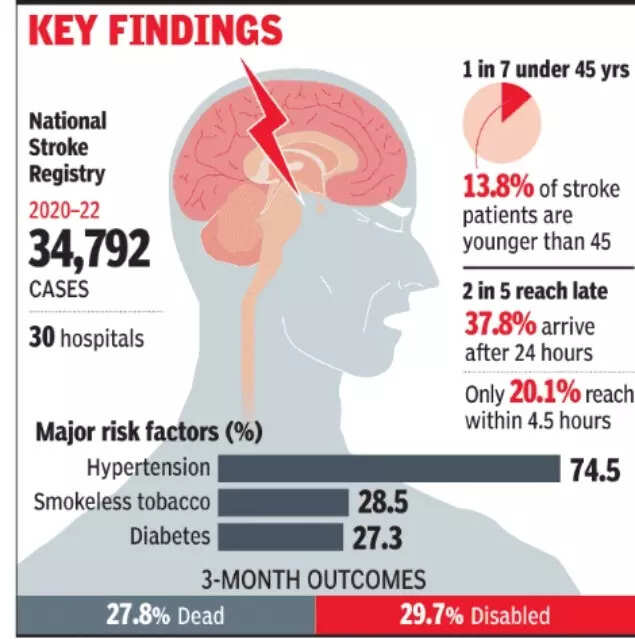
The study also noted gender differences, with women having higher rates of high blood pressure and diabetes, while men reported increased tobacco and alcohol use.According to the analysis, the time it takes to obtain treatment remains the biggest obstacle. Only 20% arrived at hospital within the crucial 4.5 hour period for emergency stroke treatment. On the other hand, 37.8% arrived at the hospital after 24 hours. As a result, only 4.6% of stroke patients received intravenous thrombolysis therapy and 0.7% underwent mechanical thrombectomy.
Delayed arrival, delays in imaging and unavailability of medications were the main reasons for missing treatment.Ischemic strokes accounted for 60% of cases, while intracerebral hemorrhage accounted for 34.2%.Dr Manjari Tripathi, head of the department of neurology at AIIMS Delhi, said the numbers reinforced a key message. “Patients should reach the hospital within three hours. Immediate brain imaging is essential and, if eligible, thrombolysis should be performed without delay.
Time is the brain, and every minute wasted means a loss of neurons, leading to long-term disability and dependence. It is important for people to recognize the symptoms of a stroke and seek emergency care early.The results are still stark, with in-hospital mortality at 13.9%, but by three months, nearly 28% had died, suggesting many patients died after discharge. Overall, more than half had a poor outcome, defined as death or major disability.
Women were more likely than men to have a disability at follow-up, suggesting potential gaps in rehabilitation and post-discharge care. Recurrent stroke within three months occurred in 1.1% of patients.Stronger control of hypertension and diabetes, tobacco cessation, faster referral systems, and improved access to acute stroke care – especially in rural India – were crucial, the authors said. Without improvements in prevention and rapid response, stroke will continue to occur early and leave families facing avoidable disability.