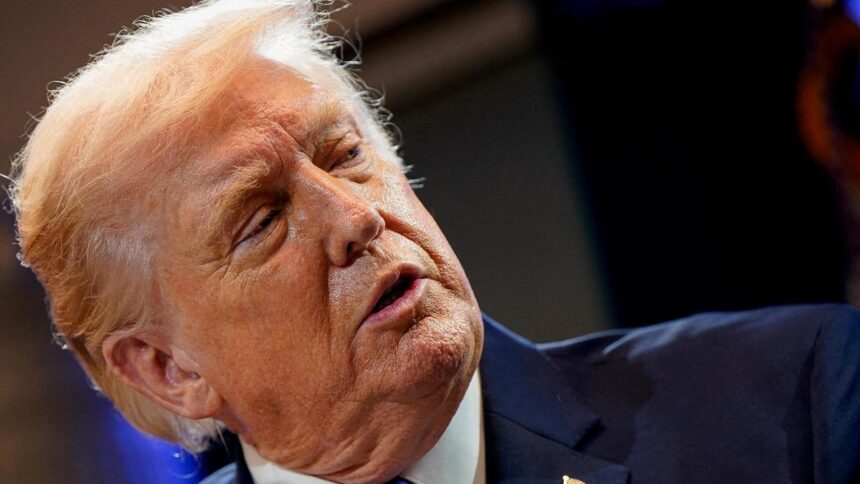

When US President Donald Trump imposed the tariffs on February 20, 2026 in Washington, DC, US, Mr. Trump spoke during a press briefing at the White House following the Supreme Court’s ruling that he had overstepped his authority. | Photo credit: Reuters
US President Donald Trump referred to Sections 301, 232 and 122 of the tariffs in his press conference on Friday (February 20, 2026), citing the US Supreme Court’s use of emergency powers granted by them to illegally impose heavy tariffs on imports.
Trump’s tariffs were directly rejected by the US Supreme Court
Mr Trump used the IEEP on April 2, 2025 to impose ‘reciprocal tariffs’ on countries. IEEP-based tariffs have been imposed on Mexico, China and Canada for failing to adequately control the flow of immigrants and fentanyl into the US, he said. Court decision.

“We will return to the same tariff level for countries. It will be less direct and a little more convoluted,” US Treasury Secretary Scott Besant said on Friday (Feb 20, 2026). Here are the Section 122, 301 and 232 Tariffs:
Section 122
Section 122 of the Trade Act of 1974 allows the US president to impose tariffs of up to 15% on a country to address a “large and serious United States balance-of-payments deficit”. The tariff is applied for no more than 150 days unless its duration is extended by the US Congress. The President is also required to consult with Congress regarding the implementation and continuation of this tariff. This section of US law has never been used before. Mr Trump said he would start the Section 122 process on Friday (February 20, 2026) to apply a global tariff of 10%.
Section 301
Section 301 of the US Trade Act of 1974 allows the US Trade Representative (USTR) to impose tariffs upon finding that a US trading partner has engaged in what it deems to be “unfair” trade practices. These have been launched in the past against many countries including India.

According to this writing, responding to the court verdict, Mr. Hours after Trump’s press conference, the 301 probe against India was not registered. The last 301 prosecution against India was in response to New Delhi’s digital services tax by the first Trump administration in 2020.
However, in November 2021, under the administration of US President Joe Biden, the countries reached an agreement on this – after India joined the Organization for Economic Co-operation and Development (OECD) global minimum tax framework. India is phasing out the digital tax (equalization levy) and first scrapped the 2% e-commerce levy and then scrapped the 6% digital advertising levy.
Section 232
Tariffs based on Section 232 of the US Trade Expansion Act of 1962 are imposed on specific sectors – rather than comprehensively – after the Secretary of Commerce deems them necessary for national security reasons. US presidents sometimes fail to act even when the Commerce Department finds that there is a national security threat.

The Trump administration has previously implemented 232 tariffs and is currently imposing them on countries across a range of sectors. For example, India faces 232 tariffs on steel and aluminum, automobiles, copper and derivatives, etc. Exemptions are possible for companies, and this has previously been offered as a politically palatable way to keep US tariffs in place, but in practice they have been applied in a limited way.
Some Indian exports currently affected by Donald Trump’s 232 tariffs may be affected (i.e. benefit) by the US-India trade deal announced on February 2. For example, the White House has announced that tariffs on certain aircraft and aircraft parts will be removed. India receives Preferential Tariff Rate Quota (TRQ) for automotive components. 232 Subject to inquiry, India can trade with the US on the outcome of negotiations in the generic pharmaceuticals and ingredients sector.
Published – February 21, 2026 04:48 am IST