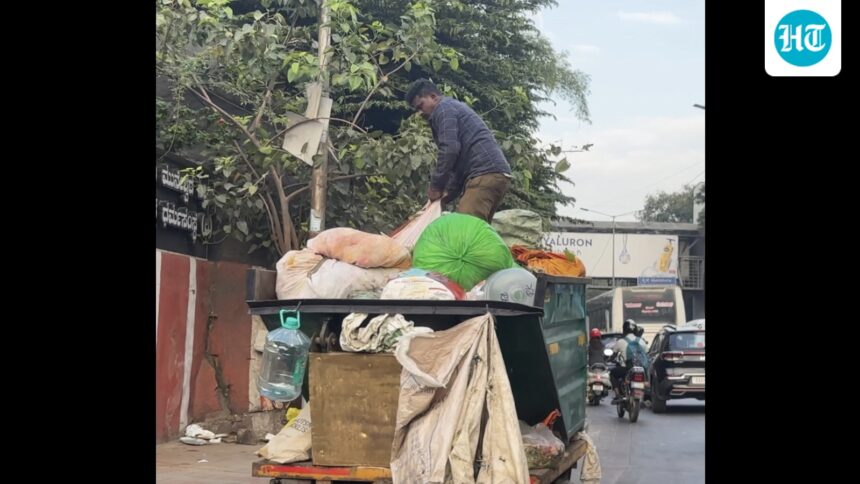
Every dawn in Bengaluru, purakarmikas, With their bare hands they bear the daily dangers of sorting through moldy food, diapers and city dust. Essential sanitation workers climb into garbage trucks and wade through piles of trash. Their service is critical to the functioning of Silicon Valley India, but it is fraught with risks they should not take.

Purakarmikas They form the backbone of Bengaluru’s sewerage system, but many workers work under private contractors or outside formal employment. A survey conducted in 2025 by Bengaluru-based social enterprise Hasirudala, in collaboration with public health non-profit HeatWatch, found that 50 of 154 sanitation workers surveyed belonged to this informal segment, highlighting how dependent the system is on workers without formal protections..
For many, basic safety equipment remains out of reach. Amal Das, 24, said: “My friend asked for equipment. They always say yes, we will give it tomorrow, but they don’t give it to us.”
Improper disposal of waste by residents makes the work more dangerous.
“People do not dispose of their waste properly. There is no separate wet waste or separate dry waste,” Amal Das said. “Sometimes when we deal with ‘dry’ waste, we will end up finding spoiled food, diapers and other wet waste in it.”
“I never use any equipment,” said Chandan R, 32, who has been dealing with waste for nearly seven years. “We are used to it, so we don’t mind the smell or touching the waste, but when a new person comes, he faces some difficulties.”
Over time, the job began to affect his health.
“For months I cough every day, and I get this on my hands sometimes,” he said, pointing to a rash around his fingernails. “Some others have worse things on their skin, but we come here to make money. If we don’t do this work, what work will we do?”
Maitri Krishnan of BBMP Pourakarmikara Sangha warned as much com. pourakarmikas Don’t live long enough to see retirement. “The average life expectancy for them is 50-60 years. Very few people retire, and even if they do, they suffer from serious illnesses. It is very dangerous work,” she said.
She said workers are often denied protective equipment and timely wages. “Despite the money being allocated for equipment, they are not getting anything. Moreover, they are not getting their minimum wages either. They will have three to four months of wages pending at any given time. If they voice concerns, they will be threatened with termination. It is a very exploitative work situation,” she said.
The risks he faces com. pourakarmikas It has received less public attention than the broader waste crisis. At the waste processing and dumping yard in Belhali, villagers blocked garbage trucks this week, citing infection and unsanitary conditions caused by negligent disposal. But sanitation workers remain the most exposed to these risks.
“Due to the type of work they do, these workers are exposed to a variety of health issues,” said Bobby Joseph, chief of occupational health services at St. John’s Medical College and Hospital.
“They lift things with their bare hands,” Joseph said. “They suffer from cuts, lacerations and skin infections. Moreover, they are also vulnerable to long-term diseases such as hepatitis B, which occurs as a result of exposure to bodily fluids that can be picked up by diapers or used needles. Respiratory diseases caused by exposure to dust are also common such as bronchitis, asthma and chronic cough. There is also the possibility of contracting tuberculosis and gastrointestinal diseases if they do not maintain proper hygiene.”
Dr Joseph said the disorganized nature of the workforce makes ongoing medical support difficult. “We have to look at them as a completely unorganized sector of the workforce. Therefore, providing services such as health checks or access to areas where they can clean themselves, on a consistent and correct basis, is complex,” he said.
Maitri Krishnan attributed many problems to the contract system. “The contract system must be abolished. It is inherently corrupt and operates like a cartel.” She also claimed that the Supreme Court says the indentured system is a form of bonded labour.
“If you subject these workers to direct pay, workers’ rights are protected and public funds are actually saved. Good working conditions should be guaranteed for the person performing essential work in the city.”
She said that the reforms promised by the government have not yet been achieved.
“The government promised to subject these contract workers to direct payment and end the contract system, but it has not done so yet because the contractor lobby is very strong. These workers enjoy all their rights com. pourakarmikasBut they were denied these rights,” Krishnan said.