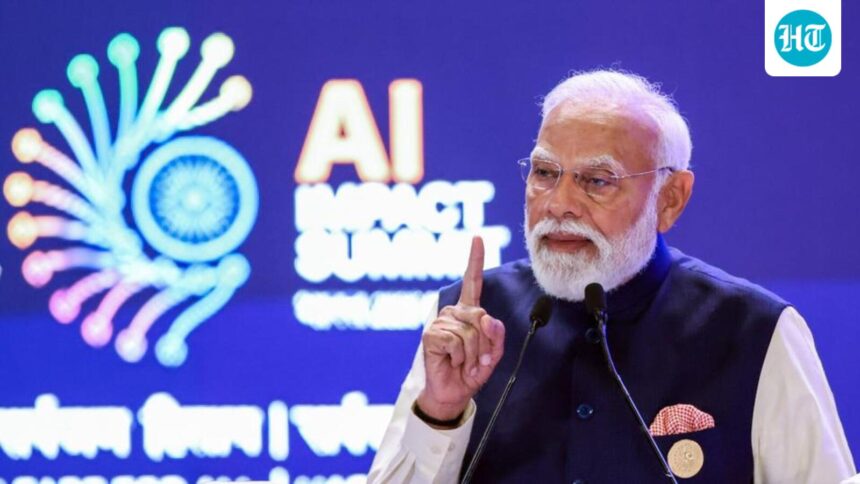
New Delhi: Prime Minister Narendra Modi on Thursday unveiled MANAV’s vision for artificial intelligence (AI) at the inaugural session of the AI Impact Summit 2026 at Bharat Mandapam, Delhi, outlining India’s approach to AI as ethical, sovereign, inclusive and globally driven.

“Today, at the AI Impact Summit in New Delhi, I am presenting the MANAV vision. MANAV stands for human. M stands for moral and ethical systems. A stands for responsible governance, transparent rules and strong oversight. N stands for national sovereignty – whose data has rights. The second A stands for accessibility and inclusion, not monopoly of AI, but multiplier. V stands for validity and legitimacy. This vision will be an important link in the well-being of humanity,” the Prime Minister said.
The focus on “his data is his right” comes amid global discussions about data localization, cross-border data flows, and typical training practices for artificial intelligence.
“We represent one-sixth of humanity. India is the world’s largest nation of youth, the largest nation of tech talent, and the largest tech ecosystem. India is building new technology and adopting new technology,” he said in his opening remarks to a packed hall of nearly 2,500 delegates.
Representatives of 118 countries attended, including French President Emmanuel Macron, UN Secretary-General António Guterres, Brazilian President Luiz Inacio Lula da Silva, Bhutan Prime Minister Tshering Tobgay, Abu Dhabi Crown Prince Sheikh Khalid bin Mohammed bin Zayed Al Nahyan, Sri Lankan President Anura Kumara Dissanayake, and the leaders of the Netherlands, Greece, Switzerland, Finland and Estonia.
Technology leaders including Google Chief Executive Officer (CEO) Sundar Pichai, Anthropic CEO Dario Amodei, OpenAI CEO Sam Altman, and Google DeepMind CEO Demis Hassabis also attended.
Referring to the huge turnout at the summit exhibition, Modi said: “There was enthusiasm for the exhibition, and young people came in large numbers. The solutions presented here reflect the strength of Made in India and are an example of India’s capabilities.”
It is estimated that about 200,000 people visited the exhibition and its sessions on Wednesday. The opening session and exhibition were closed to the public on Thursday, but will remain open on Friday and Saturday.
Artificial intelligence as a civilizational transformation
The Prime Minister said: Placing artificial intelligence in the context of civilizational transformations, and comparing it to basic technological breakthroughs:
“When the first spark came from the stones, no one imagined that that spark would form the bedrock of civilization. And when sound turned into writing, no one knew that written knowledge would become the backbone of future systems. When signals were first transmitted, no one thought that the world would one day be connected in real time. Artificial intelligence is a transformation of this magnitude. What we expect today is just a small part of what artificial intelligence will become. Artificial intelligence not only makes machines intelligent, it makes humans smarter in many ways. The difference now is scale. The difference now is scale. Previous technologies have evolved over decades, but the journey from machine learning to machine learning is fast, deep and broad.
He warned that the direction AI takes will depend on the decisions governments and societies make today. Compared to nuclear power, he said AI is a transformative technology of similar scope – capable of being highly destructive if misused, but extremely beneficial if directed responsibly. He added that the criterion for India is whether AI promotes “well-being for all” and contributes to the broader public good, in line with the theme of the summit.
Open, ethical, and inclusive AI
Prime Minister Modi also stressed the need to prevent concentration of power and data, and called for the democratization of AI – a key goal of India’s pioneering AI mission.
“For AI, humans are just data points; they are just raw material. That is why we must democratize AI. Make it inclusive, especially in the Global South. We must give AI an open sky for growth, but keep the leadership in our hands. Like GPS showing us the way, it is still up to us to decide which direction to take.”
Regarding employment concerns, Modi claimed that the long-term impact of AI will be shaped by political choices. “Decades ago, when the Internet was born, no one could have imagined how many jobs it would create. The same is true of artificial intelligence. Today, it is not possible to be certain how many jobs it will create. The future of AI work is not predetermined; it depends on the course of our work. We are entering an era in which humans and intelligent systems co-create, co-work and co-evolve. AI will make our work more impactful, efficient and intelligent. We will design better, build faster and make better decisions.”
Advocating for open AI
In a departure from calls in some countries for tightly controlled proprietary systems, Modi called for open artificial intelligence. Invoking the idea that transparency builds trust, he contrasted India’s approach with countries and companies that treat AI as a closely guarded strategic asset.
“India believes that AI achieves greater global benefit when its development is more open, with shared code and broader participation allowing millions of young innovators to improve systems and make them more secure,” he said.
Deepfakes, labeling, and children’s safety
Modi also called for setting global standards on authenticity and safety in the age of generative artificial intelligence:
“Just like the way we see labels on food, we must have authenticity labels on content. We must know what is real and what is generated by artificial intelligence. As AI permeates more text and images, the need for watermarks and clear source standards increases. We must trust the technology from the beginning.”
In recent amendments to India’s IT intermediary rules, the government has imposed deepfakes removal within three hours, mandatory labeling of AI-generated content, and stricter intermediary compliance.
Regarding child protection, he said: “Children’s safety must be taken seriously.” French President Emmanuel Macron, who spoke before Modi, also touched on child safety, citing France’s ban on social media for children under 15 and calling on India to follow suit.
“Our platforms and governments must work together to make the internet and social media a safe place. That’s why in France we set out to ban social media for children under 15. I know the Prime Minister [Modi] “You will join this club,” Macron said.
As previously reported, India is considering an Australian-style model to partially block social media platforms for users under 16 years of age.
India’s growing AI ecosystem
Prime Minister Modi highlighted three Indian AI companies that launched their prototypes at the summit: Sarvam AI, Gnani.ai and BharatGen, which showcased India’s growing talent and ecosystem.
He said: “From semi-chips to chip manufacturing s to quantum computing, India is creating a resilient ecosystem. Secure data centres, a strong IT backbone, and a dynamic startup ecosystem make India a natural hub for affordable, scalable and secure AI solutions. “We have diversity, demographics and democracy.”
“I request everyone – models developed in India can be deployed globally. Designed and developed in India, brought to the world and to humanity,” Modi added.